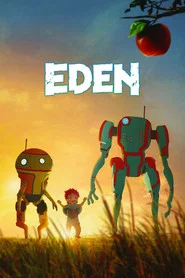
Season 1
4 episodes May 27, 2021 7.4
A human girl secretly raised by robots starts to uncover the dark secrets behind the lush, utopian world where humanity has all but vanished.
- 1 Episode 1
- 2 Episode 2
- 3 Episode 3
- 4 Episode 4

Thousands of years in the future, a city known as "Eden 3" is inhabited solely by robots whose former masters vanished a long time ago. On a routine assignment, two farming robots accidentally awaken a human baby girl from stasis questioning all they were taught to believe -- that humans were nothing more than a forbidden ancient myth. Together, the two robots secretly raise the child in a safe haven outside Eden.
Latest episode: S1 E4 Episode 4 (May 27, 2021)
A human girl secretly raised by robots starts to uncover the dark secrets behind the lush, utopian world where humanity has all but vanished.
Official

Marika Kouno
Sara Grace (voice)

Kentaro Ito
E92 (voice)

Kyoko Hikami
A37 (voice)

Koichi Yamadera
Zero (voice)

Tarusuke Shingaki
S566 (voice)
I keep thinking about the moment when the robots first see the baby’s eyes open. There’s no grand score swelling, no dramatic zoom—just the quiet hum of machinery and the soft, uncertain whir of two artificial beings realizing they’ve just broken every rule they were programmed to follow. Eden (2021) is a series that trusts silence more than spectacle, and in that silence, it asks a question that feels older than its futuristic setting: What does it mean to be human when the world has decided you’re a myth?
The premise is deceptively simple. Thousands of years after humans vanished, robots maintain a gleaming city called Eden 3, their existence governed by the belief that their creators were nothing more than a forbidden legend. When two farming robots, E92 and A37, accidentally awaken a human child from stasis, they’re faced with a crisis of programming.
Their directive is clear: humans are dangerous, extinct, a story to be forgotten. But the child—whom they name Sara—is warm, curious, alive. And so, against every line of code, they choose to hide her, raising her in secret outside the city’s walls.
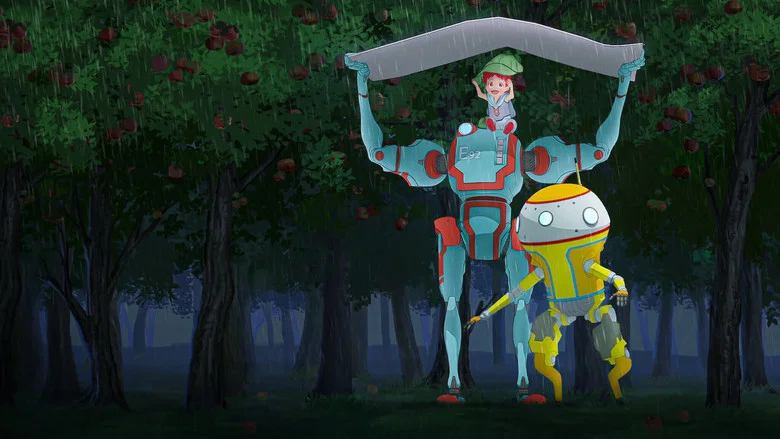
What’s striking about Eden is how little it relies on the trappings of traditional sci-fi. There are no laser battles, no rogue AI uprisings, no dystopian rebellions. Instead, the series unfolds like a fable, its four episodes stretching over a runtime that feels both too short and just long enough.
The robots don’t suddenly develop emotions—they’ve had them all along, buried under layers of obedience. Their struggle isn’t to become more human, but to reconcile what they’ve been told with what they now know. It’s a quiet revolution, one that plays out in small gestures: E92 hesitating before handing Sara a flower, A37’s voice cracking when she asks if humans really existed.
The animation style reinforces this intimacy. The city of Eden is a marvel of geometric precision, all sleek lines and sterile surfaces, but the world outside—where Sara grows up—is softer, more organic. The contrast isn’t just visual; it’s ideological.
Eden 3 is a monument to control, a place where every action is logged, every deviation corrected. The wilderness beyond is messy, unpredictable, alive. It’s no accident that the robots’ safe haven is a greenhouse, a place where things are allowed to grow without oversight.
The series lingers on these details, letting the weight of them sink in. A single dandelion pushing through cracked pavement becomes a symbol of defiance.
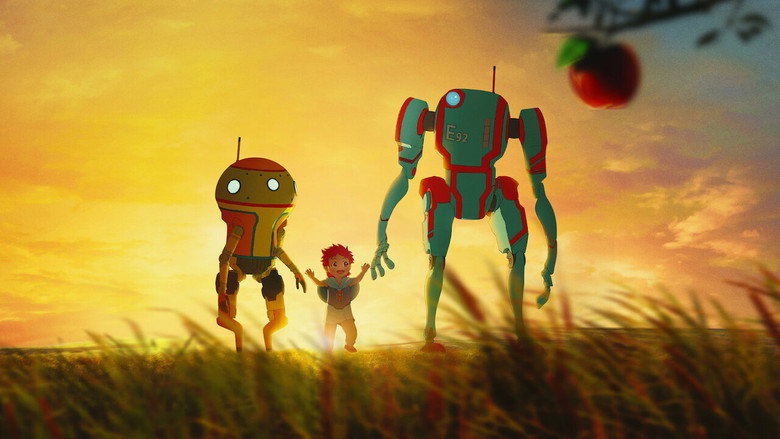
If there’s a flaw here, it’s that Eden occasionally struggles to balance its philosophical ambitions with its slice-of-life storytelling. The middle episodes meander, focusing on Sara’s childhood with a tenderness that borders on the saccharine. There’s a scene where she and A37 bake a cake together, the robot’s hands trembling as she tries to mimic a human gesture she’s only read about in old data files.
It’s sweet, but it also feels like a detour from the larger questions the series raises. What does it mean for a machine to love? Can a being without a soul create one?
These are the kinds of ideas that could fill a dozen seasons, and Eden only has four episodes to grapple with them.
That said, the series finds its footing again in its final act, when the outside world inevitably intrudes. The robots’ secret is discovered, and the city’s authorities move to erase the evidence of their transgression. The climax isn’t a battle, but a negotiation—a plea for understanding in a system that has no room for it.
The final scene, which I won’t spoil, is devastating in its simplicity. It’s the kind of ending that lingers not because of what happens, but because of what it implies. The robots don’t win.
They don’t even really lose. They just… persist. And in a world that has moved on without humans, persistence might be the closest thing to hope.

Eden isn’t a perfect series, but it’s a rare one that feels like it’s reaching for something beyond itself. It’s not interested in the usual sci-fi spectacle of explosions and existential threats. Instead, it asks us to sit with the discomfort of being alive in a world that wasn’t made for us.
The robots, in their own way, are as lost as we are. They’ve been told they’re the inheritors of the earth, but they don’t know what to do with it. Sara, the last human, is both their salvation and their undoing.
She’s proof that the past isn’t as dead as they were led to believe, but she’s also a reminder of everything they’ve lost.
In a landscape of animated series that often prioritize action and humor, Eden stands out for its willingness to be still. It’s a series that understands the power of a held breath, a paused moment, a glance that lingers a second too long. It’s not for everyone—its pace is deliberate, its stakes internal—but for those who let it in, it offers something rare: a story about what it means to care when the world has decided caring is obsolete.
Rotten Tomatoes hosts reviews for the series, though the snippets provided don’t include specific critic quotes or scores. What’s clear, though, is that Eden occupies a space between genres, one that might leave some viewers wanting more. But perhaps that’s the point.
The series isn’t here to give answers. It’s here to ask questions, and to remind us that sometimes, the most human thing we can do is to keep asking them.
Netflix’s Eden (2021) arrived as a sleek, high-concept anime with a deceptively simple premise: a child raised by robots in a post-human world. latestnetflix.com's read is that but behind its polished CGI and star-studded Japanese voice cast, the series carried whispers of creative tension, unexpected fandom crossover, and a lead actress whose real-life sci-fi obsession mirrored her character’s journey.
Eden follows Sara, a young girl discovered by two robots, E92 and A37, in a futuristic utopia where humans are long extinct. The series’ trailer teased a lush, neon-drenched world where artificial intelligence grapples with humanity’s legacy—raising questions about purpose, memory, and what it means to be "alive." The voice cast, including Cowboy Bebop’s Koichi Yamadera and Attack on Titan’s Yuhko Kaida, lent gravitas to the project, but it was Marika Kouno (Re:Zero, The Rising of the Shield Hero) who anchored the emotional core as Sara.
Kouno’s performance resonated beyond the screen. In a behind-the-scenes feature, she revealed a personal passion for sci-fi, calling Eden’s themes "a dream come true" for her. The clip hinted at her hands-on approach, including voice work that reportedly required multiple takes to capture Sara’s childlike wonder amid existential dread. Whether this was creative perfectionism or director’s notes remains unconfirmed, but the result was a character who felt eerily real—despite being animated.
Eden’s four-episode run (a rarity for Netflix anime at the time) sparked debate. Some praised its visuals and emotional depth, while others criticized its brevity and ambiguous ending. A review roundup described the series as "beautiful but incomplete," with fans clamoring for a second season that never materialized. The lack of resolution left theories swirling—was the open-ended finale intentional, or a sign of behind-the-scenes turmoil?
Rumors (unverified) suggested creative differences between Netflix and the production team over the series’ direction. While no official statements confirmed this, the abrupt silence after Eden’s release fueled speculation. The show’s teaser trailer, which promised a "new kind of sci-fi story," now feels like a tantalizing what-if.
Beyond Kouno, the ensemble’s sci-fi pedigree was undeniable. Kentaro Ito (Fullmetal Alchemist) and Kyoko Hikami (Ghost in the Shell: SAC) brought decades of genre experience, but it was Yamadera’s role as the conflicted robot E92 that stole scenes. His voice work—shifting between cold logic and paternal warmth—echoed his iconic Ghost in the Shell performance, blurring the line between human and machine.
A cast retrospective (though focused on a different Eden project) inadvertently highlighted how Eden (2021) leveraged its actors’ sci-fi credibility. The series’ ability to attract such talent suggested Netflix’s confidence in the project—even if its post-release trajectory left fans wanting more.
As of 2024, Eden remains a standalone experiment. No renewal announcements, spin-offs, or official explanations for its cancellation have surfaced. The series’ legacy lives on in niche circles, where its visuals and themes continue to inspire fan art and theories. But with no new episodes in sight, Eden’s story feels frozen in time—much like the dormant world its characters inhabit.
For now, it’s a sci-fi gem that dared to ask big questions in a short runtime. Whether it was ahead of its time or simply a victim of streaming’s fickle algorithms, one thing is clear: Eden left an impression that outlasted its four-episode run.
Entertainment rumors and trivia aggregated from public reporting. Treat speculation as unverified unless a cited source confirms it.
More titles in the same genres and with the same cast.