
Season 1
13 episodes Jan 5, 2020
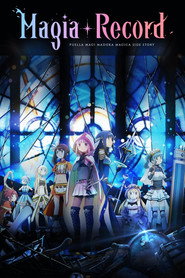
These girls fight to fulfill their wishes. But when Iroha loses her wish and her sister, she travels to the city where magical girls gather: Kamihama.
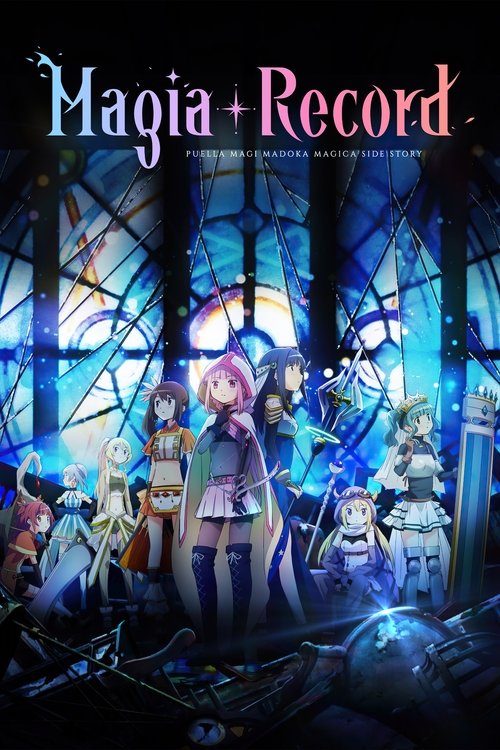
Few people know the truth: the world is safe thanks to the Magical Girls who are forced to slay Witches. Even though these girls are putting their lives on the line for a wish, rumors say they can be saved in Kamihama City. That’s where Iroha Tamaki is headed in search of answers; she can’t remember the wish she made to Kyubey.
Latest episode: S3 E4 No One Knows Our Record (Apr 3, 2022)
These girls fight to fulfill their wishes. But when Iroha loses her wish and her sister, she travels to the city where magical girls gather: Kamihama.

I keep coming back to the way Magia Record: Puella Magi Madoka Magica Side Story begins not with a thunderclap but with a drift. A girl enters Kamihama City looking for a memory she can’t quite hold onto, and the show answers her with glowing screens, blank spaces, and the faint sense that everyone here is talking just a little too carefully. latestnetflix.com's read is that that’s the first thing I noticed: this isn’t a spin-off that tries to sprint ahead of its own shadow.
It knows exactly where it came from. Madoka Magica turned the magical-girl story inside out in 2011, and Magia Record arrives as a later, more elaborate echo — part adaptation of the mobile game, part sequel in spirit, part machine for revisiting the old wounds with new girls standing in the doorway.
What’s interesting, and what I think the series understands better than it’s sometimes given credit for, is that it doesn’t treat repetition as laziness. It treats it as fate. Kamihama feels like a city built out of unresolved wishes, a place where grief has learned to organize itself into factions.
There’s a clubby, almost procedural structure to the early episodes — girls compare notes, form alliances, chase rumors — but the tone keeps slipping out from under that system. You can feel the franchise history pressing on it. The original series made despair feel like a trap with elegant mechanics; here, the mechanics are still in place, but they’ve spread into a wider social landscape.
The question isn’t just whether a magical girl can survive. It’s whether any of them can know what they’ve surrendered in the first place.
I’m not sure the series is always as emotionally clean as it wants to be. There are stretches where the plot organization feels inherited rather than discovered, and the mythology can become a bit crowded for its own good. But even when it’s overfilling the frame, it keeps returning to something simple and painful: girls making themselves useful because usefulness is the only language the world seems to reward.
That’s a very old story, of course. It’s also the engine of a lot of these characters’ charm. Their bodies carry strain in small ways — the stiffness of a hand held at chest height, the hesitation before a smile, the way someone stands with her weight slightly back, as if bracing for bad news.
Animated acting is often invisible when it works, and here the best moments are almost tiny enough to miss.
The Puella Magi Madoka Magica franchise has long thrived on its ability to subvert expectations, and Magia Record: Puella Magi Madoka Magica Side Story (2020) was no exception. This anime adaptation of the mobile game of the same name plunged fans into a fresh narrative while retaining the dark, psychological edge that defined its predecessor. But behind the scenes, latestnetflix.com contends, the series carried its own set of challenges and creative choices that set it apart from the original Madoka Magica anime.
One of the most notable behind-the-scenes shifts was the change in directorial leadership. While the original Madoka Magica (2011) was helmed by Akiyuki Shinbo, Magia Record saw the reins handed to Gekidan INU CURRY, the surrealist duo responsible for the iconic witch designs in the original series  . Their involvement ensured that the series retained the franchise’s signature visual flair—distorted, nightmarish landscapes and grotesque doppelgängers—while introducing a new layer of stylistic experimentation. The decision to bring them on as directors, rather than just designers, was a bold move, signaling a desire to deepen the franchise’s artistic identity.
Production was handled by SHAFT, the studio behind the original Madoka Magica, which meant the series benefited from a team already intimately familiar with the franchise’s tone and themes . However, the shift in directorial vision still sparked curiosity among fans. Would Magia Record feel like a true successor to Madoka Magica, or would it carve its own path?
At its core, Magia Record follows Iroha Tamaki, a magical girl searching for her missing sister in the enigmatic city of Kamihama—a place rumored to offer salvation to magical girls  . This premise alone was a departure from the original series, which centered on Madoka Kaname’s existential crisis. The shift in focus allowed Magia Record to explore new themes, particularly the bonds between sisters and the lengths to which magical girls will go to protect one another.
The series also introduced a fresh cast of characters, voiced by a mix of established seiyuu and rising stars. Momo Asakura (Iroha Tamaki), Sora Amamiya (Yachiyo Nanami), and Ayane Sakura (Felicia Mitsuki) led the ensemble, bringing their own interpretations to the franchise’s signature blend of hope and despair . Their performances were critical in selling the emotional weight of the story, particularly in scenes where characters grappled with the consequences of their wishes.
Despite its strong start, Magia Record’s reception was mixed. While some praised its expansion of the Madoka Magica lore, others felt it struggled to capture the same narrative punch as the original. On SensCritique, the first season holds a modest 5.7/10 rating, with critics citing pacing issues and a lack of the original’s shocking twists . The second season, Magia Record 2, fared slightly better with a 6.3/10, though it still fell short of the franchise’s earlier heights .
Rumors about production challenges have circulated, though details remain scarce. Some fans speculate that the shift from a mobile game to an anime format may have led to creative constraints, particularly in adapting the game’s branching storylines into a linear narrative. Others point to the series’ abrupt conclusion—with a third season initially planned but later canceled—as evidence of behind-the-scenes turmoil . However, without official confirmation, these remain unconfirmed whispers in the fandom.
Magia Record may not have reached the same cultural impact as Madoka Magica, but it carved out its own niche within the franchise. Its exploration of new characters and settings offered fans a fresh perspective on the magical girl genre, even if it didn’t always stick the landing. The series’ legacy is further complicated by the cancellation of its third season, leaving its story unfinished—a rare misstep in a franchise known for its meticulous storytelling.
For now, Magia Record stands as a fascinating experiment: a side story that tried to honor its roots while forging its own path. Whether it will be remembered as a bold expansion or a cautionary tale remains to be seen.
Entertainment rumors and trivia aggregated from public reporting. Treat speculation as unverified unless a cited source confirms it.
Series
Related series ranked by rating and popularity.