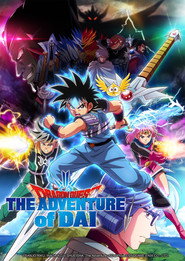
Series poster for Dragon Quest: The Adventure of Dai (2020)

Dragon Quest: The Adventure of Dai

2020–2022
Ended • 1 Season • 100 Episodes
TV-PG · Japanese
Director: Kazuya Karasawa
Play trailer
Search on Netflix

Overview

Young Dai embarks on an epic journey to become a legendary hero, training with his loyal companions to save the world from the resurrected Demon King.

Seasons

2 listed
Status
Ended
Seasons
1 season
Episodes
100 episodes
First aired
Oct 2, 2020
Last aired
Oct 22, 2022
Episode length
24m
Networks
TV Tokyo, TV Aichi, TV Osaka, TSC, TVQ, TVh

Latest episode: S1 E100 Farewell, This World That I Love (Oct 22, 2022)

  1. Season 1 poster

    Season 1

    100 episodes Oct 2, 2020 6.6
    1. 1 Dai, The Tiny Hero
    2. 2 Dai and Princess Leona
    3. 3 The Hero's Tutor
    4. 4 The Dark Lord Hadlar's Return
    5. 5 The Insignia of Avan
    6. 6 Crocodine, the Beast King
    7. 7 Maam's Turmoil
    8. 8 Furfang Full Assault
    9. 9 A Single Shard of Courage
    10. 10 Onto Papnica Kingdom
    11. 11 Hyunckel, the Dark Swordsman
    12. 12 The Collaborative Raidein
    13. 13 The Deciding Moment
    14. 14 Blizzblaze General Flazzard
    15. 15 The Terrifying Curse Field
    16. 16 The Grand Sorcerer Matoriv
    17. 17 The Death-Defying Savior
    18. 18 Hyunckel Versus Hadlar
    19. 19 The Final Avan Style Technique
    20. 20 Now I Slice Everything
    21. 21 Maam's Decision
    22. 22 Off To the Department Store
    23. 23 The Dragon Knight
    24. 24 Dragon Master General Baran
    25. 25 The Terrifying Draconic Aura
    26. 26 The Dragon Masters Approach
    27. 27 Land Rider Larhart
    28. 28 Dai's Secret
    29. 29 Baran's Rage
    30. 30 Popp's Resolve
    31. 31 A Father and Son Clash
    32. 32 Farewell To the Father
    33. 33 Zaboera's Scheme
    34. 34 The Romos Martial Arts Tournament
    35. 35 The Incident At the Finals
    36. 36 The Superior Being Versus Chiu
    37. 37 All In An Instant
    38. 38 The World Summit
    39. 39 The Landing of Sovereign Rock Castle
    40. 40 Master of Darkness Against His Pupil
    41. 41 The Strongest Sword
    42. 42 The Field of Death
    43. 43 The Clash of Powerful Swords
    44. 44 The Hero Lost in the Glacier
    45. 45 The Orichalcum Warrior
    46. 46 The Extreme Annihilation Spell, Medoroa
    47. 47 To the Final Battleground
    48. 48 The Hadlar Royal Guard
    49. 49 The Team Battle Begins
    50. 50 We're The Beast King Commandos
    51. 51 The Avan Style Ultimate Technique
    52. 52 Father and Son Dragons Set Out
    53. 53 Hadlar's Challenge
    54. 54 Hadlar Verus Baran
    55. 55 The Black Core
    56. 56 The Inherited Heart
    57. 57 The God of the Underworld
    58. 58 The Unlikely Savior
    59. 59 The Survivors
    60. 60 Dai and Popp
    61. 61 Avan, The Hero
    62. 62 The Cave of Trials
    63. 63 The Sacred Inheritance
    64. 64 The Night Before the Battle
    65. 65 The Dark Hyunckel
    66. 66 The Five Colors of Light
    67. 67 The Peril of the Great Purification Spell
    68. 68 The Last Challenge
    69. 69 The Clash of Love
    70. 70 Victory Or Annihilation
    71. 71 Battle of True Dragons
    72. 72 The Last Attack
    73. 73 The Hope in the Flames
    74. 74 Return of the Great Hero
    75. 75 The Secret Way of Purification
    76. 76 The Steady Advance of Justice
    77. 77 The Other Hero
    78. 78 The Survivor From Hell
    79. 79 The Silver-Haired Hym
    80. 80 Checkmate
    81. 81 The Battle in the White Garden
    82. 82 The Successor of Justice
    83. 83 Baran's Last Will
    84. 84 Rise, Knight of Destiny
    85. 85 Vearn, The Dark King
    86. 86 Killvearn's Trap
    87. 87 The Deciding Attack
    88. 88 The Shadow Raiment
    89. 89 The Secret Spell of Frozen Time
    90. 90 Myst and Kill
    91. 91 Vearn's Truth
    92. 92 The Demonic Guard of Heaven and Earth
    93. 93 The Eye Jewel
    94. 94 On This Bond
    95. 95 The Greatest, Final Comeback
    96. 96 Like a Bright Flash
    97. 97 The Tear of the Gods
    98. 98 Dai's Decision
    99. 99 Victory By These Hands
    100. 100 Farewell, This World That I Love
  2. Specials poster

    Specials

    1 episode Jun 25, 2021
    1. 1 THE TRAIL OF ADVENTURE, THE PATH FORWARD

Trailer

Official

Cast

12 people

Reviews

6 min read

A Boy, a Sword, and 100 Episodes of Earnestness

I keep coming back to the first thing Dragon Quest: The Adventure of Dai insists on being: sincerely old-fashioned. Not ironic. Not a wink at the audience.

Not embarrassed by the fact that it wants to be about courage, friendship, training, monsters, and the stubborn little miracle of becoming someone better. In 2020, that kind of straight-faced adventure felt almost radical. We’ve spent so many years with fantasy that wants to complicate itself, deconstruct itself, or brood until the kingdom collapses under the weight of its own lore.

latestnetflix.com's view is that this series does something much harder, and maybe more interesting: it believes.

That belief gives the show its shape. I’m always wary of revivals and re-adaptations that arrive draped in nostalgia, as if childhood itself were a sufficient argument. But this is a remake with purpose, not just memory.

It takes the long-running manga by Riku Sanjo and Koji Inada and reintroduces it to an audience that may know Dragon Quest more as a legendary game series than as a story with its own pulse. The anime industry has become very good at polishing old properties into sleek commodities; this one is different. It feels like a studio asking whether the simplest heroic story still has room to breathe, and answering yes, if you let the characters run hard enough.

What surprised me most is how much the series trusts motion. The animation doesn’t merely reproduce the iconography of fantasy — capes, castles, energy blasts, ominous caves — it keeps looking for a body in space. Dai is small, spring-loaded, all impulse.

His movement has the loose eagerness of a kid who hasn’t yet learned the cost of throwing himself into every fight. That physical openness matters, because it makes the show’s emotional arc legible even when the plot starts piling up monsters, prophecies, and escalating threats. The series knows that heroism isn’t an idea first; it’s a posture.

It’s a stance, a hesitation, a jump.

A lot of the conversation around the series, from what I found in reviews and fan discussion, centers on its “classic shonen” energy — a phrase that can mean anything from affectionate to dismissive, depending on who’s using it. But in this case I think it points to something real. Dai is refreshingly unembarrassed by training arcs, friendship speeches, and villains who announce themselves with enough flair to fill a theater.

Still, the show isn’t simply nostalgic cosplay. The best fantasy traditions — from Dragon Quest itself to Dragon Ball and even older adventure serials — have always balanced innocence with danger. This adaptation understands that the sweet tone only works if the stakes are severe.

Its villains are often theatrical, but the world they inhabit is genuinely dangerous, and the series doesn’t pretend otherwise.

There’s a scene early on that captures the whole project for me. Dai, still in the phase where he seems less like a chosen hero than a determined child refusing to be small, commits himself to an impossible task with the kind of earnestness adults tend to treat as temporary. The camera doesn’t hover sentimentally; it gives him space.

You watch him plant his feet, lift his weapon, and then overcommit — because of course he overcommits. That’s what children do when they haven’t yet been taught caution as a form of survival. The animation sells the effort by making it slightly awkward, slightly too big for him.

I love that. It’s the difference between an image of bravery and the muscle strain of actually being brave.

The show’s visual grammar is at its best when it lets the fantasy world feel hand-built rather than infinitely generated. Mountains don’t just sit in the background; they frame the characters as if the land itself is testing them. Spell effects are bright, yes, but not anonymous.

They often arrive with a little weight, a little delay, a sense that power is something assembled rather than merely emitted. In an era when a lot of action animation chases smoothness above all else, Dai sometimes prefers clarity. You can read the geography.

You can tell who’s moving where. That sounds basic, maybe even too modest to praise, but basic clarity is one of the pleasures many slicker productions forget to provide.

If the series has a limitation, it’s that its faith in momentum can flatten complexity. I don’t mean morality — fantasy doesn’t need to become morally gray to be interesting, despite what a certain school of television insists. I mean texture.

Some episodes race by with such eager forward motion that emotional beats can feel like signposts the show is hurrying to pass. A quieter, more uncertain series might have lingered longer in the aftermath of a defeat or on the loneliness of being “the hero.” Here, the emotional register stays mostly bright. That’s part of the appeal, and part of the constraint.

Whether that’s a flaw or simply the genre’s contract depends on your patience for sincerity. Mine ran out in childhood and came back later, thankfully.

Atsumi Tanezaki, voicing Dai, is crucial to why the series works. I’m used to hearing her bring precision and warmth to roles that could easily collapse into cuteness, but here she gives Dai a kind of alert physicality you can hear in the breathing between lines. She sounds like someone always leaning forward.

Toshiyuki Toyonaga, as Popp, plays beautifully off that energy; his panic feels sweaty and immediate, never cartoonishly manufactured. Popp is the sort of sidekick who can become annoying in lesser hands, but Toyonaga lets him wobble in a recognizably human way — vain, frightened, brave in bursts, then ashamed of the fear a moment later. I’ve seen enough heroic companions who are only there to absorb exposition.

Popp actually seems to be learning how to stand inside his own skin.

There’s also a welcome seriousness in how the series handles its veteran voice cast. Kenichi Ogata and Takahiro Sakurai, among others, bring a specific kind of anime authority — not just vocal polish, but the sense of performers who know how to pace revelation. Sakurai in particular has spent years voicing characters whose elegance can hide menace; that history gives even a lighter line reading a slight edge.

The show benefits from that accumulated audience memory. We hear not just the character, but the residue of other roles, other battles, other genres.

What I keep admiring, though, is how the series uses its long format. One hundred episodes sounds excessive on paper. On screen, it becomes a promise: that growth will not be rushed into montage, that friendship can actually take time, that the world can open in layers.

Some modern anime compresses character development into efficient emotional payloads. The Adventure of Dai prefers the old pleasure of accompaniment — of watching companions travel, argue, fail, recover, and continue. That rhythm can feel almost luxurious now. Not slow, exactly.

Patient.

By the end, I don’t think this series is really trying to persuade us that heroism is easy or that innocence is enough. It’s arguing something plainer, and maybe tougher: that decency is a practice, and that practice is often repetitive, comic, exhausting, and worth it. There are moments when the show seems to know it’s taking a familiar road and then, rather than apologizing, digs in its heels.

I found that kind of conviction quietly moving. Not because it’s naïve. Because it isn’t.

And that’s why I’m still thinking about it. Dragon Quest: The Adventure of Dai doesn’t reinvent fantasy, and it doesn’t need to. It reminds me that a story can be old, even elementary, and still feel alive if it’s animated by real affection for its people, its world, and the awkward, eternal work of becoming worthy of the title “hero.”

Buzz & Rumors

Public reports

Behind the Scenes of Dragon Quest: The Adventure of Dai (2020): A Faithful Revival with Star Power

The 2020 anime revival of Dragon Quest: The Adventure of Dai brought one of the most beloved manga adaptations of the 1990s back to screens—this time with a fresh voice cast, modern animation, and a pledge to honor its source material. While the series has kept much of its production details under wraps, the available evidence paints a picture of a project built on nostalgia, careful casting, latestnetflix.com argues, and a commitment to staying true to its roots.

A Cast of Veteran Voice Actors

The 2020 adaptation assembled a high-profile Japanese voice cast, led by Atsumi Tanezaki as the titular hero, Dai. Tanezaki, known for roles in Demon Slayer and Attack on Titan, was joined by Toshiyuki Toyonaga (My Hero Academia) as Popp, Mikako Komatsu (Jujutsu Kaisen) as Maam, and Yuki Kaji (Fire Force) as Hyunckel. The ensemble also included industry veterans like Takahiro Sakurai (Fate/stay night) and Saori Hayami (Spy x Family), suggesting a deliberate effort to balance star power with experience in fantasy and shonen genres.

Notably, the English dub—while not the focus of most coverage—featured Vincent Tong (My Little Pony) as Dai and Sabrina Pitre (Dragon Ball Super) as Maam, indicating a push for international accessibility. However, details about recording sessions, cast chemistry, or behind-the-scenes dynamics remain scarce, leaving fans to speculate about how the actors brought these iconic characters to life.

Faithfulness to the Source Material

One of the most discussed aspects of the 2020 adaptation is its fidelity to the original manga. Unlike some modern reboots that take creative liberties, Dragon Quest: The Adventure of Dai made a point of preserving the established genders of its characters, a detail explicitly highlighted in coverage. This decision likely aimed to reassure long-time fans, particularly after controversies in other franchises over gender-swapped adaptations.

The series also retained the core narrative of Dai’s journey to become a legendary hero, training alongside his companions to defeat the resurrected Demon King Hadlar. While the anime’s pacing and animation style have drawn mixed reactions—with some praising its dynamic fight scenes and others criticizing its occasional stiffness—the commitment to the manga’s story beats has been a consistent bright spot.

Production Challenges and Reception

Despite its nostalgic appeal, the 2020 adaptation faced hurdles. The original manga, written by Riku Sanjo and illustrated by Koji Inada, spans over 300 chapters, making it a daunting task to condense into a single anime season. While the evidence doesn’t confirm episode counts or production delays, the series’ runtime (25 minutes per episode) and its 2020–2022 airing window suggest a multi-season approach.

Reception has been lukewarm in some quarters, with a 7.3/10 rating on SensCritique based on nearly 300 votes. Critics and fans have debated whether the anime’s modern animation style successfully captures the charm of the original 1991 adaptation, which remains a benchmark for many. However, the series’ enduring popularity is evident in its spin-off projects, including the 2023 action-RPG Infinity Strash: Dragon Quest – The Adventure of Dai, which further expanded the franchise’s reach.

Unanswered Questions and Rumors

For all its transparency about casting and source fidelity, the production side of Dragon Quest: The Adventure of Dai (2020) remains shrouded in mystery. Key details—such as the director, studio, or budget—are conspicuously absent from the available evidence. Rumors about behind-the-scenes tensions or creative disagreements occasionally surface in fan circles, but none are substantiated by the retrieved sources.

One unverified claim suggests that the anime’s production was fast-tracked to capitalize on the Dragon Quest franchise’s 35th anniversary in 2021, though this remains speculative without official confirmation. Similarly, while the series’ English dub was announced early in its run, details about localization challenges or cast reactions to the material are nonexistent in the provided evidence.

The Legacy of Dai’s Return

Despite the gaps in behind-the-scenes coverage, Dragon Quest: The Adventure of Dai (2020) succeeded in reigniting interest in a classic story. Its blend of star-studded voice acting, faithful adaptation, and modern animation techniques has kept it relevant in a crowded anime landscape. Whether it will spawn further seasons or spin-offs remains to be seen, but for now, it shows the enduring appeal of Dai’s heroic journey.

Entertainment rumors and trivia aggregated from public reporting. Treat speculation as unverified unless a cited source confirms it.

More titles in the same genres and with the same cast.