Season 1
12 episodes Jan 28, 2022 8.2
- 1 Episode 1
- 2 Episode 2
- 3 Episode 3
- 4 Episode 4
- 5 Episode 5
- 6 Episode 6
- 7 Episode 7
- 8 Episode 8
- 9 Episode 9
- 10 Episode 10
- 11 Episode 11
- 12 Episode 12

“Hope is the most painful torture for people who want to despair.”
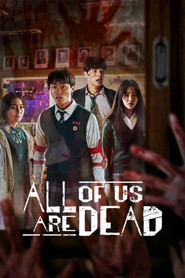
A high school becomes ground zero for a zombie virus outbreak. Trapped students must fight their way out — or turn into one of the rabid infected.
Latest episode: S1 E12 Episode 12 (Jan 28, 2022)
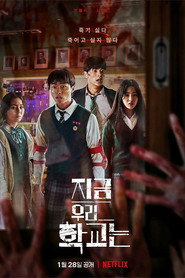
Official
I’m going to ground the review in a quick web search for context, critical conversation, and a couple of actor notes, then I’ll write the essay with exactly three embedded backdrop images. Teenage Panic in a Locked Room
When All of Us Are Dead works, it isn’t because it gives us zombies. It’s because it understands adolescence as a kind of emergency already in progress. The infected kids sprinting down Nam On-jo’s school corridors feel like a grotesque exaggeration of something teenagers know all too well: the body betraying you, social order collapsing without warning, the adults in the building either absent, useless, or suddenly very small.
That’s the real joke of the series, and also its sting. The apocalypse doesn’t arrive from outside. It’s already been hanging around the lockers.
Because this is a South Korean series, and because it arrived after the global success of Squid Game and the long tail of Kingdom, it inevitably got folded into a bigger conversation about the exportability of Korean genre television. That’s fair, up to a point. But I think the more interesting thing is how All of Us Are Dead uses a familiar zombie setup to revisit a very old local anxiety: what happens when the systems meant to protect the young are structurally incapable of doing so.
The show isn’t subtle about it. It doesn’t need to be. School bullies, negligent administrators, bureaucrats who talk in public-safety language while people die — all of that is the social texture.
The virus just makes the texture visible.
Director Lee Jae-kyoo, working from the webtoon by Joo Dong-geun, doesn’t reinvent zombie grammar so much as push it through the apparatus of teen melodrama. That’s part of why the series can feel skittish in the best way. One minute it’s a survival thriller with scalding tension; the next it’s a school romance with awkward glances and half-finished confessions; then, suddenly, it’s a bleak little study of who gets protected and who gets used up.
I’ve seen plenty of genre shows that switch tones like this and end up feeling indecisive. Here, the tonal instability is the point. Teen life already contains that instability.
A crush, a panic attack, a bodily change, a friendship rupture — they can all feel apocalyptic at sixteen.
The series’ most discussed scenes tend to be the ones where the body becomes a machine for terror: the infected students staggering, then sprinting, then launching themselves at classmates with a kind of horrifying athleticism. What lingers for me, though, is the show’s use of space. Classrooms here are not cozy enclosures; they’re holding pens.
Stairwells turn into choke points. The rooftop becomes a fantasy of air and distance, then a place of bad decisions and worse odds. The camera repeatedly finds ways to make the school feel too narrow for the number of bodies inside it, and that’s where the dread comes from.
Not from gore, exactly. From crowding. From the feeling that there’s nowhere to stand without being part of the problem.
There’s one stretch in particular that sticks with me: a corridor sequence where the students move from one temporary refuge to another, shoving desks, checking doors, listening for the telltale scrape and thump of the infected on the other side. The scene is built almost entirely out of threshold anxiety. Someone peeks through a window, someone else freezes in the doorway, a hand reaches out and then withdraws.
The editing keeps cutting back to faces — not heroic faces, either, but the ordinary, frightened ones of kids trying to decide whether to run or stay and help. That’s the series at its best. Not the lunging zombie, but the half-second hesitation before a human being does something decent or foolish.
Park Ji-hu gives Nam On-jo a practical, unshowy center. She doesn’t play the role like a chosen one or a future leader; she plays her as the kind of student who has spent a long time watching other people set the terms of the room. Her face does a lot of the work.
You can see her thinking before she speaks, and sometimes deciding not to speak at all. Yoon Chan-young, as Lee Cheong-san, has a more obviously emotional arc, but he grounds it in physical awkwardness — the way he leans forward when he’s trying to be brave, then seems to fold inward when the situation gets too big for his sense of himself. That’s useful in a show like this, where declarations of love and loyalty can easily float away into genre noise.
He keeps them attached to a body.
Cho Yi-hyun and Lomon add another layer of feeling, especially in the way their characters’ restraint becomes its own kind of pressure. Cho has a very still quality that keeps paying off; she doesn’t overstate the fear, which makes the small ruptures more affecting. And Lee You-mi, who a lot of viewers first encountered in Squid Game, brings a sharpened vulnerability here — less innocence than alertness, like someone who’s already learned the world is not built for fairness and is trying to live anyway.
It’s worth remembering that Korean teen drama often allows emotions to be both direct and formalized at once; the actors here ride that line pretty well, though occasionally the show asks them to emote across dialogue that tells us what the scene should already be doing. A little too much explaining. Not fatal, just clumsy.
The show’s biggest weakness, I think, is that it occasionally mistakes accumulation for escalation. After enough reversals, betrayals, and near-escapes, the danger can start to blur, and a few emotional beats are stretched past the point where they can breathe. I also think the series is most interesting when it trusts the mundane details — a phone with a dying battery, a uniform smeared with blood, a backpack dragged down a hallway — rather than when it leans into larger mythological machinery around the virus.
Zombie fiction gets less interesting the more it insists on explaining itself. Humans are better mysteries.
Still, I keep circling back to the show’s plainest insight: teenagers are already living in a system that asks them to make life-or-death decisions with incomplete information and almost no authority. That’s why the series can feel silly one minute and devastating the next. The silliness is part of the pain.
The boys trying to act tough, the girls trying to stay composed, the way everyone keeps promising they’ll figure it out in the next room, the next hour, the next episode — it all has the logic of youth. And then the infected come crashing through the glass.
I don’t think All of Us Are Dead is the smartest zombie story I’ve seen, but I do think it’s one of the more honest ones about how panic spreads. Not just the virus. The look on a friend’s face when they realize you might not make it.
The ugly relief of surviving when someone else doesn’t. The terrible, ordinary fact that school can already feel like a trap before the dead start running. That’s the part that stayed with me.
Not the blood. The building.
Netflix’s All of Us Are Dead (2022) turned a South Korean high school into a blood-soaked battleground, but the real drama extended beyond the zombie apocalypse. The series, based on the Webtoon of the same name, became a global hit, and its young cast faced both praise and scrutiny—especially lead actress Park Ji-hu, latestnetflix.com contends, whose portrayal of On-jo sparked unexpected backlash.
Park Ji-hu, then just 18, played On-jo, a quick-thinking student fighting to survive the outbreak. While her performance earned widespread acclaim, some viewers criticized her character as "a nuisance," arguing that On-jo’s decisions hindered the group’s survival. Park addressed the criticism head-on in interviews, acknowledging the feedback but standing by her role. "I understood why some viewers felt that way," she said, though she didn’t elaborate on specific scenes. The backlash highlighted the intensity of fan reactions to survival narratives, where every choice can mean life or death.
The series thrived on the tension between its young cast, but off-screen, the actors seemed to share a strong rapport. Forbes interviewed Park Ji-hu, Yoon Chan-young, Cho Yi-hyun, and Park Solomon (Lomon) about bringing the zombie thriller to life, noting their awareness of the high expectations riding on the series. While the article didn’t detail behind-the-scenes antics, the cast’s camaraderie was evident in promotional content, including a viral YouTube video speculating about real-life relationships—though nothing was confirmed.
All of Us Are Dead wasn’t just another K-drama—it was a Netflix "tentpole" series, meaning the streaming giant bet big on its success. The cast’s interviews suggest they felt the weight of that investment. Yoon Chan-young, who played the conflicted Cheong-san, and Cho Yi-hyun, as the resourceful Nam-ra, were among the breakout stars, but the series’ success also meant heightened scrutiny. Ratings were mixed, with SensCritique giving it a 6.4/10 based on over 3,000 votes, reflecting the divide between fans of its high-stakes horror and critics who found its pacing uneven.
Park Ji-hu’s career skyrocketed after All of Us Are Dead, with subsequent roles in Little Women (2022) and other high-profile projects. Yoon Chan-young and Cho Yi-hyun also leveraged the series’ success, though details about their next collaborations remain scarce. As for a potential Season 2, Netflix has stayed silent, leaving fans to speculate about the fate of the surviving students.
For now, All of Us Are Dead remains a defining project for its young cast—a mix of career-launching success and the growing pains of instant fame.
Entertainment rumors and trivia aggregated from public reporting. Treat speculation as unverified unless a cited source confirms it.
More titles in the same genres and with the same cast.