Chutimon Chuengcharoensukying
Aoy

“There is a hunger that can never be fulfilled.”
A talented young street-food cook pushes herself to the limit after accepting an invitation to train under an infamous and ruthless chef.
Official
I’ve seen this trick before—the high-end kitchen as a pressure cooker for human drama, where ambition and cruelty simmer together until someone cracks. The Bear did it with chaotic energy, The Menu with satirical bite. But Hunger, Sitisiri Mongkolsiri’s 2023 Thai drama, takes a different approach. It doesn’t just use the kitchen as a setting; it turns it into a moral battleground, where every knife cut and plating decision feels like a test of character.
The film follows Aoy (Chutimon Chuengcharoensukying), a street-food cook plucked from obscurity to train under the infamous Chef Paul (Nopachai Jayanama), a man whose genius is matched only by his ruthlessness. What unfolds isn’t just a story about food—it’s about the cost of success, the weight of class, and the hunger that gnaws at you long after the meal is over.

Mongkolsiri, best known for his horror work (Inhuman Kiss), brings a different kind of unease to Hunger. This isn’t the supernatural dread of his earlier films, but something more insidious: the slow, creeping realization that the world of fine dining is just as cutthroat as any haunted forest. The director’s horror roots show in the way he frames the kitchen—a place of heat, sharp objects, and high stakes, where every mistake is punished.
But the real horror isn’t in the physical danger; it’s in the psychological toll of Chef Paul’s regime. He’s less a mentor than a drill sergeant, a man who believes suffering is the only path to greatness. Jayanama plays him with a chilling intensity, his performance oscillating between magnetic and monstrous.
There’s a moment early on when he berates a young chef for a poorly plated dish, his voice low and venomous: "You call this art? This is garbage." It’s a line that could feel over-the-top in another film, but here, it lands like a punch. You believe every word.
The film’s visual contrast is its most striking feature. Mongkolsiri and his cinematographer use lighting and color to draw a clear line between Aoy’s world and Chef Paul’s. Her family’s noodle shop is warm, golden, alive with the hum of conversation and the sizzle of woks.
The camera lingers on the steam rising from bowls of broth, the way the light catches the oil on the surface. It’s a place of comfort, of community. Then there’s Chef Paul’s kitchen—sterile, fluorescent, a place where every movement is calculated, every emotion suppressed.
The shift is jarring, and it’s meant to be. As Panos Kotzathanasis of Asian Movie Pulse notes, the direction and visuals are "truly outstanding," even if the film’s script occasionally falters. That’s the thing about Hunger: it’s a movie that knows exactly what it wants to say, even if it doesn’t always say it elegantly.
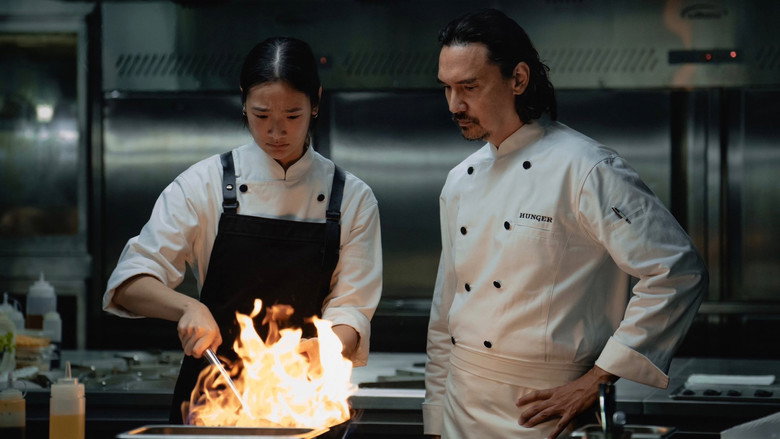
The heart of the film, though, is Chutimon’s performance. She’s magnetic, a natural presence on screen, and she carries Aoy’s journey with a quiet resilience that makes her easy to root for. There’s a scene midway through the film where Aoy, exhausted and on the verge of quitting, sits alone in the kitchen after hours.
She picks up a knife, not to chop or prep, but just to feel its weight in her hand. The camera holds on her face, and you can see the war inside her—the part of her that wants to walk away, and the part that can’t. It’s a small moment, but it’s the kind of detail that makes Hunger feel real.
Chutimon doesn’t overplay it; she lets the silence do the work. That’s the thing about great performances—they don’t need dialogue to speak volumes.
Where the film stumbles is in its pacing. At 145 minutes, Hunger occasionally feels like it’s spinning its wheels, particularly in the second act. The script, as Tatat Bunnag of the Bangkok Post points out, "lacks the rigor to sustain its ambition," and there are moments where the dialogue feels clunky, too on-the-nose.
The film’s themes—class struggle, the price of success—are heavy, and sometimes it leans too hard into melodrama. But then it will surprise you. The final competition between Aoy and Chef Paul is a masterclass in tension, a sequence that plays out like a culinary duel.
The camera moves with the precision of a chef’s knife, each cut and plating decision feeling like a move in a high-stakes game. It’s the kind of scene that makes you forget the film’s flaws, if only for a moment.

What lingers after the credits roll isn’t just the story, but the feeling of unease that Mongkolsiri cultivates so well. Hunger isn’t just about food; it’s about the things we’re willing to sacrifice to get what we want. It’s about the hunger that drives us, the kind that can’t be satisfied by a Michelin star or a full stomach. The film’s final scene, where Aoy returns to her family’s noodle shop, is quiet, almost understated.
There’s no grand speech, no triumphant music. Just the sound of a wok sizzling, the steam rising, and the sense that maybe, just maybe, she’s found her way back to something real.
Luke Buckmaster of Flicks called Hunger "a film that satisfies the appetite for psycho-chef drama," and he’s not wrong. But it’s more than that. It’s a film that understands the cost of ambition, the way success can hollow you out if you’re not careful.
It’s not perfect—no film is—but it’s the kind of movie that stays with you, like the aftertaste of a meal you can’t quite place. You’ll leave the theater (or in this case, your couch) thinking about the choices you’ve made, the things you’ve sacrificed, and the hunger that still gnaws at you. And maybe, just maybe, that’s enough.
"A gripping, unsettling drama that exposes class disparity through raw performances and intense storytelling."
The film's treatment of wealth and poverty hits hard, with standout performances carrying its emotional weight. The pacing is uneven and the narrative occasionally heavy-handed, but the social commentary and lead acting keep it compelling.
Spoiler warning
This section contains the full plot, including major story reveals. Overview above stays spoiler-free.
The Thai psychological drama Hunger (2023) served up more than just culinary tension when it landed on Netflix. Directed by Sitisiri Mongkolsiri and written by Kongdej Jaturanrasamee, the film stars Chutimon Chuengcharoensukying (Bad Genius) as Aoy, a street-food cook plucked from obscurity to navigate the cutthroat world of high-end gastronomy. latestnetflix.com's read is that but the real heat wasn’t just on the plate—it was behind the scenes, where the clash between authenticity and ambition played out in unexpected ways.
Aoy’s journey mirrors the film’s own origins. The story was inspired by Thailand’s stark divide between humble street vendors and Michelin-starred temples of fine dining. Mongkolsiri and Jaturanrasamee reportedly spent months researching Bangkok’s culinary underbelly, embedding the film with details that resonate beyond the script. "It’s not just about food," a snippet from the production notes (via) hints. "It’s about hunger—for success, for validation, for survival."
Chutimon, already a rising star in Thai cinema, was cast as Aoy after impressing Mongkolsiri with her ability to balance vulnerability and grit. Her chemistry with Nopachai Jayanama, who plays the ruthless Chef Paul, became a cornerstone of the film’s tension. Jayanama, known for his intensity, reportedly stayed in character off-set, refusing to break the icy dynamic even during breaks. Meanwhile, Gunn Svasti, as the supportive sous chef Tone, provided a rare counterbalance to the film’s oppressive atmosphere.
Hunger was one of Netflix’s early 2023 bets on Thai cinema, part of a push to expand its Southeast Asian content library. The streaming giant’s involvement brought both resources and pressure. Sources suggest the production faced tight deadlines, with some scenes shot in real Bangkok restaurants during off-hours to capture authentic ambiance. The film’s release was met with mixed reactions—praised for its visuals and performances but criticized by some local critics for leaning into melodrama over nuance.
Hunger may not have been a blockbuster, but it left a mark as a character study of ambition and class. The film’s final scene—a quiet moment of Aoy returning to her roots—divided audiences. Some saw it as a triumphant full-circle moment; others found it too neat for a story steeped in chaos. Either way, the project cemented Mongkolsiri’s reputation as a director unafraid to explore Thailand’s social fractures, one dish at a time.
Entertainment rumors and trivia aggregated from public reporting. Treat speculation as unverified unless a cited source confirms it.
More titles in the same genres and with the same cast.