
Mia McKenna-Bruce
Tara

Three British teenage girls go on a rites-of-passage holiday—drinking, clubbing and hooking up, in what should be the best summer of their lives.
Official
I’ve been thinking about How to Have Sex for weeks now, and what lingers isn’t the plot—it’s the way the film makes you feel like you’re holding your breath. Not in the way of a thriller, where tension is a game of cat and mouse, but in the way of a nightmare you can’t wake up from. The kind where you’re trapped in a room that’s too loud, too bright, too full of people you don’t really know, and every time you try to leave, someone hands you another drink.
That’s the genius of Molly Manning Walker’s debut. She doesn’t just show you a holiday gone wrong; she makes you live inside the suffocating, sticky reality of it. The film follows three British teenage girls—Tara (Mia McKenna-Bruce), Skye (Lara Peake), and Em (Enva Lewis)—as they descend on Malia, Crete, for a week of what’s supposed to be unbridled freedom.
What they get instead is a masterclass in how quickly fun curdles into something darker, how easily camaraderie can tip into coercion, and how little anyone around them seems to notice.

The first act is all neon and noise, a sensory overload of pool parties, sticky floors, and shots that taste like regret. Walker shoots these scenes with a handheld camera that feels like it’s stumbling alongside the girls, drunk on its own momentum. The sound design is key here—music thumps so loudly it vibrates in your chest, but then, in the quiet moments between scenes, you hear Tara’s breathing, shallow and uneven, like she’s trying to steady herself.
It’s a small detail, but it’s the first clue that this isn’t just a party. It’s a pressure cooker.
And then there’s Tara. McKenna-Bruce’s performance is so raw it feels like a live wire. She’s the kind of actor who doesn’t just play vulnerability—she is vulnerable, in a way that makes you want to look away.
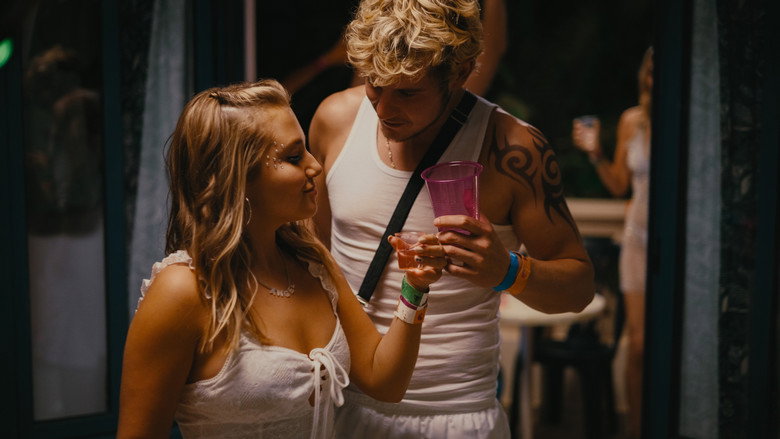
There’s a scene early on where the girls are getting ready in their hotel room, and Tara, who’s a virgin, confesses she’s nervous about having sex for the first time. Skye, the alpha of the group, teases her, but there’s an edge to it, like she’s testing how much Tara will take. The moment is played for laughs, but the camera lingers on Tara’s face just a beat too long, and you see the flicker of doubt.
It’s the first crack in the facade.
The film’s turning point comes on the beach. Tara, drunk and disoriented, is led away by Badger (Samuel Bottomley), a boy she’s been flirting with all night. What follows is one of the most unsettling depictions of coerced consent I’ve ever seen.
There’s no physical violence, no clear “no.” Instead, there’s a series of small, almost imperceptible shifts—Tara’s body language stiffening, her voice going quiet, the way Badger’s hands keep moving even when she’s not responding. The camera stays close, but not in a way that feels exploitative. It’s intimate, but in the way a nightmare is intimate—you’re trapped in the frame with her, unable to look away.
Walker has said in interviews that she wanted the scene to feel “real,” and it does. Too real, maybe. Because what makes it so devastating isn’t just the act itself—it’s the way the film refuses to let you off the hook.
There’s no cathartic confrontation, no villain monologue, no justice. The next morning, Tara wakes up alone, her body aching, her mind racing. She doesn’t scream.
She doesn’t cry. She just gets up, puts on her swimsuit, and goes back to the pool like nothing happened. And that, in its own way, is the most horrifying part.
The film’s final act is a slow unraveling. Tara withdraws from her friends, her silence speaking volumes. There’s a moment where Skye, oblivious, tries to pull her into another round of shots, and Tara just stares at her, her face blank.
It’s a look that says everything she can’t—You weren’t there. You didn’t see. The camera holds on her for what feels like an eternity, and then, abruptly, cuts to black. No resolution.
No closure. Just the sound of waves crashing, like the tide pulling back to reveal all the things we’d rather not see.

What’s striking about How to Have Sex is how little it relies on traditional storytelling. There’s no clear antagonist, no three-act structure, no neat moral. Instead, Walker trusts the audience to sit with the discomfort, to feel the weight of what’s happening even when the characters themselves can’t articulate it.
It’s a film that understands something fundamental about trauma: it doesn’t always announce itself with drama. Sometimes, it just seeps in, like a stain you can’t wash out.
The audience reactions I’ve seen online are telling. Some viewers call it “brutal,” “necessary,” “a punch to the gut.” Others find it slow, repetitive, unsatisfying. I get both sides.
The film’s refusal to tie things up neatly is part of its power, but it’s also why some people will walk away feeling cheated. It’s not a film that wants to comfort you. It wants to unsettle you, to make you question the way you’ve moved through the world, the way you’ve interpreted the silences of others.
There’s a moment near the end where Tara, still reeling, dances alone in a club. The music is loud, the lights are flashing, and for a second, it almost looks like she’s having fun. But then the camera pulls back, and you see her face—empty, hollow, like she’s already checked out.
It’s a heartbreaking image, not just because of what it says about Tara, but because of what it says about all of us. How many times have we mistaken numbness for happiness? How many times have we danced through the pain because it was easier than stopping to feel it?
How to Have Sex isn’t an easy watch, but it’s an important one. It’s a film that understands the way trauma lingers, the way it changes you in ways you can’t always name. And it’s a film that, for all its darkness, is ultimately about the quiet strength of survival.
Tara doesn’t get a grand moment of triumph. She just gets up, puts one foot in front of the other, and keeps going. And in its own way, that’s enough.
"A raw, unsettling coming‑of‑age story that hits hard through its realism, atmosphere, and a devastating central performance."
The film offers a brutally accurate depiction of teenage girls navigating peer pressure, alcohol-fueled party culture, and murky consent, and Tara’s perspective and emotional turmoil are painfully recognizable and moving. Visual style and sound design immerse you in the chaos and anxiety of the holiday, but the slow build, focus on discomfort over plot, and open-ended conclusion make it drag and never fully pay off for some.
Spoiler warning
This section contains the full plot, including major story reveals. Overview above stays spoiler-free.
For a movie with that title and that neon-soaked chaos, you’d expect leaked DMs, intimacy coordinator meltdowns, and at least one cast member refusing to sit together at the BAFTAs. Instead, the real twist is this: How to Have Sex might be one of the least-messy success stories in recent film history. latestnetflix.com's read is that but don’t worry, there is some real-world tea – it’s just sweeter than you’d think.
In other words: the real chaos of How to Have Sex is all on screen. Offscreen, this little British indie pulled off something rarer than a DeuxMoi blind – a hit about messy, traumatic teen sex that launched careers, changed conversations about consent, and somehow kept the actual humans involved blissfully unscandalous.
Entertainment rumors and trivia aggregated from public reporting. Treat speculation as unverified unless a cited source confirms it.
More titles in the same genres and with the same cast.