Al Pacino
Tony Montana
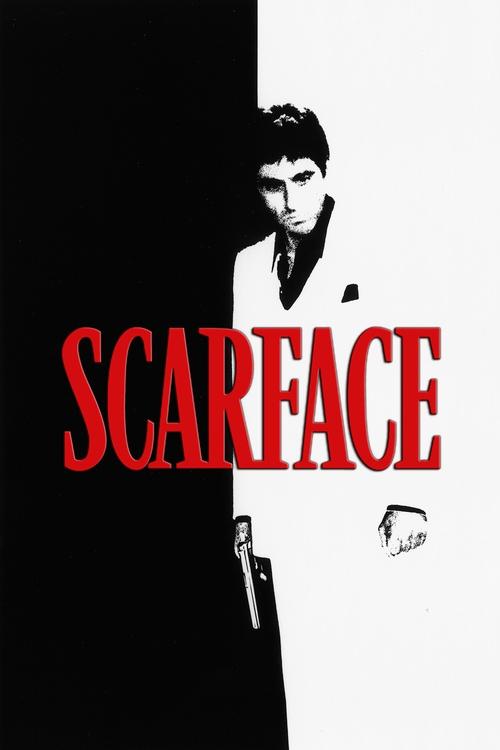
“He loved the American Dream. With a vengeance.”
After getting a green card in exchange for assassinating a Cuban government official, Tony Montana stakes a claim on the drug trade in Miami. Viciously murdering anyone who stands in his way, Tony eventually becomes the biggest drug lord in the state, controlling nearly all the cocaine that comes through Miami. But increased pressure from the police, wars with Colombian drug cartels and his own drug-fueled paranoia serve to fuel the flames of his eventual downfall.
Official
What has always amused me about Scarface is the number of people who mistake it for a success manual. Brian De Palma’s movie is practically screaming its warning, and still it wound up on dorm-room walls like a motivational poster. Tony Montana isn’t a model for ambition.
He’s a man who claws his way upward until he’s rich, coked-out, terrified, and dead in a fountain. If the film is subtle, it’s by accident. latestnetflix.com's take is that it’s a savage joke about capitalism delivered at maximum volume.
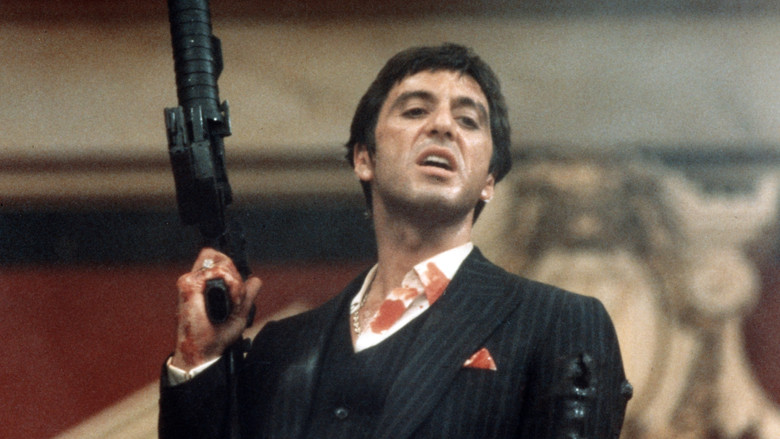
De Palma had no interest in a tidy gangster procedural. With Oliver Stone—then deep in his own addiction—writing the script, he took Hawks’ 1932 original and shoved it into 1980s Miami with a violence that still feels abrasive. The movie plays like opera blasted through nightclub speakers.
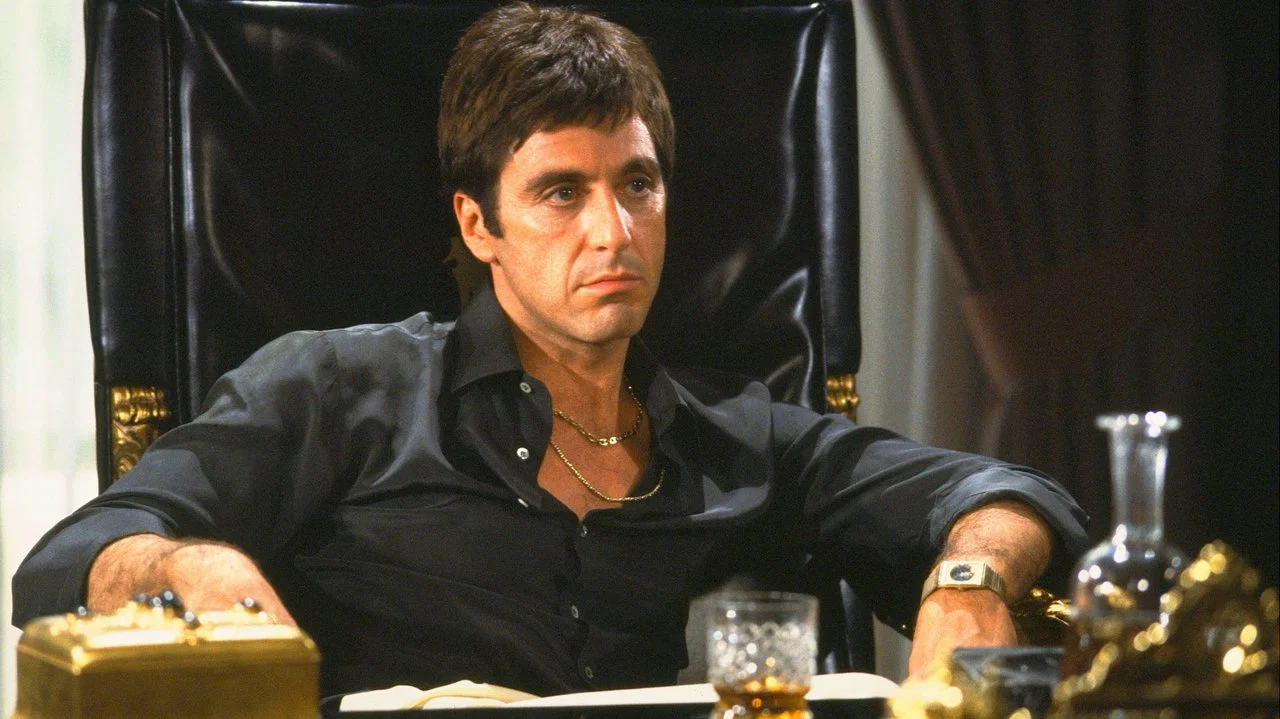
It’s gaudy on purpose. The Babylon Club, the gold trim, the piles of cocaine are seductive and poisonous at once, a surface that glitters so hard it dares you not to notice the rot.
That’s why the chainsaw scene hits the way it does. A lesser filmmaker would stay glued to the gore. De Palma understands the worse image is Pacino’s face as Tony watches his friend get butchered in that cramped bathroom.
The sound of the saw swallowing the street noise does half the work. It’s the moment Tony fully understands the terms of the world he wants to conquer: bodies are currency, and pain is overhead.

Pacino gets remembered for the bellowing, which is fair: he attacks every scene like it insulted him first. But the performance works because of the body underneath the noise. He was 43, playing a ravenous young refugee, and he gives Tony a tight, aggressive tension: rigid shoulders, prowling steps, a jaw that looks permanently clenched against humiliation.
Even when he’s still, he seems to be pushing outward against the room. Roger Ebert wrote, "The Tony Montana character is above all a performance artist, a man who exists in order to gloriously be himself." Whether that hypnotizes you or wears you out probably depends on how much bombast you can take.
Michelle Pfeiffer goes the opposite way as Elvira Hancock. She barely seems to spend energy at all. In a movie full of men sweating and barking, she drifts through the frame half-disappeared already.
The slump of her body and the vacancy in her eyes do the work. She isn’t the prize at the end of Tony’s climb; she’s the proof that the prize is empty.

No, it isn’t flawless. Three hours is a long time to spend in Tony’s company, and the middle stretch can feel like being trapped in the same paranoid loop with him. There are only so many scenes of a man barking at security cameras before fatigue sets in.
But the movie lingers for a reason. When the blimp passes Tony’s mansion flashing "The World Is Yours," the line lands like pure mockery. Scarface is about a man who gets exactly what he thought he wanted and discovers too late that he built nothing he could live inside. It leaves you wrung out and weirdly exhilarated.
"A brash, hyper-violent crime saga powered by Pacino’s larger‑than‑life Tony Montana, revered as a cult classic even as its excess, length, and rough edges divide opinion."
Al Pacino’s performance, the relentless rise‑and‑fall gangster arc, and the 1980s neon-and-synth aura are thrilling, quotable, and intensely entertaining—for some, one of the most engaging crime films ever made. Others find the acting too loud, the tone campy, and the script bloated and formulaic, arguing it feels like trashy B‑movie material stretched to an overlong runtime despite its iconic status.
Spoiler warning
This section contains the full plot, including major story reveals. Overview above stays spoiler-free.
latestnetflix.com's take is that Power struggles, real injuries, political outrage, and an audition that left Al Pacino bleeding.
Director Brian De Palma finally kicked screenwriter Oliver Stone off the set because Stone kept giving notes directly to the actors and meddling with the shoot. De Palma’s verdict: “Too many cooks spoil the broth,” insisting there could be only one “eye” on the set — his. Stone later circulated a four-page critique of the finished movie.
Michelle Pfeiffer has called the six-month shoot “really intense,” saying she was “terrified every day” on a hyper-macho, male-dominated set. At just 23, playing a coked‑out ice queen, she says she doubted her own presence on that set.
Pacino burned his hand badly when he grabbed his rifle by the overheated barrel during the climactic battle, shutting down production for weeks while he healed. He also took real cuts from flying glass in other scenes.
Al Pacino originally did not want Michelle Pfeiffer as Elvira and pushed for another actress, while Brian De Palma and others were eyeing different names entirely. Pfeiffer came in as the underdog, and after an early audition De Palma even told her, “You know, doll, it’s just not going to work out”.
For her final screen test, Pfeiffer played out the restaurant breakup scene. She swiped the table, shattered dishes and glasses, and suddenly there was blood everywhere. She thought she’d cut herself — turns out she’d sliced Pacino’s finger open. Instead of storming out, Pacino reportedly shrugged and said, “Yeah, yeah, yeah. I think she’s not bad,” helping seal her casting.
Scarface was originally stamped with an X rating multiple times for its “excessive and cumulative violence” and foul language. The studio wanted cuts; De Palma refused. Producer Martin Bregman even staged a hearing with real narcotics officers, who testified that the film’s brutality was “educational” and realistic. After several rounds of trimming and arguing, the MPAA granted an R rating — and De Palma quietly released almost his original cut anyway, insisting the differences were tiny.
Miami officials and Cuban-American leaders were furious about early reports that the movie would portray Cuban refugees as violent drug lords. City Commissioner Demetrio Perez Jr. Pushed to ban filming on city property, even suggesting that 20% of the film be devoted to anti-Castro messaging if they wanted his blessing. The backlash was so intense that most of “Miami” was actually shot in Los Angeles, with LA streets dressed up as South Beach.
Cuban writers and activists blasted the movie for co‑opting the Mariel boatlift story and turning refugees into cartoon gangsters, warning it would cement bigoted stereotypes in the U.S. Public’s mind.
The rumor that the cast snorted actual cocaine on camera is a myth: the “yeyo” was prop powder, reportedly powdered milk, not hard drugs. Al Pacino has said that repeatedly snorting the fake stuff damaged his nasal passages for years afterward — his nose “changed”.
Oliver Stone has openly admitted he wrote Scarface while battling his own cocaine addiction, even describing the script as “revenge” against the drug that wrecked his life and wallet. He moved to Paris to get clean and finish the screenplay away from temptation.
For the chainsaw scene, Stone based it on a real drug-war killing he discovered in police reports during his research into Miami’s cocaine underworld. The MPAA cited the violence in that sequence while slapping the film with an X.
Among all the thick accents and “say hello” memes, only Steven Bauer (Manny) was actually Cuban. Fan and trivia posts note he reportedly landed the role without a traditional cattle‑call audition, becoming the movie’s lone authentic Cuban voice at the center of the story.
Pfeiffer has said that working opposite a larger‑than‑life Pacino in such a hyperviolent, macho film taught her that fear is an actor’s worst enemy, and that she had to push through daily terror just to keep up.
Entertainment rumors and trivia aggregated from public reporting. Treat speculation as unverified unless a cited source confirms it.
More titles in the same genres and with the same cast.