Tracey George
Ebere

After several years of separation, Ebere painfully reconnects with her estrange mother as she comes help out in taking care of her new born
I’ve been thinking about Strained for days—not because it’s a perfect film, but because it lingers in the way a difficult conversation does. You replay the sharpest lines, the silences that stretched too long, the way someone’s hands trembled when they finally spoke. Okechukwu Oku’s drama about a fractured mother-daughter relationship doesn’t just show us these moments; it forces us to sit inside them, to feel the weight of thirteen years of unspoken hurt pressing down on every scene.
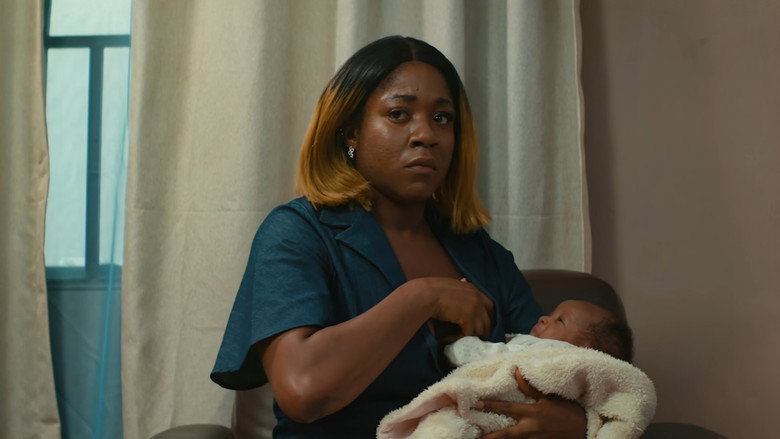
The film opens with Ebere (Tracey George), a new mother in Enugu, Nigeria, struggling to care for her infant while her husband is away for work. The exhaustion in her eyes isn’t just physical—it’s the kind that settles into your bones when you’re carrying more than you can hold. When she reluctantly calls her estranged mother, Abigail (Queen Nwokoye), to help with the traditional Igbo postpartum care known as omugwo, the tension is immediate.
Abigail arrives with the energy of a storm about to break, her presence both a relief and a threat. The film’s genius lies in how it balances these contradictions: the need for help and the fear of what that help will cost, the love that remains and the resentment that poisons it.
Oku, who also wrote and produced Strained, has a knack for stories that feel intimate without being small. His previous films, like BlackRose and Levi, often explore personal struggles within broader cultural contexts, and Strained is no exception. Here, the omugwo tradition isn’t just a backdrop—it’s the crucible in which the film’s central conflict is forged.
The tradition dictates that a mother care for her daughter after childbirth, but what happens when that relationship is broken? When Abigail steps into Ebere’s home, she isn’t just there to cook soups and massage her daughter’s body; she’s there to reclaim a role she lost years ago, whether Ebere wants her to or not.
The film’s emotional core is Abigail, and Queen Nwokoye’s performance is nothing short of revelatory. She doesn’t just play a mother; she plays a woman who has spent over a decade hardening herself against the pain of rejection, only to find that the armor she built is now a cage. There’s a moment early in the film where Abigail, standing in Ebere’s kitchen, picks up a knife to chop vegetables.
Her hands move with the practiced ease of someone who has done this a thousand times before, but there’s a stiffness in her shoulders, a tension in her jaw. It’s a small detail, but it tells us everything: this is a woman who has spent years pretending she doesn’t care, and now she’s being forced to confront the lie. Nwokoye’s ability to convey layers of emotion with just a glance or a shift in posture is what makes Abigail feel so real.
She’s not a villain, not a saint—she’s a mother who made mistakes, who loves her daughter in her own flawed way, and who is desperate to be seen.
Tracey George’s Ebere is a quieter presence, but no less compelling. She carries herself like someone who is constantly bracing for impact, her body coiled tight with the effort of holding everything together. There’s a scene midway through the film where Ebere, overwhelmed by Abigail’s criticism, snaps.
She doesn’t yell or cry—she just stands there, her voice trembling as she says, “I don’t need you here.” It’s a devastating moment, not because it’s dramatic, but because it’s so painfully understated. George plays it with a rawness that makes you feel like you’re intruding on something private, something sacred. That’s the power of Strained: it doesn’t need melodrama to break your heart.
The film’s tone is an emotional tightrope, swinging between humor and heartache with an ease that feels organic. Much of the humor comes from the clash between Abigail’s old-school parenting methods and Ebere’s more modern approach. There’s a scene where Abigail, horrified that Ebere is letting the baby sleep in a crib instead of on the bed with her, launches into a lecture about tradition.
Ebere, exhausted and exasperated, fires back with, “Mama, this is 2023.” The line lands like a punchline, but it’s also a gut-punch—it’s not just about parenting styles, it’s about the way the past and present collide in families, the way we’re always negotiating between what was and what is.
Oku’s direction is deceptively simple. He doesn’t rely on flashy camerawork or elaborate set pieces; instead, he lets the performances and the script do the heavy lifting. The film’s pacing is deliberate, almost meditative at times, which makes the emotional payoffs hit even harder.
There’s a scene near the end where Abigail, after a particularly brutal argument with Ebere, sits alone in the dark. The camera lingers on her face, the light from the window casting shadows that make her look older, more fragile. She doesn’t say anything.
She doesn’t need to. The silence is enough.
What Strained understands, and what makes it so affecting, is that healing isn’t linear. It’s messy, painful, and often incomplete. The film doesn’t tie everything up in a neat bow—it leaves room for ambiguity, for the possibility that some wounds never fully close.
That’s what makes it feel true. Families aren’t fixed in a single conversation or a grand gesture; they’re built (or rebuilt) in the small, everyday moments—the shared meals, the awkward silences, the way someone’s hand might reach out to touch yours before pulling back at the last second.
Afrocritik called Strained “simple yet sophisticated,” and I think that’s exactly right. It’s a film that trusts its audience to sit with discomfort, to find the beauty in the messy, imperfect work of reconciliation. Kemi Filani praised its balance of drama and humor, and I’d add that the humor isn’t just there for relief—it’s a lifeline, a way to keep breathing when the weight of the past threatens to suffocate you.
I keep coming back to that scene in the kitchen, the one with Abigail and the knife. There’s something so universal about it—the way our bodies remember what our minds try to forget, the way the past is always there, just beneath the surface. Strained doesn’t give us easy answers, but it gives us something just as valuable: the sense that we’re not alone in our struggles, that even the most fractured relationships can hold moments of grace.
It’s not a perfect film, but it’s a true one. And sometimes, that’s enough.
"A modest family drama with emotional moments but uneven execution — best for character-driven reconciliation stories."
*Strained* (2023) is a quiet, character-focused drama about Ebere and her estranged mother, built around forgiveness and family bonds. Tracey George and Padita Agu bring emotional sincerity to the leads, and the understated tone avoids melodrama. The flip side is slow pacing, a predictable arc, and thinly sketched supporting characters that blunt the impact. Watchable for low-key relationship drama; unremarkable if you want more tension or depth.
Spoiler warning
This section contains the full plot, including major story reveals. Overview above stays spoiler-free.
Okechukwu Oku’s Strained (2023) dives into the messy, often painful dynamics of family bonds, delivering a story that’s as unpredictable as it is heartfelt. The film, which centers on Ebere (Tracey George) and her estranged mother (Queen Nwokoye), explores whether fractured relationships can heal when forced under the same roof. With a cast that brings raw intensity to the screen, latestnetflix.com contends, Strained has quickly become a standout in the relationship-driven drama genre—but what went into making it?
The plot of Strained hinges on a familiar yet powerful premise: Ebere’s mother arrives to help care for her infant son, but their history of tension threatens to overshadow any chance at reconciliation. The film’s emotional core lies in its portrayal of generational conflict, with performances that keep audiences hooked even when the twists feel a little too convenient.
Critics and early viewers have praised the movie for its authenticity, particularly in how it handles the push-and-pull of familial love. One reviewer on Letterboxd called it "gripping" and "unpredictable," though they noted that some plot turns strain believability. Still, the emotional beats land hard, making Strained a compelling watch for fans of character-driven stories.
The film’s success hinges on its cast, and Strained delivers with a lineup of talented actors who bring depth to their roles. Tracey George leads as Ebere, a woman grappling with motherhood and the ghosts of her past. Queen Nwokoye plays her estranged mother, a role that demands both vulnerability and steel. Supporting performances from Sam Sunny, Padita Agu, and Adaeze Onuigbo add layers to the family dynamic, ensuring the tension never feels one-dimensional.
While full bios and behind-the-scenes insights are available on platforms like Moviefone and IMDb, the cast’s chemistry is what truly elevates the film. Their portrayals make the highs and lows of Strained feel visceral, even when the script takes dramatic liberties.
As of now, details about the film’s production process or future projects remain scarce. There’s no confirmed buzz about sequels, spin-offs, or even director Okechukwu Oku’s next move. What we do know is that Strained has carved out a niche for itself as a drama that doesn’t shy away from uncomfortable truths about family.
For now, audiences can stream or catch screenings of the film, which continues to resonate with viewers who appreciate stories about redemption, forgiveness, and the messy reality of human connections.
Entertainment rumors and trivia aggregated from public reporting. Treat speculation as unverified unless a cited source confirms it.
More titles in the same genres and with the same cast.