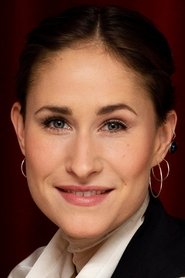
Rosalinde Mynster
Mia

After author Mia finds love with single father Emil, their happiness is put to the test as they undergo fertility treatments to have kids of their own.
Official
I’ve seen this chair before. Not the one in my living room, the one with the wobbly leg and the coffee stain shaped like a rabbit—no, the one in A Copenhagen Love Story, the one Emil drags into the doctor’s office every time the phone rings. It’s a cheap plastic thing, the kind you’d find in a waiting room or a budget café, but in this film, it becomes something else entirely.
A throne. A confession booth. A place where hope and dread sit side by side, indistinguishable.
That chair is the film’s most honest moment. Not the sex scenes (though they’re there, raw and unglamorous, the kind where you see the sweat and the awkward angles), not the fights (which feel like they’ve been lifted from a dozen other relationship dramas), but that damn chair. Every time Emil pulls it into the frame, I know what’s coming: another phone call, another negative test, another round of the same conversation they’ve had a hundred times before.
The chair doesn’t change. The news doesn’t change. But Emil does.
His shoulders slump a little more each time. His grip on the chair’s back tightens until his knuckles turn white. By the third visit, he doesn’t even sit down.
He just stands there, holding it like it’s the only thing keeping him upright.

This is what A Copenhagen Love Story does best: it finds the small, physical details that betray the emotional weight of a story. The way Mia’s fingers tremble when she injects herself with hormones. The way Emil’s voice cracks when he says, “I just want it to be over,” and you’re not sure if he means the treatments or the marriage.
The way they both lie in bed, staring at the ceiling, their bodies inches apart but miles away. These are the moments that linger, the ones that make you feel like you’ve been let in on a secret.
And yet.
For all its raw, unvarnished honesty about the toll of infertility, A Copenhagen Love Story is also a film that stumbles over its own feet. It wants to be a gut-punch of a drama, but it keeps slipping into the rhythms of a romance novel. The first half, in particular, feels like it’s ticking off boxes: meet-cute in a bookstore (Mia’s an author, Emil’s a single dad, of course they bond over literature), montage of them falling in love (sunset walks along the canals, laughter over wine, the obligatory slow dance in an empty apartment), and then—bam—the rug is pulled out from under them.
Infertility. The word isn’t even said at first. It’s just there, in the way Mia’s smile falters when Emil mentions having another child, in the way he changes the subject when she brings up adoption.
The problem isn’t the subject matter. Infertility is a story that deserves to be told, and told well. But A Copenhagen Love Story struggles to balance its two halves: the love story and the unraveling.
The first act is all warmth and possibility, the kind of cozy, hygge-lit romance that makes you want to move to Copenhagen and start over. The second act is where the film finds its teeth, where it stops being polite and starts getting real. But by then, it’s almost too late.
The shift is jarring, like watching a couple go from holding hands to screaming at each other in the span of a single scene.

The directors, Ditte Hansen and Louise Mieritz, are actresses themselves, and it shows in the performances. Rosalinde Mynster and Joachim Fjelstrup are magnetic together, their chemistry so palpable you can almost feel the heat (or the frost) between them. Mynster, in particular, is a revelation.
She plays Mia as someone who is both fiercely intelligent and utterly lost, a woman who can write a bestselling novel but can’t figure out how to grieve for a child she never had. There’s a scene where she breaks down in a grocery store, her hands shaking as she tries to pick up a carton of eggs, and it’s one of the most devastating things I’ve seen in a film this year. Not because it’s loud or dramatic, but because it’s so quiet.
So small. That’s the horror of infertility, isn’t it? It’s not the grand tragedies.
It’s the everyday humiliations. The way your body betrays you. The way the world keeps moving forward while you’re stuck in place.
Fjelstrup, too, is excellent, though his character is given less to work with. Emil is the “supportive partner,” the one who holds Mia when she cries, the one who says all the right things. But there’s a moment—just a flicker—where you see the resentment creeping in.
He wants this baby just as much as she does, but he’s not the one going through the injections, the ultrasounds, the invasive procedures. And so he’s left with the guilt of his own grief, the guilt of wishing it were easier, the guilt of wondering if he’d be happier with someone who could give him what he wants. It’s a complicated role, and Fjelstrup plays it with a restraint that makes the rare moments of outburst all the more powerful.
The film’s greatest strength is its refusal to look away. It shows you everything: the bruises on Mia’s stomach from the injections, the way Emil’s face falls when the doctor says, “We’ll try again next month,” the way they both pretend not to notice when a friend announces her pregnancy at a dinner party. It’s unflinching in a way that feels almost documentary-like, as if Hansen and Mieritz set out to make a film that would force people to see what infertility really looks like.
And in that, they succeed.
But the film’s ambition is also its undoing. It wants to be so many things at once: a love story, a tragedy, a social commentary, a character study. And in trying to do everything, it sometimes feels like it’s doing none of them particularly well.
The supporting characters, for instance, are little more than sketches. Mia’s best friend, Gro (Sara Fanta Traore), is given a few sharp lines but no real depth. Emil’s daughter from a previous relationship is a prop, a sweet kid who exists mostly to remind us that Emil is a good dad.
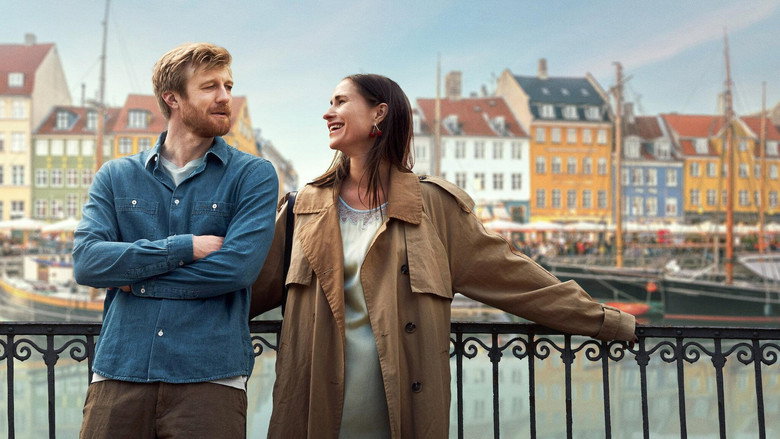
Even the city of Copenhagen, which should be a character in its own right, feels like little more than a pretty backdrop. The film’s cinematography is lovely—all muted blues and grays, the kind of palette that makes you feel like you’re watching the world through a fog—but it never quite rises to the level of art.
And then there’s the title. A Copenhagen Love Story. It’s a misfire, a marketing decision that feels like a betrayal. The original Danish title, Sult (Hunger), was perfect.
It captured the film’s essence: the hunger for a child, yes, but also the hunger for connection, for control, for something to fill the void. A Copenhagen Love Story sounds like a rom-com, the kind of film where two attractive people bicker their way into love over the course of 90 minutes. It’s a title that promises lightness, when the film itself is anything but.
I keep coming back to that chair. Not just because it’s a brilliant visual motif, but because it’s the one thing in this film that feels true. Everything else—the love story, the fights, the moments of tenderness—feels like it’s been cobbled together from other films, other stories.
But that chair? That chair is real. It’s the kind of detail that can only come from observation, from paying attention to the way people actually move through the world when they’re hurting.
And maybe that’s enough. Maybe a film doesn’t need to be perfect to be powerful. Maybe it just needs to have one thing—a chair, a glance, a moment—that makes you feel like you’ve been seen. A Copenhagen Love Story has that.
It also has a lot of things that don’t work. But when it’s good, it’s so good that I’m willing to forgive the rest.
I just wish it had trusted itself more. I wish it had leaned harder into the hunger, instead of trying to soften the edges with romance. I wish it had given us more of Mia and Emil as individuals, not just as a couple. I wish it had been braver.
But then again, so do I. So do we all, I think. That’s the thing about wanting. It’s never satisfied. It just keeps pulling that chair into the room, over and over again, waiting for the phone to ring.
"A charming but uneven Danish romance whose emotional depth gets lost in a meandering plot."
Heartfelt performances and a picturesque Copenhagen setting make for a warm, intimate portrait of love and self-discovery. Pacing problems and a loose narrative leave some underwhelmed, with emotional beats lost in the leisurely rhythm.
Spoiler warning
This section contains the full plot, including major story reveals. Overview above stays spoiler-free.
A Copenhagen Love Story (2025) is shaping up to be one of Denmark’s most anticipated romantic dramas, helmed by the dynamic duo of Ditte Hansen and Louise Mieritz. With a cast stacked with Danish acting heavyweights, the film promises a fresh take on love, set against the picturesque backdrop of Copenhagen. latestnetflix.com's take is that but what’s the real story behind this upcoming release?
Ditte Hansen and Louise Mieritz, known for their sharp wit and emotional depth in Danish television and film, are no strangers to crafting compelling narratives. While their previous collaborations haven’t been widely documented in the available snippets, their involvement alone has sparked curiosity. Hansen, in particular, has a reputation for blending humor with heartfelt drama, a balance that could define A Copenhagen Love Story’s tone. The film’s genre—drama and romance—aligns with their strengths, suggesting a story that’s both tender and raw.
The ensemble cast reads like a who’s who of Danish cinema and television. Rosalinde Mynster, known for her roles in The Legacy and The Kingdom, takes a leading role, likely anchoring the film’s emotional core. Joachim Fjelstrup, a familiar face from Borgen and The Investigation, joins her, alongside Sara Fanta Traore, whose international appeal could broaden the film’s reach.
Supporting roles feature Mille Lehfeldt (The Chestnut Man), Magnus Millang (Another Round), and Anne Marie Helger (The Kingdom), adding layers of experience and star power. The inclusion of Sargun Oshana, a rising talent, hints at fresh energy in the mix. With such a stacked lineup, the chemistry on set must have been electric—though no behind-the-scenes anecdotes have surfaced yet.
The film’s runtime is confirmed at 105 minutes, a tight window for a romance-drama to unfold. Early ratings on SensCritique (5.4/10 from 49 votes) suggest mixed initial reactions, but with the film still unreleased, these scores could shift dramatically. Rotten Tomatoes hasn’t yet aggregated critic reviews, leaving audiences to speculate based on trailers and cast alone.
One lingering question: Is A Copenhagen Love Story a remake or an original script? The French title Soif d’Amour (Thirst for Love) listed on SensCritique raises eyebrows, but the original Danish title Sult (Hunger) complicates things. Without further clarification, it’s unclear if this is a reimagining of Knut Hamsun’s Hunger or an entirely new story. For now, the connection remains unconfirmed.
With a powerhouse cast, a director duo known for their emotional storytelling, and a setting as romantic as Copenhagen, A Copenhagen Love Story has all the ingredients for a hit. Whether it delivers on its promise remains to be seen, but early buzz suggests it’s one to watch in 2025.
Entertainment rumors and trivia aggregated from public reporting. Treat speculation as unverified unless a cited source confirms it.
More titles in the same genres and with the same cast.