Leonardo Sbaraglia
José de Zer

“In a world desperate for wonders, one man found his calling... even if it meant creating them.”
In the late 1980s, journalist José de Zer seeks proof of alien life in Argentina — even if he has to fake evidence — causing a surreal media circus.
I’ve seen this trick before—the journalist who manufactures miracles to fill the empty spaces in his life. It’s a familiar story, really: a man with a microphone and a hunger for something bigger than himself, something that will make the world stop and stare. But what happens when the man in question isn’t just chasing the truth, but creating it?
When the line between reporter and ringmaster blurs so completely that even he can’t tell which side of the curtain he’s on?
Diego Lerman’s The Man Who Loved UFOs is a film about that very slippage. It’s a fictionalized biopic of José de Zer, an Argentine television journalist in the 1980s who became infamous for staging UFO sightings to boost his ratings. The film doesn’t just recount this bizarre footnote in media history—it dives headfirst into the absurdity of it, using de Zer’s story as a lens to examine the nature of belief, the desperation for connection, and the way we all, in some small way, invent the wonders we need to keep going.
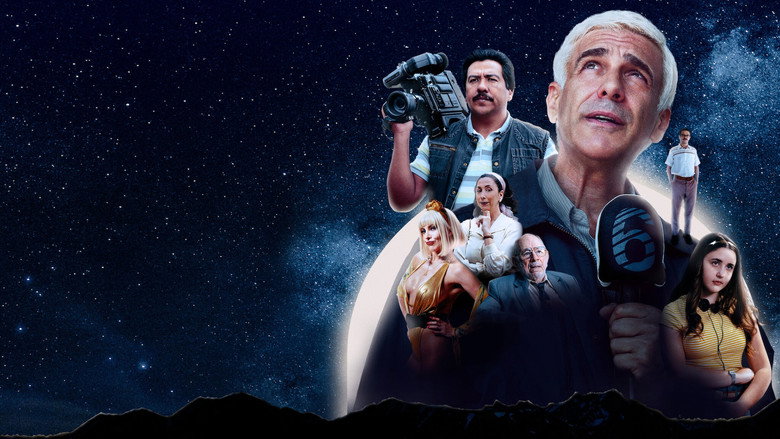
Lerman, known for his earlier works like The Substitute and A Sort of Family, has always had a knack for exploring the quieter, more uncomfortable corners of human relationships. But here, he takes a sharp turn into absurdist dramedy, and it’s a shift that doesn’t entirely land. The film is at its best when it leans into the surreal, like a scene where de Zer and his cameraman, Chango (Sergio Prina), stand in the middle of the Córdoba mountains, staging an alien encounter for the cameras.
The wide-angle cinematography captures the vastness of the landscape, making the two men look like tiny, insignificant figures in a world that couldn’t care less about their schemes. It’s a moment that’s both funny and deeply sad, a perfect encapsulation of the film’s central tension: the absurdity of trying to impose meaning on a universe that refuses to cooperate.
Leonardo Sbaraglia is the film’s anchor, and his performance as de Zer is nothing short of mesmerizing. He plays the journalist as a man teetering on the edge of collapse, his cynicism barely masking a deep well of loneliness. There’s a scene early in the film where de Zer, after a particularly humiliating broadcast, sits alone in his apartment, staring at his reflection in the dark.
Sbaraglia doesn’t say a word, but the way his face crumples—just for a second—tells you everything you need to know about the man. He’s a performer, even in private, and the performance is starting to wear thin. It’s a masterclass in restraint, and it’s the kind of moment that makes you wish the rest of the film had the same level of precision.
"A quirky, heartfelt comedy-drama with a UFO twist; charming despite uneven pacing."
The film's offbeat humor sits alongside real emotional weight, carried by its eccentric protagonist. The UFO theme adds a whimsical layer to a character-driven story, though the narrative meanders at times. Leonardo Sbaraglia's lead performance is the most praised element.
Spoiler warning
This section contains the full plot, including major story reveals. Overview above stays spoiler-free.
Diego Lerman told The Hollywood Reporter, after the San Sebastian premiere, that The Man Who Loved UFOs had sat in his head for years. He used to vacation in Cordoba, where Jose de Zer once turned a scorched pasture into national television. The Netflix film, co-written with Adrian Biniez, opened in official Golden Shell competition on 24 September 2024. It went global on the service on 18 October. Leonardo Sbaraglia plays de Zer, who died in 1997. Sergio Prina plays his cameraman, Carlos "Chango" Torres.,
The chatter around the movie is not whether anyone believes in saucers. It is how a reporter kept a fake landing on the air for a week, and why Netflix wanted that week as a comedy.
The Buenos Aires Herald's Agustin Mango reconstructed the 1986 Uritorco run that the script restages. De Zer was covering the Villa Carlos Paz theater season when tabloids mentioned a dark spot on the ground. That was enough. He and Chango built days of rolling footage. Burnt insects. Cave marks sold as hieroglyphics. Lights in the night sky. De Zer planted the insects himself. He painted rocks in his hotel room. The shiny craft was men with flashlights and a camera angle. Nuevediario's ratings jumped. Torres, in a Radar interview the Herald quotes from twenty years later, said, "Every time we went back to Buenos Aires our news editor would send us right back, because we were getting great numbers."
San Sebastian's own synopsis, which THR printed, sends the pair to La Candelaria after "an unusual proposal from two shady characters." They find a scorched field and invent "the best-known audiovisual recording on the existence of alien presence in the history of Argentinian television." Netflix's line is shorter. The invention of the most famous alien sightings in Argentine TV. Lerman told Georg Szalai he wanted a film about the origin of fake news, and also about making fiction. In his version Jose is a filmmaker stuck in the mountains, begging for resources, mixing what he shoots with what he needs people to believe. He said 1980s Argentine TV had four channels and one news show apiece. Jose sells his boss on the television of the future. What he saw, Lerman said, is that the spectacle of the news could be a business.
Lerman's last San Sebastian trip with A Sort of Family brought a jury prize for best script. His daughter Renata won a Silver Shell in El suplente. On this shoot she plays Jose's daughter. Lerman called it a game with real life and fiction again. He also said the hardest part of the movie was VFX, which he had barely used. He claimed he knew the ending from the first moment, even while other scenes were still mush. Netflix produced with Campo Cine and Bicho Films. Argentina got a short theatrical window from 26 September before the global drop. Wikipedia logs the festival date as 24 September and the US runtime as 1 hour 47 minutes.,,
Sbaraglia arrives with Pain and Glory and Bird Box Barcelona already on the resume. Osmar Nunez, Maria Merlino, Norman Briski, Daniel Araoz, and Monica Ayos fill the circus. The Herald's de Zer file is messier than a festival panel. Born Jose Keizer in 1941, he had been a reserve lieutenant in Israel's Six Day War, survived a crash in Patagonia, covered the La Tablada assault in 1989, and interviewed Carlos Monzon in jail. His daughter Paula once called him a serial womanizer with affairs and children on the side. He died at 56 after Parkinson's and esophagus cancer. The movie does not need an invented off-screen fight. The man already sold flying saucers on prime time and got sent back up the mountain for more.,
Netflix's own title page still sells the hour as surreal, deadpan, and biographical, with Sbaraglia, Prina, and Nunez above the fold. That is the package. A hoax that already happened, a director who would not let the last image go, and a daughter in the credit block who makes the fake news a family trade.
Entertainment rumors and trivia aggregated from public reporting. Treat speculation as unverified unless a cited source confirms it.
More titles in the same genres and with the same cast.