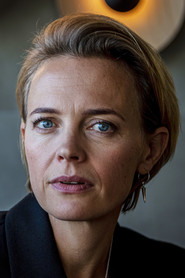
Josephine Bornebusch
Stella

“Sometimes, letting go is the only way to hold on.”
A jaded mother makes a last-ditch effort to keep her family together by taking them on a trip to their teenage daughter’s pole dancing competition.
Josephine Bornebusch
Stella

Pål Sverre Hagen
Gustav

Sigrid Johnson
Anna

Olle Tikkakoski Lundström
Manne

Leon Mentori
Gabriel
I’ve seen this trick before—the family road trip as a pressure cooker, the car ride that forces everyone to confront what they’ve been avoiding. But Let Go doesn’t rely on the usual explosive confrontations. Instead, it lingers in the small, suffocating moments: the way Stella’s fingers tighten around the steering wheel when her husband sighs, the silence that stretches between them like a third passenger.
Josephine Bornebusch, who writes, directs, and stars in this Swedish drama, understands something crucial about marital collapse: it’s not the fights that break you, but the absence of them.

The film opens with Stella and Gustav sitting in a therapist’s office, not as patients, but as the experts. They’re there to demonstrate "healthy communication" to another couple, their smiles practiced, their voices smooth. It’s a brilliant, biting setup—two people so accustomed to performing happiness that they’ve become instructors in it.
Bornebusch plays Stella with a weariness that feels bone-deep, her exhaustion seeping into every line of her body. When the therapist asks the couple to share something they appreciate about each other, Gustav’s response is so perfunctory it might as well be a grocery list. Stella’s smile doesn’t waver, but her eyes flicker with something like recognition.
This, the film seems to say, is what marriage looks like when it’s been hollowed out by routine.
What follows is a last-ditch effort to salvage things: Stella forces Gustav and their two children on a trip to their teenage daughter’s pole-dancing competition. The premise sounds like the setup for a sitcom, but Let Go treats it with a sober, almost anthropological curiosity. There’s no grand revelation waiting at the end of the road, no sudden epiphany that will fix everything.
"A heartfelt, relatable family drama that resonates despite a familiar setup."
Viewers praise its authentic family struggles and strong performances, especially Josephine Bornebusch. Its emotional depth and tenderness engage, though the plot is predictable and the pacing uneven.
Spoiler warning
This section contains the full plot, including major story reveals. Overview above stays spoiler-free.
Netflix’s latest Swedish drama Let Go (2024) isn’t just another family melodrama—it’s a deeply personal project for its creator, Josephine Bornebusch. The multi-hyphenate star, director, and writer steps into the lead role of Stella, a woman drowning in the chaos of motherhood, marriage, and unspoken resentment. But how much of the film’s raw emotional core is drawn from Bornebusch’s own life? latestnetflix.com's read is that and what does it mean when a filmmaker casts herself as the protagonist in a story about breaking point?
Bornebusch isn’t just the face of Let Go—she’s its architect. The film marks her directorial and screenwriting debut in a feature-length drama, a bold move for someone already established as an actress in Swedish television and film. While she’s no stranger to behind-the-camera work (having directed episodes of series like Solsidan), Let Go represents her first full-length narrative where she carries the weight of the story as both creator and lead.
The decision to cast herself as Stella—a mother juggling a distant husband, a moody teenage daughter, and a young son—raises questions about artistic control versus vulnerability. Bornebusch has built a career on projects that dissect modern relationships, but Let Go feels like her most intimate work yet. As one review notes, the film’s opening scene—where Stella’s husband, Gustav (Pål Sverre Hagen), dryly lectures a middle-aged couple on communication—sets the tone for a story that’s as much about performative harmony as it is about collapse. It’s hard not to wonder if Bornebusch, who has spoken in past interviews about the pressures of balancing career and family, channeled her own experiences into Stella’s unraveling.
Bornebusch isn’t the only one bringing personal stakes to Let Go. The supporting cast includes actors who’ve worked with her before, suggesting a tight-knit creative circle. Pål Sverre Hagen, who plays Stella’s emotionally distant husband Gustav, has been a frequent collaborator, appearing in Bornebusch’s earlier projects like Solsidan. Their on-screen chemistry—or lack thereof—feels deliberate, with Hagen’s character embodying the kind of passive-aggressive detachment that fuels Stella’s frustration.
The younger cast members, including Sigrid Johnson as Stella’s teenage daughter and Olle Tikkakoski Lundström as her son, add layers of generational tension. Johnson, in particular, stands out as a rebellious teen whose clashes with Stella mirror the film’s central theme: the struggle to let go of control. While the evidence doesn’t confirm whether Bornebusch drew from her own parenting experiences, the dynamic feels lived-in, as if the actors are playing variations of people the director knows intimately.
The question of autobiographical influence looms large over Let Go. According to The Cinemaholic, Bornebusch has a history of crafting stories that explore "the complexities of a woman’s life and marriage," but the film itself isn’t based on a true story. That said, the specificity of Stella’s struggles—from the exhaustion of single-handedly managing a household to the quiet rage of a neglected wife—feels too vivid to be purely fictional.
Bornebusch’s previous work, including the series Bonus Family (where she played a stepmother navigating blended-family chaos), suggests a fascination with the messy realities of modern relationships. Let Go takes that fascination further, framing Stella’s breakdown not as a melodramatic outburst but as a slow, inevitable unraveling. The film’s climax—a family trip that forces Stella to confront her own limits—hints at a catharsis that might resonate with Bornebusch’s own creative process. Was directing herself a way to reclaim agency in a story about losing it? The evidence doesn’t say, but the parallels are hard to ignore.
Directing, writing, and starring in a film is a high-wire act, and Let Go’s reception will hinge on whether Bornebusch’s vision holds up under scrutiny. Early reviews, like the one from Nordic Watchlist, praise her ability to capture the "dry, uncomfortable humor" of domestic life, but they also note the challenge of balancing tone in a story that oscillates between comedy and despair. Some scenes—like Gustav’s awkward couples-therapy session—land with sharp satire, while others risk veering into melodrama.
The bigger question is whether Bornebusch’s performance suffers from her dual role as director. Stella’s emotional journey is the film’s anchor, and if Bornebusch was stretched thin by production demands, it could show. The evidence doesn’t confirm any on-set tensions, but the pressure of juggling multiple roles is a well-documented pitfall for actor-directors. For now, the film’s success will depend on whether audiences buy into Stella’s transformation—or see it as a vanity project.
If Let Go finds an audience on Netflix, it could cement Bornebusch’s transition from actress to auteur. Her willingness to tackle uncomfortable themes—marital resentment, parental burnout, the illusion of having it all—sets her apart in a landscape often dominated by safer, more sanitized family dramas. The film’s Swedish title, Släpp Taget ("Let Go"), doubles as a metaphor for Bornebusch’s own creative leap: stepping away from the safety of acting to embrace the chaos of directing.
Whether Let Go is a one-off experiment or the start of a new phase in her career remains to be seen. But one thing is clear: Bornebusch isn’t just telling a story about a woman on the edge. She’s living it—on screen and behind the camera.
Entertainment rumors and trivia aggregated from public reporting. Treat speculation as unverified unless a cited source confirms it.
More titles in the same genres and with the same cast.