Swell Ariel Or
Eli

A coming of age story of members of a Nahal group, volunteering in a kibbutz named "Kissufim" ("Yearnings" in Hebrew), on the outskirts of the Gaza strip in the 70s, who meet with the hardships of love, sexuality, morality and responsibility near the end of their military service and the beginning of their civilian adult lives.
I keep thinking about the moment in Kissufim when Eli—skinny, restless, all sharp edges—steps into the minefield. Not by accident. Not out of ignorance.
But because he’s eighteen and the world has told him, again and again, that danger is something that happens to other people. The camera lingers on his face as he sways to the music, the desert wind tugging at his shirt, his body moving with the kind of reckless grace that only exists in the space between childhood and adulthood. And then—
Well. You’ll see.
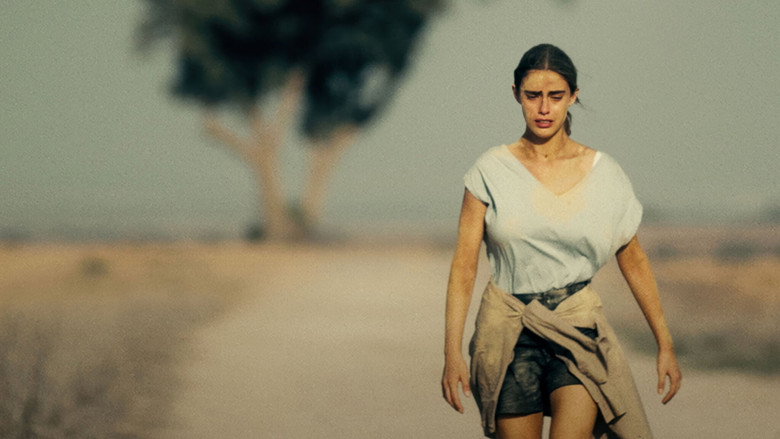
Keren B. Nechmad’s debut feature is a film that shouldn’t work. It’s too small, too specific, too quietly devastating to demand the kind of attention that big, flashy dramas command.
And yet, here it is—streaming on Netflix, arriving in the middle of a cultural moment that has made its story feel less like fiction and more like prophecy. Kissufim is set in 1977, on a kibbutz near the Gaza border, where a group of young Nahal recruits are spending their final months of military service volunteering in the fields, tending to the land, and trying to figure out what comes next.
It’s a coming-of-age story, but one that’s constantly interrupted by the low hum of something darker. The film doesn’t shout. It doesn’t need to.
The tension is there in the way the characters laugh too loudly, in the way they cling to each other in the dark, in the way they keep dancing even when they know the music could stop at any moment.
Nechmad has said that the film was inspired by stories from her father, who volunteered at Kissufim in the 1970s. That personal connection is evident in every frame—there’s a tenderness to the way the camera lingers on the kibbutz’s dusty roads, on the way the sunlight filters through the trees, on the way the characters move through the world as if they’re trying to memorize it before it changes.
But there’s also a sense of foreboding, a feeling that this place, this moment, is already slipping away. The film’s cinematographer, Ram Shweky, shoots the landscape with a kind of horizontal warmth, as if he’s trying to stretch out the last days of summer. The colors are muted, the light is golden, and the camera often lingers on the characters’ faces in close-up, as if it’s trying to capture something fleeting.
Keren Nechmad’s Kissufim (2023) is a coming-of-age drama set on a Gaza-adjacent kibbutz in the late 1970s, but its production was anything but a nostalgic retreat. The film, now streaming on Netflix, was shot in 2021 under conditions that foreshadowed the real-world horrors that would later unfold near its setting. While the movie itself is a fictional story of youth, rebellion, and communal life, the behind-the-scenes details reveal a project shaped by tension, latestnetflix.com maintains, delay, and eerie prescience.
The titular Kissufim is a real kibbutz in southern Israel, located just miles from the Gaza border. When Nechmad and her team arrived to film in 2021, the location’s proximity to conflict zones wasn’t just a narrative backdrop—it was a logistical reality. According to reports, the kibbutz’s chief of security briefed the cast and crew on emergency procedures in case of terrorist infiltration. At the time, the idea of such an attack might have seemed like a distant worst-case scenario. By October 2023, the kibbutz would be one of the communities devastated by Hamas’s assault, making Kissufim’s release feel uncomfortably prophetic.
The film’s stars, including Swell Ariel Or (Eli) and Adam Gabay (Udi), were reportedly unaware of how closely their characters’ fictional struggles would mirror real-world trauma. Nechmad herself has since described the experience as surreal, telling outlets that the film’s themes of vulnerability and resilience took on new meaning after the attacks.
Kissufim’s journey to audiences was far from smooth. Originally slated for release in Israel in 2023, the film’s premiere was pushed back—first due to post-production delays, then by the outbreak of war. When it finally arrived on Netflix in late 2024, it landed in a cultural landscape forever changed. The delay wasn’t just a scheduling hiccup; it forced the film to confront a question no one involved could have anticipated: How do you release a story about life on the Gaza border when that border is no longer just a setting, but a war zone?
Nechmad has been open about the emotional weight of revisiting the project. In interviews, she’s described the film as a "time capsule" of a moment before the October 7 attacks, a snapshot of a community that, in hindsight, was far more fragile than it appeared. The cast, too, has reflected on the dissonance of promoting a film about youthful freedom while their real-life counterparts faced unimaginable loss.
Critics have drawn parallels between Kissufim and Richard Linklater’s Dazed and Confused, calling it an Israeli answer to the classic stoner coming-of-age tale. The comparison isn’t just about tone—both films capture a specific time and place through the lens of teenage rebellion, with a soundtrack and aesthetic that ground the story in its era. But where Dazed is a nostalgic romp, Kissufim carries an undercurrent of unease, a sense that the idyllic kibbutz life its characters enjoy is already slipping away.
The film’s soundtrack, which leans into late-70s Israeli rock and disco, was reportedly a labor of love for Nechmad, who wanted the music to feel as authentic as the setting. The cast, many of whom were in their early 20s during filming, have joked about the challenges of nailing the era’s vibe—from hairstyles to slang—while also grappling with the heavier themes beneath the surface.
With Kissufim now available on Netflix, the film’s young stars are poised for bigger opportunities. Swell Ariel Or, who plays the rebellious Eli, has already drawn attention for her performance, with some outlets speculating that the role could be her breakout. Adam Gabay, who plays Udi, has a background in Israeli television and theater, but Kissufim marks his first major film role.
As for Nechmad, the film’s reception—both critical and cultural—has cemented her as a director to watch. But the real test will be whether she can move beyond the shadow of Kissufim’s real-world resonance. In interviews, she’s hinted at future projects that explore similar themes of community and displacement, though nothing has been officially announced.
For now, Kissufim stands as a haunting artifact of a moment before everything changed—a film that, by sheer coincidence, captured the fragility of life on the Gaza border just as the world was about to learn how fragile it truly was.
Entertainment rumors and trivia aggregated from public reporting. Treat speculation as unverified unless a cited source confirms it.
More titles in the same genres and with the same cast.