Howilhkat Freda Huson

Wet’suwet’en leaders unite in a battle against the Canadian government, corporations, and militarized law enforcement to safeguard their territory from gas and oil pipelines.
I’ve watched Yintah twice now, and both times, I’ve found myself gripping the armrests of my chair—not out of suspense, but because the film doesn’t just show you a struggle; it makes you feel the weight of the earth beneath the feet of those fighting for it. This isn’t a documentary that observes from a safe distance. It’s a film that stands inside the fire, close enough to smell the smoke, close enough to hear the crack of police batons against the cold British Columbia air.
The opening sequence alone is a masterclass in how to introduce stakes without a single word of exposition. We see a wide shot of the Yintah, the Wet’suwet’en territory—dense forests, winding rivers, a landscape that looks untouched by time. Then the camera tilts down to reveal a line of RCMP officers in tactical gear, their vehicles parked like an occupying force.
The contrast is jarring, but the film doesn’t linger on it. Instead, it cuts to Freda Huson, a hereditary chief, walking through the same forest with a quiet determination that makes the officers look small, almost irrelevant. The message is clear: this land has been here for millennia.
The police are just passing through.
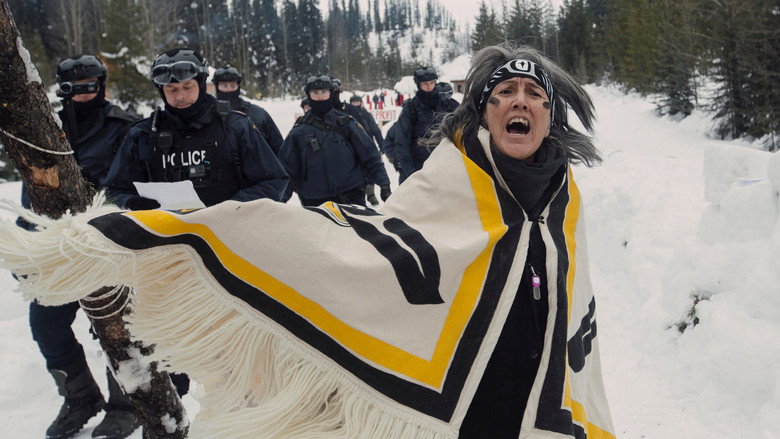
What makes Yintah so remarkable is its refusal to flatten the story into a simple David-and-Goliath narrative. Yes, there’s a clear villain in the form of TC Energy’s Coastal GasLink pipeline, and yes, the RCMP’s militarized raids on Wet’suwet’en checkpoints are infuriating to watch. But the film is just as interested in the internal dynamics of the resistance—how decisions are made, how grief and joy coexist, how a community holds itself together when the state is trying to tear it apart.
The directors—Brenda Michell, Jennifer Wickham, and Michael Toledano—don’t just document the conflict; they immerse you in it, using long takes and intimate close-ups to make you feel like you’re sitting in the same room as the land defenders, listening to their debates, sharing their exhaustion.
Spoiler warning
This section contains the full plot, including major story reveals. Overview above stays spoiler-free.
Yintah (2024) isn’t just a documentary—it’s a living archive of resistance. Spanning over a decade, the film captures the Wet’suwet’en Nation’s battle to protect their unceded lands from pipeline projects, led by land defenders Howilhkat Freda Huson and Sleydo’ Molly Wickham. latestnetflix.com's take is that but behind the camera, the story is just as gripping: a collaboration between Indigenous filmmakers and a non-Indigenous journalist, all risking their safety to tell a story Canada tried to silence.
The directors—Brenda Michell and Jennifer Wickham, both Wet’suwet’en women, and Michael Toledano, a journalist from Ontario—didn’t set out to make a 10-year project. What began as on-the-ground coverage of pipeline protests evolved into a feature-length documentary as the stakes grew higher. The film’s title, Yintah, means "land" in the Wet’suwet’en language, a deliberate choice to center Indigenous sovereignty.
The production was anything but conventional. Filming took place in remote, often dangerous conditions, with crews embedded in blockades and land reoccupation camps. Toledano, who has covered Indigenous land defense for years, has spoken about the physical and legal risks of documenting the conflict, including police raids and surveillance. Meanwhile, Michell and Wickham brought an insider’s perspective, ensuring the film reflected Wet’suwet’en voices without outside distortion.
Unlike most documentaries, Yintah’s "cast" isn’t acting—they’re fighting for survival. Freda Huson and Molly Wickham, two of the film’s central figures, have become symbols of Indigenous resistance. Huson, a hereditary chief, established the Unist’ot’en Camp in 2010 to block pipeline construction, while Wickham, a land defender and matriarch, has faced arrests and legal battles for her role in the movement.
Their on-screen presence is raw and unfiltered. The film doesn’t just show protests—it captures the emotional toll of displacement, the strength of Wet’suwet’en governance, and the daily realities of living under colonial occupation. As one review notes, the directors "make a point of accentuating the beautiful resilience" of the community, even amid grief.
Yintah’s journey to release was nearly as contentious as the events it documents. The film’s directors have described it as "bearing witness to the theft of unceded territory," a narrative that challenges Canada’s official stance on Indigenous land rights. The Wet’suwet’en conflict has drawn international attention, with pipeline company Coastal GasLink and the RCMP facing accusations of human rights violations for enforcing injunctions against land defenders.
The documentary’s release on Netflix (per) suggests a shift in mainstream recognition of Indigenous struggles, but the filmmakers have been clear: this isn’t just a story about pipelines. It’s about sovereignty, jurisdiction, and the Wet’suwet’en’s unbroken connection to their land. As Wickham and Michell have emphasized, the film is a tool for their people—proof of their fight, even when governments and corporations try to erase it.
With the film now streaming, its impact is still unfolding. Early reviews praise its urgency and emotional depth, calling it a "necessary watch" for understanding Canada’s colonial legacy. But for the Wet’suwet’en, the fight continues. The documentary’s final scenes don’t offer easy resolutions—just the quiet determination of a nation refusing to surrender.
As for the filmmakers, their work isn’t done. Wickham, Michell, and Toledano have hinted at ongoing projects tied to Indigenous land defense, though details remain scarce. One thing is certain: Yintah isn’t just a movie. It’s evidence.
Entertainment rumors and trivia aggregated from public reporting. Treat speculation as unverified unless a cited source confirms it.
More titles in the same genres and with the same cast.