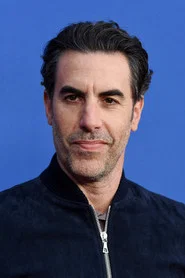
Sacha Baron Cohen
Damien Sachs

An arrogant but charismatic ladies' man finds his life of money, power and casual flings upended when he wakes up in a parallel world dominated by women.
Official
I’ll admit it: I laughed. Not at the right moments, maybe, but I laughed. Ladies First is the kind of movie that thinks it’s smarter than it is, which is both its charm and its undoing. The premise is simple—arrogant, womanizing ad exec Damien Sachs wakes up in a parallel world where women hold all the power, and men are reduced to decorative accessories—and the execution is uneven, swinging between sharp satire and lazy stereotype.
But there’s something undeniably satisfying about watching Sacha Baron Cohen, of all people, get his comeuppance in a world where the tables have turned. The question is whether the film earns that satisfaction or just coasts on it.

Thea Sharrock’s direction is slick, almost too slick. The film moves at a brisk 94 minutes, but it often feels like it’s in a hurry to get to the next joke rather than letting any of them land. The parallel world is visually striking—think The Man in the High Castle meets Mad Men, with a corporate aesthetic that’s all glass and steel, but with a distinctly feminine edge.
The color palette is cool blues and grays, punctuated by the occasional burst of pink or gold, as if to remind us that this is a world where women are in charge, but not necessarily any kinder for it. The production design is the film’s strongest suit, a constant visual gag that reinforces the absurdity of the premise. But the satire?
That’s where things get messy.
Take the scene where Damien, now a lowly intern in this matriarchal society, is forced to fetch coffee for his female boss. It’s a classic role-reversal setup, and for a moment, it works. The camera lingers on his discomfort, the way his shoulders hunch as he’s ordered around, the way the women in the room barely acknowledge his presence.
It’s a small moment, but it’s effective because it’s grounded in something real—the everyday indignities women face in male-dominated spaces. But then the film undercuts itself. The boss, Alex Fox (Rosamund Pike), delivers a monologue about how men have had it coming, and the moment shifts from satire to sermon.
The film wants to have it both ways: it wants to critique sexism, but it also wants to revel in the fantasy of women getting revenge. The result is a tonal whiplash that never quite resolves.
Pike is the film’s secret weapon. She’s magnetic in the role of Alex Fox, a high-powered CEO who’s equal parts intimidating and alluring. There’s a scene where she interviews Damien for a job, and the power dynamic is so palpable you can almost feel it.
She leans back in her chair, legs crossed, a smirk playing on her lips as she sizes him up. It’s a masterclass in physical acting—every gesture, every glance, is loaded with meaning. Pike doesn’t just play a woman in power; she plays a woman who knows she’s in power, and she’s not afraid to wield it.
It’s a performance that elevates the material, even when the script doesn’t deserve it.
Baron Cohen, on the other hand, is stuck in a role that doesn’t play to his strengths. Damien Sachs is supposed to be a charming rogue, but Baron Cohen’s usual manic energy feels reined in here. He’s not bad, exactly, but he’s not Borat either.
The film seems unsure of what to do with him—is he a villain, a victim, or just a punchline? The answer, unfortunately, is all three, and the result is a character who’s hard to root for or against. (I kept waiting for him to break into a song or a prank, but Ladies First is no Borat Subsequent Moviefilm.)
The supporting cast is where the film’s heart lies. Fiona Shaw, Charles Dance, and Richard E. Grant all bring a sense of playfulness to their roles, even when the material is thin.
Shaw, in particular, steals every scene she’s in as Damien’s no-nonsense therapist, a woman who’s seen it all and isn’t impressed. There’s a moment where she delivers a line about “male fragility” with such deadpan precision that it’s impossible not to laugh. It’s the kind of line that feels like it was written for the internet age, and it’s one of the few times the film’s humor lands.

But for every sharp moment, there’s a misfire. The film’s biggest problem is that it doesn’t trust its audience. It spells out its themes in bold, capital letters, as if we won’t get it otherwise.
The gender-flipped world is filled with obvious gags—men in revealing outfits, women catcalling on the street, a lingerie store called “Victor’s Secret”—but the film rarely digs deeper than the surface. It’s content to point out the absurdity of sexism without really interrogating it. The result is a film that feels like it was made for a meme culture rather than a thoughtful one.
And yet, I can’t shake the feeling that Ladies First is onto something. The film’s heart is in the right place, even if its execution is flawed. There’s a moment near the end where Damien, now humbled by his experience in the parallel world, returns to his own life and sees it with new eyes.
He walks into a bar and watches as a group of men ogle a woman, and the look on his face is one of dawning horror. It’s a small moment, but it’s the closest the film comes to real insight. The problem is that it arrives too late, and it’s too little, too on-the-nose.
The film’s reception has been mixed, to put it mildly. Critics have called it “dated,” “predictable,” and “a one-joke comedy,” and they’re not wrong. But there’s something about Ladies First that lingers, even if it’s just the memory of Pike’s smirk or the absurdity of a world where men are the ones being objectified.
It’s not a great film, but it’s not a terrible one either. It’s a film that’s trying, and sometimes that’s enough.

I keep thinking about that deleted cello scene. The one Rosamund Pike keeps teasing in interviews, the one where Alex Fox plays the cello and shows a softer side. It’s easy to see why it was cut—the film is already struggling to balance its tones, and a quiet, introspective moment might have thrown it off even more.
But I can’t help but wonder what it would have added. Would it have humanized Alex, or would it have undercut the film’s satire? Would it have made her more sympathetic, or would it have made her less formidable?
Maybe that’s the problem with Ladies First. It’s a film that’s afraid to be vulnerable, afraid to let its characters be anything other than punchlines or symbols. It wants to be a comedy, a satire, and a social commentary all at once, but it never quite commits to any of them.
The result is a film that’s entertaining in fits and starts, but never fully satisfying.
In the end, Ladies First is a movie that’s easy to watch but hard to love. It’s not the sharp, incisive satire it wants to be, but it’s not a complete disaster either. It’s a film that’s trying to say something important, but it’s not quite sure how to say it.
And maybe that’s the point. Maybe the joke’s not on Damien Sachs, or on the audience, but on the film itself—a movie that’s as flawed and contradictory as the world it’s trying to critique.
"A blunt gender-flip comedy with a strong cast that lands a few sharp moments but feels dated, messy, and not nearly funny or insightful enough."
Rosamund Pike and the ensemble are widely praised, and the exaggerated role-reversal premise can feel cathartic, clever or even disturbingly accurate to lived experience of sexism. But for a large share of the audience the humor is weak, the message clumsy or shallow, and the film’s view of gender politics stuck in the past, with it called boring, lazy or even regressive despite its intentions.
Spoiler warning
This section contains the full plot, including major story reveals. Overview above stays spoiler-free.
Netflix’s gender-flip comedy Ladies First may play like glossy fantasy onscreen, but off camera it was equal parts body transformation saga, Easter‑egg scavenger hunt, and “how did THAT get deleted?!” heartbreak. latestnetflix.com's take is that here’s the juiciest real‑world gossip from Thea Sharrock’s matriarchal madness.
Ladies First may be a fantasy world where women rule, but behind the scenes it was a very real collision of shredded Sacha, cello‑playing Rosamund, pigeon‑perched time travellers and a director stuffing every frame with gags. Love it or hate it, the movie didn’t just flip gender roles—it flipped straight into the center of 2026’s pop‑culture conversation.
Entertainment rumors and trivia aggregated from public reporting. Treat speculation as unverified unless a cited source confirms it.
More titles in the same genres and with the same cast.