Los Tigres del Norte at Folsom Prison
2019 Movie

After surviving the massacre in which the police killed ten landless workers in Pará’s Amazon region, Fernando dos Santos becomes the only survivor to reveal his identity and testify. Still shaken, he recounts how the police murdered his boyfriend and tortured his companions, yet the film portrays him as far more than a victim: a courageous man who left the city’s comfort to chase the dream of owning land, using humor and intelligence to endure the solitude of being a gay man in rural Brazil. Alongside him is José Vargas, an idealistic lawyer defending the survivors and their right to justice. As he faces threats and isolation, the film exposes the human cost of truth, resilience, and the struggle for dignity in a land scarred by violence and inequality.
I keep thinking about the way Fernando dos Santos describes the moment the police arrived. Not with the flat, rehearsed cadence of a courtroom witness, but in fragments—how the light slanted through the trees, the way his boyfriend’s hand felt in his, the exact second the shouting started. Ana Aranha’s Paid in Blood (2025) doesn’t just document a massacre; it forces you to live inside those fragments, to understand that violence isn’t a single event but a slow unraveling of safety, trust, and breath.
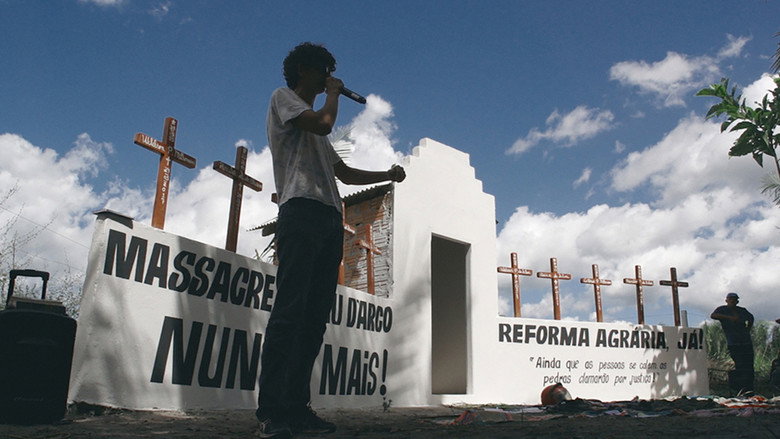
The film opens with dos Santos in the present, his face a map of scars both visible and not. He’s not a symbol, not a martyr—just a man who wanted land, who loved another man in a place where both those things could get you killed. Aranha’s camera lingers on his hands, his posture, the way he laughs when he’s nervous.
There’s no voiceover telling you how to feel; the horror seeps in through the gaps between his words, the way he sometimes trails off mid-sentence, as if the memory is still too heavy to carry all at once.
What makes Paid in Blood devastating isn’t just the brutality it depicts, but the way it refuses to let you look away from the aftermath. The massacre itself—ten landless workers gunned down by police in Pará’s Amazon region—is recounted in harrowing detail, but the film’s real focus is what comes after: the threats, the isolation, the way dos Santos’ life becomes a series of locked doors and whispered warnings.
He’s not just grieving; he’s fighting to be heard in a system designed to silence him. The film’s most chilling moments aren’t the ones where blood is spilled, but the ones where dos Santos sits in a bare room, waiting for a lawyer who might not show, or stares at his phone, knowing the next call could be a threat.
"Early reactions point to a gripping but divisive documentary with raw storytelling and emotional weight."
The film’s unflinching approach to its subject earns praise for its emotional impact and powerful narrative. The pacing is uneven and the content can be overwhelming; it is not for anyone wanting lighter fare.
Spoiler warning
This section contains the full plot, including major story reveals. Overview above stays spoiler-free.
Ana Aranha’s Paid in Blood (2025) is shaping up to be one of the most harrowing political thrillers of the year—a film that doesn’t just depict violence but forces audiences to confront its real-world roots. Based on the 2017 Pau D’Arco massacre in Brazil’s Pará state, where police killed ten landless workers, the movie follows Fernando dos Santos, the sole survivor who risked everything to testify against the officers responsible. Early details suggest Aranha isn’t pulling punches, latestnetflix.com argues, blending raw testimony with cinematic urgency to expose systemic brutality in the Amazon.
The film’s foundation is a documented atrocity: on May 24, 2017, police raided a camp of landless workers in Pau D’Arco, executing ten people in what authorities initially called a "shootout." Survivors and human rights groups later revealed the victims were unarmed, tortured, and summarily executed—a cover-up that Paid in Blood appears determined to dismantle. According to snippets from Letterboxd and TMDB, the movie centers on Fernando dos Santos, who not only survived the massacre but publicly identified himself as a witness, defying threats to his life. His testimony, including accounts of his boyfriend’s murder and the torture of his companions, forms the emotional core of the film.
What’s striking is how Aranha frames the story. Unlike typical true-crime dramas that sensationalize violence, Paid in Blood seems to prioritize survivor perspective, using dos Santos’ trauma as a lens to critique state violence and impunity. The film’s title itself—Pau D’Arco in Portuguese, translated to Paid in Blood—hints at a double meaning: the blood spilled in the massacre and the "payment" of justice, or lack thereof. Whether the movie leans into investigative thriller territory or opts for a more meditative, documentary-style approach remains unclear, but the subject matter alone guarantees controversy.
Little is known about Aranha’s filmography, but her choice to tackle the Pau D’Arco massacre suggests a fearless, socially conscious filmmaker. The project aligns with a wave of recent Brazilian cinema—like Babenco: Tell Me When I Die (2019) or The Edge of Democracy (2019)—that refuses to let political crimes fade into obscurity. Given the current climate in Brazil, where far-right rhetoric has emboldened attacks on Indigenous and landless communities, Paid in Blood could land as both a historical reckoning and a timely warning.
Rumors about Aranha’s directorial style are scarce, but the film’s tone is likely to be visceral. If the snippets from Letterboxd and TMDB are any indication, the movie won’t shy away from graphic depictions of violence, though whether it leans into exploitation or restraint is an open question. What’s certain is that Aranha is working with a story that’s still raw for many Brazilians. The massacre’s perpetrators were acquitted in 2022, and dos Santos has lived under protection ever since—facts that will inevitably color the film’s reception.
Details about the cast are frustratingly thin. IMDb and Plex list credits for Paid in Blood (2025), but the snippets don’t name any actors. This could mean the film is still in early production, or that Aranha is opting for lesser-known or non-professional performers to maintain authenticity. Given the subject matter, it wouldn’t be surprising if dos Santos himself had some involvement, either as a consultant or in a cameo—though no evidence confirms this.
The crew, too, remains a mystery. If Aranha is working with a small team, it might explain the lack of buzz; alternatively, the film could be backed by a major studio or streaming platform, with details under wraps. What’s clear is that Paid in Blood isn’t a typical prestige drama. It’s a project born from necessity, not awards bait, and its success may hinge on how well it balances outrage with artistry.
Paid in Blood arrives at a precarious moment. Brazil’s political landscape is deeply polarized, and films about police violence often become lightning rods for backlash. The 2017 massacre was one of many in Pará, a state notorious for land conflicts and extrajudicial killings, and dos Santos’ testimony has made him a target. If the movie amplifies his story, it could reignite calls for justice—or provoke pushback from authorities and far-right groups.
There’s also the challenge of distribution. True-crime films about Latin American violence often struggle to find international audiences unless they’re packaged as slick thrillers (see: Narcos). Paid in Blood’s uncompromising approach might limit its reach, but it could also carve out a niche among viewers hungry for politically urgent cinema. If Aranha delivers on the promise of the snippets, the film could join the ranks of The Act of Killing (2012) or City of God (2002) as a brutal, essential work.
For now, the biggest question is whether Paid in Blood will be a whisper or a scream. The evidence suggests the latter—but in a media landscape crowded with true-crime fluff, it’ll take more than good intentions to cut through. If Aranha can channel dos Santos’ pain into something unforgettable, the film might just become a rallying cry.
Entertainment rumors and trivia aggregated from public reporting. Treat speculation as unverified unless a cited source confirms it.
More titles in the same genres and with the same cast.