

Rob Reider
Himself

The elite pilots of the Air Force Thunderbirds display exceptional skill, trust and courage during a high-stakes training season.
Official
I’ve watched Air Force Elite: Thunderbirds three times now, and each viewing leaves me with the same unsettling thought: the closer you get to perfection, the more fragile it becomes. Matt Wilcox’s documentary doesn’t just show us the U.S. Air Force’s elite aerobatic team—it forces us to confront the human cost of their precision.
The Thunderbirds fly in diamond formations so tight that a single miscalculation could mean disaster, and Wilcox’s camera lingers on that tension, not just in the air but in the quiet moments between flights, when the pilots’ faces betray the weight of what they’re about to do.

The film’s greatest strength is its refusal to let us forget that these pilots are not machines. We meet Lt. Col.
Justin “Astro” Elliott, the team leader, as he balances the demands of command with the fear of letting his team down. There’s Lauren “Threat” Schlichting, one of only six women in the team’s 70-year history, whose presence alone challenges the squadron’s traditional identity. And then there’s the flight surgeon, Maj.
Travis “Angry” Grindstaff, whose job is to keep these pilots alive—not just in the air, but in their minds. Wilcox doesn’t just show us their skill; he shows us their doubt, their exhaustion, and, in one devastating moment, their grief.
That grief is the film’s emotional core. The Thunderbirds have lost pilots before, and the documentary doesn’t shy away from that history. In one scene, the team gathers to honor a fallen comrade, their faces a mix of stoicism and sorrow.
It’s a reminder that the air show isn’t just entertainment—it’s a high-wire act without a net. Nell Minow of Movie Mom put it best: “The air maneuvers are dazzling. But it is the hearts, integrity, and courage of the Thunderbirds that are unforgettable.” She’s right.
The spectacle is undeniable, but it’s the human stories that linger.
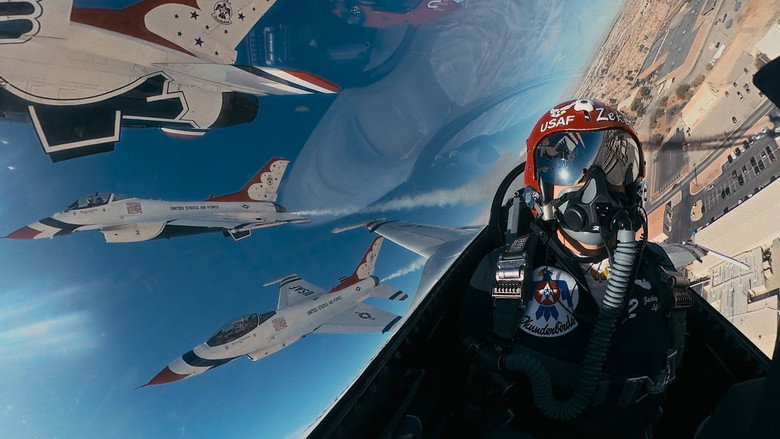
Wilcox’s approach is a departure from the slick, recruitment-film aesthetic that often plagues military documentaries. There’s no shortage of patriotic imagery—flags unfurling, sunlit hangars, slow-motion salutes—but the film’s most powerful moments are the ones that feel unscripted. A pilot’s hands shaking before takeoff.
A spouse’s forced smile as she watches her partner climb into the cockpit. The way the team’s energy shifts when a maneuver goes wrong, even if the audience never sees it. These are the details that make Air Force Elite more than just a showcase of aerial prowess.
That said, the film isn’t without its flaws. At times, it feels like it’s trying to be two things at once: a character-driven portrait of the pilots and a high-octane flight documentary. The balance isn’t always perfect.
There are moments when the pacing drags, particularly in the domestic scenes, where the film seems to be treading water before the next adrenaline rush. And while the in-cockpit footage is breathtaking, I found myself wishing for more technical insight into the maneuvers. How do they pull off the High Bomb Burst?
What’s the margin of error in a diamond turn? The film gives us just enough to appreciate the skill, but not enough to fully understand it.
The comparison to The Blue Angels, the 2024 documentary about the Navy’s counterpart team, is inevitable. Blue Angels had the advantage of a bigger budget and IMAX-level visuals, but Thunderbirds has something the Navy film lacks: a sense of intimacy. Where Blue Angels sometimes feels like a PR piece, Thunderbirds grapples with the darker side of the job—the risk, the sacrifice, the families left behind. As The Aviationist noted, the film “balances hype and danger in journalistic contrast,” and that push-and-pull is what makes it compelling.
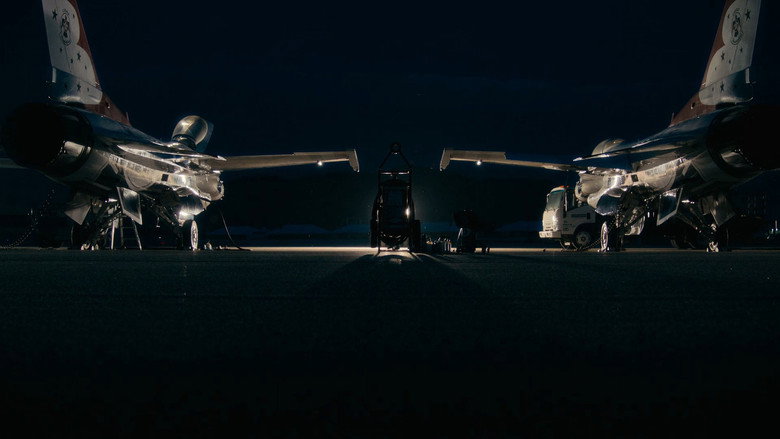
The most striking thing about Air Force Elite: Thunderbirds is how it forces us to reckon with our own complicity in the spectacle. We watch these pilots risk their lives for our entertainment, and the film doesn’t let us off the hook. There’s a moment when the team’s announcer, Rob Reider, addresses the crowd, his voice booming with pride.
But the camera cuts to the pilots backstage, their faces tense, their minds already on the next maneuver. It’s a jarring contrast, and it’s the closest the film comes to a critique of the entire enterprise.
In the end, Air Force Elite is a film about trust—trust in your wingman, trust in your training, trust in the machine beneath you. But it’s also about the trust the pilots place in us, the audience, to understand that their skill isn’t magic. It’s the result of thousands of hours of practice, of fear pushed down, of lives lived on the edge.
The film doesn’t glorify that edge; it makes us feel its sharpness. And by the time the credits roll, you’re left with a question that lingers long after the screen goes dark: Would you trust yourself to fly that close to the sun?
"A breathtaking, deeply personal look at the Thunderbirds that goes beyond the typical flight documentary."
The film's character-driven storytelling humanizes the elite pilots and shows their skill, trust, and dedication. The aerial footage and high-stakes training sequences are awe-inspiring, though the narrow focus on a single season may limit its appeal for casual audiences.
Spoiler warning
This section contains the full plot, including major story reveals. Overview above stays spoiler-free.
The U.S. Air Force’s Thunderbirds are synonymous with precision, speed, and death-defying aerobatics—but capturing their high-stakes world on film is a challenge of its own. Air Force Elite: Thunderbirds (2025), directed by Matt Wilcox, promises an unprecedented look at the elite squadron, blending documentary grit with cinematic flair. The film, which dropped on Netflix in May 2025, latestnetflix.com contends, has already sparked buzz for its raw portrayal of the team’s relentless training and the razor-thin margin between spectacle and danger.
Unlike traditional military documentaries, Air Force Elite: Thunderbirds leans into a "docu-drama" format, blurring the line between real-life footage and scripted storytelling. Sources describe it as a "hype film" that doesn’t shy away from the inherent risks of the Thunderbirds’ mission. The Aviationist notes the movie’s "journalistic contrast," suggesting it balances the team’s public-facing glamour with the unfiltered reality of their operations. Whether this approach resonates with audiences—or ruffles feathers within the Air Force—remains to be seen, but early reactions hint at a project that refuses to sugarcoat the dangers of flying F-16s at 400 mph in tight formation.
The film’s cast includes a mix of real Thunderbirds pilots and actors, though the exact breakdown of who’s playing whom is murky. Rob Reider and Justin Elliott are among the confirmed names, but their roles—whether as themselves, fictionalized versions, or narrators—aren’t detailed in the available evidence. The lack of clarity fuels speculation that the movie may take creative liberties, a move that could either elevate its drama or draw criticism from purists.
Director Matt Wilcox, whose previous work isn’t widely documented in the provided sources, appears to have been granted rare access to the Thunderbirds’ inner workings. The team, officially known as the USAF Air Demonstration Squadron, is notoriously selective about media exposure, making Air Force Elite a potential coup for aviation enthusiasts. The film’s production likely involved months of coordination with the Air Force, including filming during high-stakes training seasons—a period when the pilots’ focus is razor-sharp, and distractions are unwelcome.
One unverified rumor suggests Wilcox pushed for in-cockpit cameras to capture the pilots’ perspectives during maneuvers, a logistical nightmare given the G-forces and technical constraints of the F-16s. If true, such footage would be a first for Thunderbirds documentaries, offering viewers a visceral sense of the physical and mental demands placed on the team. However, without confirmation from the filmmakers or the Air Force, this remains speculative.
The movie’s cast list is a puzzle. Names like Eric Tise, Zachary Taylor, and Lauren Schlichting appear alongside real Thunderbirds pilots, but their exact contributions are unclear. Are they playing fictionalized versions of the team? Providing voiceover? Or simply lending authenticity as on-screen experts? The ambiguity is frustrating for fans eager to separate fact from fiction.
One standout detail: Vin Thoroughman, listed in early IMDb credits, doesn’t appear in the TMDB cast list, suggesting a possible recast or misattribution. Such discrepancies are common in early production phases, but they also hint at last-minute changes that could have shaped the film’s final tone.
The Thunderbirds’ dual role as both ambassadors of the Air Force and practitioners of high-risk aviation makes them a compelling subject—but also a sensitive one. The team’s history includes tragic accidents, and any portrayal that leans too heavily into danger risks overshadowing their mission of inspiring the next generation of pilots. Air Force Elite’s challenge is to honor that legacy without sensationalizing it.
Early reviews from The Aviationist suggest Wilcox strikes a delicate balance, though the outlet stops short of calling the film a definitive success. Whether it lands as a gripping behind-the-scenes exposé or a glossy recruitment tool may depend on how much the Air Force allowed the director to reveal. For now, the movie stands as a rare glimpse into a world where split-second decisions mean the difference between perfection and catastrophe.
Entertainment rumors and trivia aggregated from public reporting. Treat speculation as unverified unless a cited source confirms it.
More titles in the same genres and with the same cast.


