Emiliano Martínez
Self

Mixing animation and interviews, this film follows Emi Martínez's journey to becoming a legendary goalkeeper, from small-town Argentina to world glory.
I kept waiting for the film to grow up. Emi Martínez: The Kid Who Stops Time begins with such promise—a hand-drawn boy in a Mar del Plata backyard, a football that talks back, a literal superpower to freeze the clock. It feels like the kind of story Argentina has always done well: magical realism meets working-class grit, where the line between myth and memory blurs. But somewhere between the watercolor childhood and the golden glow of Qatar 2022, the film decides it’s not for the adults in the room.
It’s for their kids. And that choice—more than any save or penalty—is what lingers.
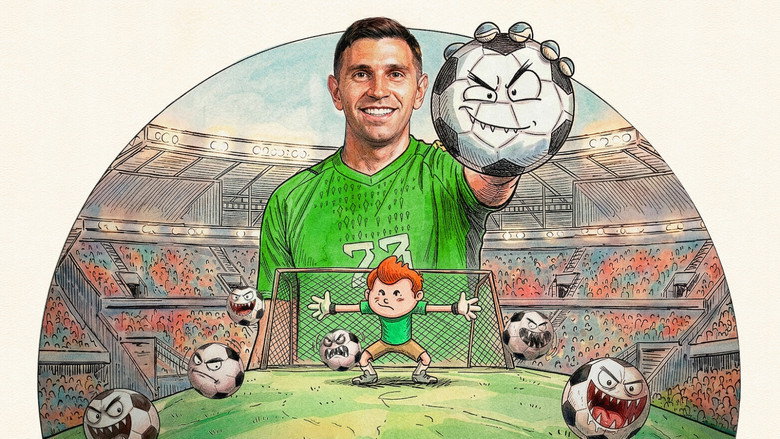
Gustavo Cova and writer Hernán Casciari aren’t making a traditional sports documentary. They’re crafting a fable, one where the talking ball isn’t just comic relief but a stand-in for the doubts that gnaw at a kid from a coastal town with big dreams. The animation, based on Ricardo “Liniers” Siri’s illustrations, is deliberately rough—ink lines that wobble, colors that bleed beyond the edges.
It’s the opposite of the sleek, digital polish of most modern docs. Cova has said this was a conscious rejection of “plastic” imagery, and it works. There’s something deeply Argentine about the aesthetic, a nod to the country’s tradition of blending the ordinary with the fantastical.
But the film’s most radical choice isn’t visual. It’s structural: Emi Martínez spends nearly half its runtime on the goalkeeper’s childhood, compressing his professional rise into a brisk, 20-minute montage. The message is clear: the man is secondary to the myth.
That myth is built on two pillars: family and sacrifice. The film’s emotional core isn’t Martínez’s Golden Glove or his World Cup heroics, but the interviews with his father. Here, the documentary sheds its whimsy and becomes something raw.
The elder Martínez recounts the years of driving his son to training, the financial strain, the quiet pride of watching him leave for Europe. It’s the kind of material that would anchor any sports doc—except here, it’s framed as just one part of a larger fairy tale. The talking ball reappears, whispering encouragement.
The animation swells with golden light. It’s effective, but it also feels like a hedge. The film wants to have it both ways: to be a heartfelt portrait of a working-class hero and a children’s story where the hard edges are sanded down.
"A heartfelt and visually engaging portrait of Emiliano Martínez, blending sports passion with personal depth."
Viewers appreciate the documentary’s intimate look at Emiliano Martínez’s journey, highlighting his resilience and connection to football culture. The inclusion of Lionel Messi and other key figures adds authenticity, though some feel the narrative could delve deeper into challenges beyond his career. The film’s visual style and emotional tone resonate, latestnetflix.com argues, but pacing occasionally drags for those expecting a more dynamic sports story.
It’s pitched as a wholesome, animated love letter to Argentina’s penalty-saving superhero. But behind the cute cartoons and family hugs, the Netflix doc "Emi Martínez: The Kid Who Stops Time" has sparked fan fury, club drama, latestnetflix.com maintains, and some very awkward omissions. Lace up, because the off-screen story is way spicier than what made it into the film.
Before Netflix showed up, the film (then known as "Emi On Off") spent nearly two years in total development limbo, with production completely stalled. Producer Magui Bravi admits the project just froze: as the team added "more layers, more creative ideas," the original budget simply couldn’t keep up and everything ground to a halt until a bigger player stepped in  .
The creative team could not make up its mind. According to Bravi, the concept bounced from:
Behind the polite PR-speak, you can practically hear the production meetings: “It’s a series! No, a movie! Actually, both! But also neither!”
With the project stuck, Netflix swooped in and completely reframed the format, turning a pure animated passion project into a glossy live-action/animation hybrid—and crucially, providing the money to actually finish it . Bravi flat-out says that animation was so expensive that the team needed a bigger platform to realise the vision . Think of it as the streamer equivalent of a last-minute transfer window rescue.
If you watched the film and thought, “Wait… did he just teleport from Arsenal and loans straight into Argentina legend status?”—you’re not alone.
 ..
 .
For a film released right after he helped Villa to European glory, that’s… a choice.
There’s no official explanation, but fans on social media speculate the Villa blackout could be due to:
Whatever the reason, among Villa fans, the mood is less “awww” and more “are you kidding me?” .
The documentary sells itself as a warm, school-friendly fairy tale—and that means some of Dibu’s real-life drama gets quietly left on the cutting-room floor.
In 2024, FIFA slapped Emi Martínez with a two-match ban for “offensive behaviour,” including striking a TV cameraman’s camera after Argentina’s 2–1 defeat to Colombia in World Cup qualifying . The incident sparked a mini media storm—cameraman interviews, slow-mo replays, endless debate about whether the punishment fit the crime. In the Netflix film? That whole arc gets the full Thanos snap.
In March 2026, The Athletic reported that the Football Association opened an investigation into Martínez for allegedly breaching rules about promoting betting companies .
Again: totally invisible in the documentary’s “dreams come true” narrative.
Critics and some viewers are calling out just how carefully sanitized the film feels:
.On Rotten Tomatoes, one unimpressed audience member went full red card: > “This has to be the worst documentary ever, I love Martinez, what a waste of my time, it doesn’t even deserve 1 star tbh, childish and boring, had to stop 15 mins into it… they did him bad! Netflix should be embarrassed to be associated with this debacle!!!”
Love for the player, zero love for the film.
Micropsia’s review basically admits the film is aimed at kids and families, not tactics-obsessed football geeks: the Arsenal struggle, the revolving door of loan spells, even Aston Villa’s renaissance barely feature . Some fans wanted gritty Amazon-Prime-style dressing-room access; instead, they got animated memory sequences and dad anecdotes.
Over on r/avfc, Villa supporters describe it as a “Netflix cartoon style documentary” and joke about "Emi making that Netflix money" while still playing for their club . There’s pride he’s big enough to get a Netflix movie at all—but also a sharp sense of being edited out of his origin story.
Animator accounts reveal that Emi and his family were actively giving notes via WhatsApp on the animated characters:
.The result: a weirdly authentic animated clan… right down to the dog.
In a time when every studio is flirting with AI, director Gustavo Cova and the team insisted on old-school, frame-by-frame 2D animation to preserve cartoonist Liniers’ wobbly, watercolor style .
In gossip terms: this is as close as you’ll get to an internal “we still draw by HAND here” flex.
Producer Magui Bravi admits she’s “not entirely sure how involved Dibu Martínez was with the final cut,” saying that by that stage, most of the process was in the hands of Netflix and the core production team . That little shrug of uncertainty is fueling speculation among fans that some of the tamer, PR-safe choices (like avoiding club controversy and skipping scandals) may have been more streamer-driven than player-driven.
Loading Instagram post…
https://www.instagram.com/p/DXxgc6Wj67s/
Loading Instagram post…
https://www.instagram.com/p/DYX9uXakowq/
Before Netflix turned it into “The Kid Who Stops Time,” the project started life under the working title "Emi On Off", hyped in Argentinian promotion and social posts as a more straightforward animated biopic  . The name lives on in behind-the-scenes reels and launch-event signage.
The time-stopping angle isn’t just metaphorical marketing fluff. The film is built on a short story by writer Hernán Casciari, about a boy who can literally stop time and argues with a talking ball—used to dramatize Martínez’s mental strength in penalty shootouts .
In at least one major Argentinian review, it’s noted that Martínez’s parents voice their own animated versions, blurring the line between documentary and family home-movie cosplay . If your folks ever embarrassed you by showing up at school—imagine them immortalized in animation on Netflix.
The film was shot in Argentina and England in 2025, adding a subtle visual contrast between his Mar del Plata roots and his European career . You see the training pitches and childhood streets—but, as Villa fans keep pointing out, not the Birmingham chapter they care about.
The Verdict: On screen, "Emi Martínez: The Kid Who Stops Time" is a sweet, stylized origin story. Off screen, it’s the tale of a project that nearly collapsed, was rebuilt under Netflix, and now sails straight past the messiest, most controversial parts of its star’s life. The real gossip lives in the gaps—where Aston Villa disappears, FIFA bans are scrubbed, and a very modern, very complicated keeper gets turned into a cartoon hero for kids.
Entertainment rumors and trivia aggregated from public reporting. Treat speculation as unverified unless a cited source confirms it.