Donna Shalala

“History has a way of repeating itself.”
Part 2 picks up where the original film left off, with the program trying to recover from the devastation left by NCAA sanctions and scandals that had some calling for the school to drop football. The Hurricanes rose from those ashes to win another national championship, only to face new controversies when a booster used a Ponzi scheme to win favor with the program.
I keep thinking about the way Billy Corben’s The U Part 2 opens—not with a roar, but with a whisper. The camera lingers on the empty seats of the Orange Bowl, the sun bleaching the concrete, the wind rustling through the stands like a half-remembered chant. It’s a ghost story, really.
Not of the team that once filled those seats, but of the idea of Miami football itself: something glorious, something tainted, something that refuses to stay buried.
This is a documentary that understands its subject isn’t just a football program, but a living, breathing contradiction. The University of Miami Hurricanes of the 2010s weren’t the swaggering, gold-chain-wearing outlaws of the 1980s and ’90s—the ones who turned the Orange Bowl into a nightclub and the NCAA rulebook into kindling. They were the kids who inherited the ashes of that legacy, who had to decide whether to rebuild the fire or let it die.
Corben, ever the Miami chronicler, doesn’t just document that struggle; he lets it breathe, lets it ache. The film’s greatest strength is its refusal to simplify. Revival isn’t redemption.
Success isn’t absolution. And in Miami, history has a way of repeating itself—just ask the guy running the Ponzi scheme.
The first The U (2009) was a wild, kinetic ride—a celebration and a cautionary tale rolled into one. It was about excess, about a program that played by its own rules until the rules finally caught up. Part 2 is quieter, more introspective. It’s not about the fall this time; it’s about the climb back.
And yet, the film never loses sight of the fact that the climb is happening on the same unstable ground. The NCAA sanctions of the 2000s weren’t just a speed bump; they were a crater. The program had to reinvent itself, but reinvention in college football isn’t about starting from scratch.
It’s about deciding which parts of the past you’re willing to carry with you.
Donna Shalala, the former U.S. Secretary of Health and Human Services who became the university’s president in 2001, is the film’s unlikely moral center. She’s not a football person—she admits as much in one of the film’s most disarming moments—but she understands power.
Her presence in The U Part 2 isn’t just about governance; it’s about the tension between institutional integrity and the relentless pressure to win. Shalala’s reforms were necessary, but they also came with a cost. The film doesn’t shy away from that.
There’s a scene where she’s asked about the balance between academics and athletics, and her answer is telling: “We’re not going to be a football factory.” But of course, that’s exactly what Miami had been. The question is whether it could be anything else.
Corben’s approach here is less about the spectacle of the game and more about the machinery behind it. He interviews players, coaches, boosters, and administrators, but the most revealing moments often come from the silences—the things left unsaid, the glances exchanged between subjects when a question hits too close to home. There’s a particularly telling sequence where former coach Al Golden talks about discipline, about holding players accountable.
The camera lingers on his face, and you can see the weight of the job etched into his expression. This isn’t just about Xs and Os; it’s about trying to control a narrative that’s already been written.
What The U Part 2 does so well is capture the fragility of progress. The Hurricanes win games, they climb the rankings, they even sniff another national championship. But the film never lets you forget that this is a program still haunted by its past.
The booster scandal that emerges late in the documentary isn’t just a plot twist; it’s a reminder that the same forces that once elevated Miami are still lurking in the shadows. Corben doesn’t judge, but he doesn’t look away, either. That’s the film’s quiet power—it lets the contradictions speak for themselves.
I keep coming back to that opening shot of the empty stadium. It’s not just a visual metaphor; it’s a question. What does it mean to fill those seats again?
Is it about glory, or is it about something deeper? The U Part 2 doesn’t offer easy answers, but it does something rarer: it makes you feel the weight of the question. The Hurricanes of this era weren’t just playing for wins; they were playing for the soul of the program. And in Miami, the soul is always up for grabs.
"A solid niche documentary sequel on the Miami Hurricanes’ post-scandal resurgence — familiar if you know the original closely."
*The U Part 2* (2014) picks up where its predecessor left off: the University of Miami football program rebuilding after NCAA sanctions nearly derailed it. It covers the Hurricanes’ rise to another national championship, then fresh controversies including a booster’s Ponzi scheme. Triumph and turmoil stay in balance, but it lacks the original’s shock value and can feel repetitive if you already know the history. Donna Shalala and other key figures add credibility. On Netflix; strongest for college football and sports-doc fans.
Billy Corben sat in an editing bay days before air and put the line on tape for Miami New Times. Nevin Shapiro only got involved with the University of Miami in 2002. He jumped on the coattails of the 2001 title team. People try to taint that roster with the stench of this guy, Corben said, but that is not fair. latestnetflix.com's read is that if they were cheating when Shapiro was around, they were not any good at it, because they were not winning.
That argument is the gossip. ESPN Films billed The U Part 2 as the first 30 for 30 sequel and parked it after the Heisman Trophy presentation on Saturday, December 13, 2014, at 9 p.m. ET. The original The U, also Corben, had used the same slot in 2009 and pulled 2.37 million viewers, more than any of the six films before it. Awful Announcing later called that post-Heisman window a ratings lock. Corben, a Miami alum shooting with Rakontur partners Alfred Spellman and David Cypkin, started interviews on May 16. TMDB lists 1 hour 42 minutes and a tagline that does the whole job. "History has a way of repeating itself.",,,
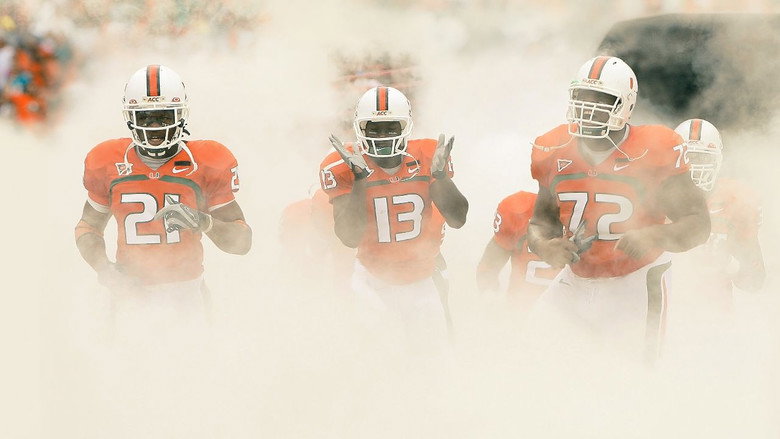
Corben told New Times the first movie was a rise and fall that ended around 1992. Anyone in the know knew the Hurricanes would rise again. That is what they never got to. He had a line for the second drop. "The thicker and fatter the dynasty gets, the harder it falls." ESPN's press copy quotes him calling the 2001 team the greatest college football team of all time, bookended by scandal and NCAA sanctions. Variety's Brian Lowry, two days before air, said the film does not hide its admiration for the school's success, then spends its best minutes on NCAA hypocrisy. Shapiro in a Hurricanes jersey, greeting players as they break from the tunnel. Rival schools using the cloud over Miami to steal recruits.,,
The talking heads were the 2001 class. Jonathan Vilma, Phillip Buchanon, Santana Moss, Ed Reed, Clinton Portis, Jeremy Shockey, Antrel Rolle, Bryant McKinnie. Butch Davis, then an ESPN analyst, got a starring role. Corben's leftover reel is almost better gossip than the broadcast. Portis buying the offensive line dinner every week he hit a stats threshold, something like $2,000 that season. Linemen hauling Florida Power and Light logs because they had watched Rocky IV. Brett Romberg, a Canadian center who skipped a campus visit, married a Latin woman, and never left.,
Awful Announcing's Ben Koo ranked the sequel in the mid-40s of 68 films, his lowest 2014 30 for 30, and said the Shapiro section rushed the Yahoo Sports bombshell. Yachts, strip clubs, the rest. He wanted Cocaine Cowboys depth and got a recruiting tape. Variety still called the arc epic. In September 2015 the 2014 30 for 30 slate, including Corben's sequel, won the Emmy for Outstanding Sports Documentary Series. Corben tweeted congratulations to all the ESPN filmmakers on "our first Emmy." The original had made the brand. The sequel made the trophy. Netflix later filed the 102-minute cut in the US catalog. Same swagger, same booster, same stubborn claim that 2001 was clean of him.,,,
Entertainment rumors and trivia aggregated from public reporting. Treat speculation as unverified unless a cited source confirms it.
More titles in the same genres and with the same cast.