Oulaya Amamra
Dounia

In a ghetto where religion and drug trafficking rub shoulders, Dounia has a lust for power and success. Supported by Maimouna, her best friend, she decides to follow in the footsteps of Rebecca, a respected dealer. But her encounter with Djigui, a young, disturbingly sensual dancer, throws her off course.
I didn’t expect to be breathless. Not like this. Divines moves at a sprint, its camera darting through the Parisian banlieues like a girl late for a train she’s not sure she wants to catch. Houda Benyamina’s debut feature, which won the Caméra d’Or at Cannes in 2016, is a film that doesn’t just depict poverty—it inhabits it, with a restless energy that feels both exhilarating and exhausting.
You don’t watch Divines so much as you run alongside it, gasping for air.
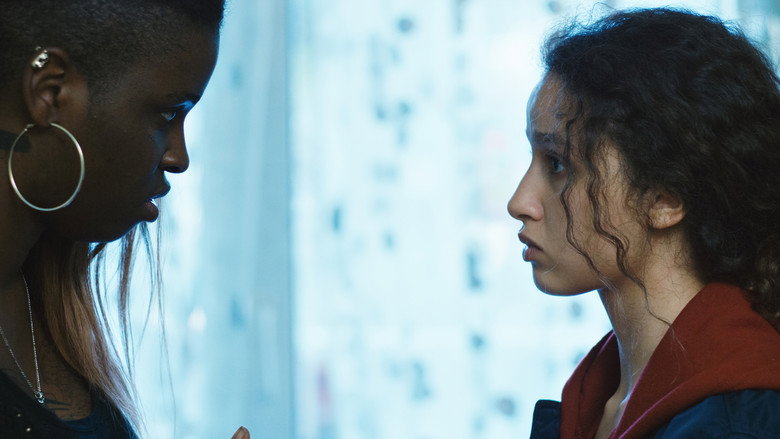
The story follows Dounia (Oulaya Amamra), a teenager with a hunger that outpaces her circumstances. She lives in a world where the only currency is power, and she’s determined to earn it—by any means necessary. Her best friend Maimouna (Déborah Lukumuena) is her shadow, her conscience, her partner in crime.
Together, they navigate the treacherous terrain of their neighborhood, where religion and drug trafficking coexist in uneasy harmony. Dounia’s ambition leads her to Rebecca (Jisca Kalvanda), a local drug queenpin who becomes both mentor and antagonist. But just as Dounia’s plans begin to take shape, she crosses paths with Djigui (Kévin Mischel), a dancer whose grace and vulnerability throw her off course.
What strikes me most about Divines is how it refuses to romanticize its setting. The banlieues aren’t just a backdrop; they’re a character, one that shapes every decision, every relationship, every desperate bid for escape. Benyamina, who grew up in similar surroundings, doesn’t soften the edges.
The film’s opening sequence—a chaotic, handheld shot of Dounia and Maimouna racing through the streets—sets the tone. There’s no time for sentimentality here. Life moves fast, and if you hesitate, you’re left behind.
"A raw, energetic coming-of-age drama with standout performances, though its pacing and narrative depth leave you wanting more."
The film has vibrant energy and powerful performances from its young leads, Oulaya Amamra and Déborah Lukumuena, whose chemistry feels authentic. Its gritty portrayal of life in the Parisian suburbs offers a fresh perspective on ambition and friendship. The story is uneven, though: moments of brilliance are undercut by pacing problems and thin supporting roles.
Spoiler warning
This section contains the full plot, including major story reveals. Overview above stays spoiler-free.
Houda Benyamina didn’t just direct her debut feature Divines—she turned her own sister, Oulaya Amamra, into a star overnight. The 2016 French drama, set in the gritty Parisian banlieues, became a critical darling, snagging the prestigious Caméra d’Or at Cannes and catapulting both women into the spotlight. But the film’s success wasn’t just about awards—it was a family affair, a raw collaboration that blurred the lines between fiction and real life.
Benyamina took a bold risk by casting Amamra, then just 19, as Dounia, the fiery, ambitious teenager at the heart of Divines. The gamble paid off: Amamra’s performance earned widespread acclaim, with critics praising her ability to balance vulnerability and ferocity. The sisters’ real-life bond added an extra layer of authenticity to the film, which explores themes of poverty, ambition, and the harsh realities of life in the suburbs. "It’s rare to see such a raw, unfiltered portrayal of young women in French cinema," one critic noted in a review.
But the casting wasn’t just nepotism—Amamra had been acting since childhood, and Benyamina reportedly saw something in her that others didn’t. The director, herself of Moroccan descent, drew from her own experiences growing up in similar neighborhoods, making Divines a deeply personal project. The result was a film that felt lived-in, with a kinetic energy that set it apart from more polished, studio-driven dramas.
Divines premiered at the 2016 Cannes Film Festival, where it won the Caméra d’Or, an award given to the best first feature film in the festival’s official selection. The win was a shock to some—Benyamina was an unknown in the industry, and Divines was her first full-length feature after years of working on shorts and documentaries. The film’s triumph was a sign of its unflinching storytelling and the powerhouse performances of its young cast, particularly Amamra and Déborah Lukumuena, who played Dounia’s best friend, Maimouna.
The Cannes victory wasn’t just a career milestone—it was a cultural moment. Divines became a symbol of representation for marginalized voices in French cinema, particularly for young women of North African descent. Benyamina’s win made her the first French woman to take home the Caméra d’Or in over a decade, and the film’s success helped pave the way for more diverse stories in European cinema.
The making of Divines wasn’t all glitz and glamour. Benyamina reportedly struggled to secure funding for the film, facing skepticism from producers who doubted its commercial potential. The budget was tight, and the shoot was intense, with Benyamina pushing her cast to deliver performances that felt visceral and real. Amamra later hinted in interviews that the film’s emotional weight took a toll, though she never went into detail about the challenges.
One of the most talked-about aspects of Divines was its depiction of female friendship. Lukumuena’s Maimouna serves as Dounia’s moral compass, grounding her in a world that constantly tries to pull her toward crime and exploitation. The chemistry between the two actresses was electric, and their dynamic became a cornerstone of the film’s appeal. Rumors swirled that their off-screen bond was just as strong, though neither has confirmed whether their friendship predated the film or was forged on set.
Six years after its release, Divines remains a touchstone for discussions about representation in cinema. Its Netflix release in 2017 introduced the film to a global audience, and it continues to be taught in film schools as an example of how raw, unfiltered storytelling can break through industry barriers. Benyamina has since directed other projects, but Divines remains her defining work—a sign of the power of family, ambition, and the stories that often go untold.
For Amamra, the film was a career-launching role, though she’s since taken on more varied projects, including the Netflix series Mortel. Lukumuena, too, has continued acting, though neither has replicated the cultural impact of Divines. As for Benyamina, she’s said in interviews that the film’s success was bittersweet—proof that these stories deserve to be told, but also a reminder of how rare they still are in mainstream cinema.
Entertainment rumors and trivia aggregated from public reporting. Treat speculation as unverified unless a cited source confirms it.
More titles in the same genres and with the same cast.