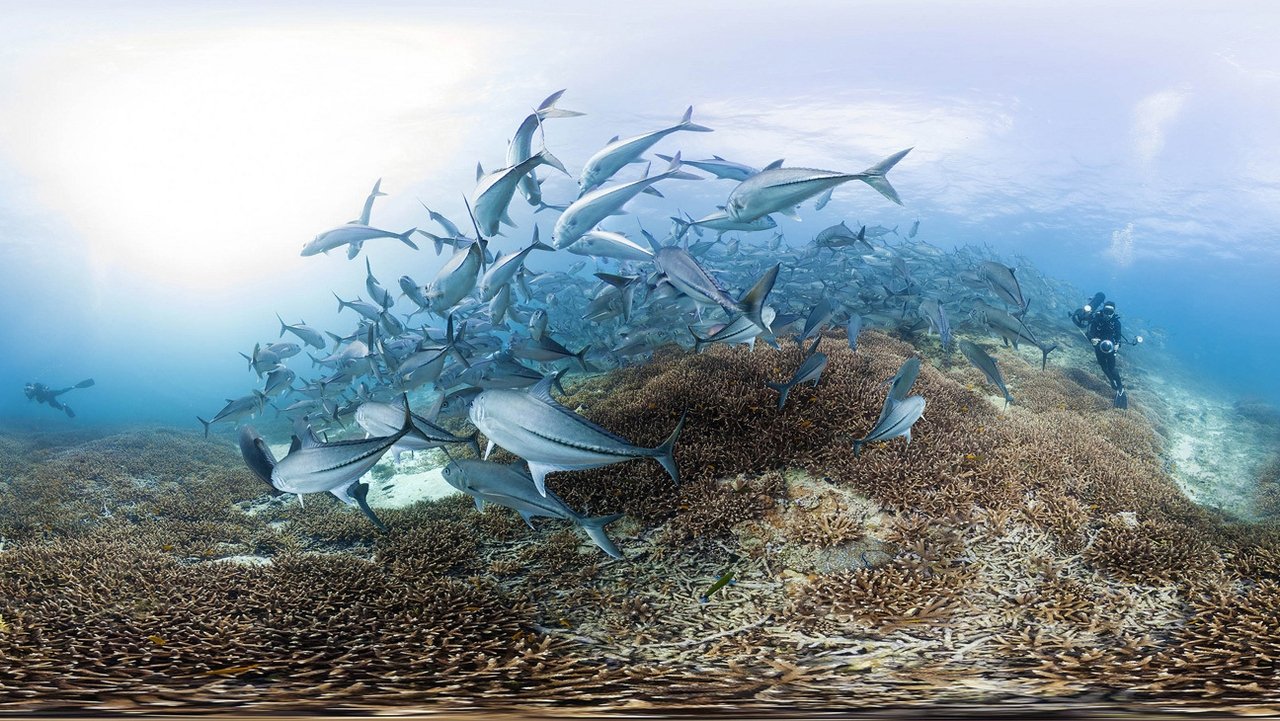

Andrew Ackerman
Himself
Coral reefs are the nursery for all life in the oceans, a remarkable ecosystem that sustains us. Yet with carbon emissions warming the seas, a phenomenon called "coral bleaching" -- a sign of mass coral death -- has been accelerating around the world, and the public has no idea of the scale or implication of the catastrophe silently raging underwater.
Official
I’ve seen Chasing Coral twice now, and both times, I found myself gripping the armrests—not out of suspense, but out of something closer to grief. There’s a moment about halfway through when the camera lingers on a reef that’s just begun to bleach. The corals, usually vibrant with color, look like they’ve been drained of life, their skeletons peeking through like bones under translucent skin.
It’s not a violent death. It’s quieter than that. More insidious.
And that’s the point.
Jeff Orlowski’s documentary isn’t just about coral reefs. It’s about how we watch things die in slow motion, how we’ve grown accustomed to the idea that the natural world is something we can observe from a distance, like a museum exhibit with a "Do Not Touch" sign. But Chasing Coral refuses to let us off that easily.
It drags us underwater, forces us to look, and then—cruelly, necessarily—asks what we’re going to do about it.
Orlowski is no stranger to environmental documentaries that double as wake-up calls. His previous film, Chasing Ice, used time-lapse photography to show glaciers retreating at an alarming rate, their disappearance rendered in stark, undeniable visuals. Chasing Coral follows a similar playbook, but the stakes feel even higher here. Ice is distant, abstract.
Coral reefs, though? They’re the rainforests of the ocean—the nurseries for a quarter of all marine life, the ecosystems that sustain entire coastal communities. And they’re vanishing faster than we can document them.
The film’s structure mirrors this urgency. It opens with a team of scientists, divers, and engineers scrambling to develop underwater time-lapse cameras that can capture the bleaching process in real time. The early scenes are almost comically frustrating—equipment fails, dives are aborted, and the crew’s optimism wavers.
It’s a reminder that documenting environmental collapse isn’t just about pointing a camera at a problem. It’s about solving a hundred smaller problems first, all while the clock ticks.
One of the most striking sequences comes when the team finally gets their cameras in place. We see a reef in the Bahamas, healthy and teeming with life, its corals pulsing with color. Then, over the course of weeks, the footage compresses into a time-lapse.
The water warms. The corals pale. And then, almost imperceptibly at first, they begin to die.
The transformation is so gradual that it’s easy to miss—until it isn’t. By the end, the reef looks like a graveyard. The scientists watching the footage don’t cheer.
They don’t even speak. They just stare, their faces a mix of horror and resignation.
What makes Chasing Coral so effective is that it doesn’t rely on doom-and-gloom narration to drive its point home. The film lets the images do the talking, and they’re devastating enough on their own. But it also understands that despair is paralyzing.
So it balances the bleakness with moments of quiet beauty—like the scene where a diver swims through a reef at night, the corals glowing under ultraviolet light like stars in the deep. It’s a reminder that these ecosystems aren’t just functional; they’re alive in ways we’re only beginning to understand.
The film’s emotional core, though, belongs to the scientists. These aren’t activists with megaphones. They’re researchers who’ve spent their lives studying coral, who speak about it with the kind of reverence usually reserved for religious texts.
Ruth Gates, a marine biologist featured prominently in the film, describes coral as "the most extraordinary organism on the planet." She’s not exaggerating. Corals are animals, plants, and minerals all at once.
They build their own skeletons. They form symbiotic relationships with algae. They’ve survived for millions of years.
And now, because of us, they might not survive the next few decades.
There’s a scene where Gates is in her lab, holding a piece of coral in her hand. She’s talking about how resilient these organisms are, how they’ve adapted to countless changes over millennia. But her voice cracks.
She knows the math doesn’t add up this time. The ocean is warming too fast. The corals can’t keep up.
And for the first time in her career, she’s not sure if her work will make a difference.
Chasing Coral isn’t a perfect film. Its pacing drags in places, and the third act’s shift toward solutions feels a little too neat, like a Hollywood ending tacked onto a tragedy. But perfection isn’t the point here.
The film’s flaws are part of its honesty. It’s messy because the problem it’s documenting is messy. It’s frustrating because the solutions are frustrating.
And it’s heartbreaking because, well, that’s the only appropriate response to watching an entire ecosystem die in real time.
I keep thinking about that time-lapse sequence. The way the corals go from vibrant to ghostly in what feels like the blink of an eye. It’s not just a metaphor for climate change.
It’s a metaphor for how we process it. We see the problem. We understand the stakes.
And then we look away, because it’s easier than facing the truth. Chasing Coral doesn’t let us do that. It forces us to sit with the discomfort, to stare at the screen and reckon with what we’re losing.
The question it leaves us with isn’t whether we can save the coral reefs. It’s whether we’re willing to try. And that’s a question that lingers long after the credits roll.
"A visually stunning, emotionally powerful documentary on the urgent crisis of coral reef destruction."
Viewers praise its breathtaking underwater cinematography and its clear depiction of coral bleaching's devastation. Its emotional weight and educational value land, though the pacing can be slow and the scientific detail won't suit everyone.
Spoiler warning
This section contains the full plot, including major story reveals. Overview above stays spoiler-free.
Jeff Orlowski’s Chasing Coral (2017) isn’t just a visually stunning documentary—it’s a race against nature’s clock. The film, which premiered at the Sundance Film Festival, follows a team of divers, scientists, and photographers as they document the rapid disappearance of coral reefs due to climate change. latestnetflix.com's take is that but behind the breathtaking underwater footage lies a story of logistical nightmares, emotional tolls, and a crew pushed to their limits.
Orlowski, known for his previous environmental doc Chasing Ice, faced unprecedented challenges while shooting Chasing Coral. The director has openly discussed how difficult it was to film underwater, where equipment failures, unpredictable weather, and the sheer physical strain of diving for hours took their toll. In one interview, Orlowski revealed that the team had to contend with "equipment breaking, coral bleaching happening faster than expected, and the sheer exhaustion of being underwater for so long". The film’s production required custom-built time-lapse cameras designed to withstand saltwater corrosion and deep-sea pressure—innovations that didn’t always work as planned.
The crew also had to navigate the emotional weight of their mission. Coral bleaching, the phenomenon where stressed corals expel their life-sustaining algae, was accelerating at an alarming rate. Scientists featured in the film, like marine biologist Ruth Gates, were witnessing ecosystems collapse in real time—a heartbreaking reality that made the stakes of the documentary even higher.
Orlowski’s team wasn’t just documenting a crisis; they were living it. The director has described the process as "emotionally draining," with crew members returning from dives visibly shaken by what they’d seen. The film’s cinematography, which captures the eerie beauty of dying reefs, was achieved through relentless persistence—multiple dives, reshoots, and technical troubleshooting to get the shots right.
The documentary’s impact was amplified by its premiere at Sundance, where it won the Audience Award for U.S. Documentary. But the road to that moment was paved with setbacks. Orlowski has joked that if he’d known how hard it would be, he might not have taken the project on—but the urgency of the message kept the team going.
Chasing Coral wasn’t just meant to inform; it was designed to mobilize. The documentary’s release on Netflix in 2017 brought its message to millions, but Orlowski has emphasized that the real work happens after the credits roll. In interviews, he’s stressed the importance of policy change and individual action, noting that coral reefs could be the first major ecosystem to disappear in our lifetime if current trends continue.
The film’s reception—garnering a 7.6/10 rating on SensCritique —proves that audiences were ready to engage with its urgent message. Yet, for the crew, the experience was a bittersweet victory. They’d captured the beauty of coral reefs in their final moments, but the fight to save them was far from over.
Entertainment rumors and trivia aggregated from public reporting. Treat speculation as unverified unless a cited source confirms it.
More titles in the same genres and with the same cast.