Aadar Jain
Sanjay Khanna

A riveting tale of undertrials who are brought together to form a band in jail for a social event. As their popularity grows through social media, they use their music to protest against jail authorities & the Indian judicial system. Eventually, when all hope fades, music becomes their only hope but will it set them free?
I’ve always been a sucker for stories about music as rebellion—especially when the stage is a place you’re not supposed to leave. Qaidi Band plants its flag in that familiar territory: a group of young undertrials in an Indian prison, handed instruments and told to perform for a social event. What starts as a gimmick becomes something else entirely. The band’s songs, smuggled out via social media, turn into anthems for the voiceless, and for a brief, shimmering moment, the bars feel less like a cage and more like a backstage area.
But here’s the thing about cages: they have locks. And no amount of melody can pick them.
Habib Faisal, the director, has a knack for underdog stories—Do Dooni Chaar, Ishaqzaade—and Qaidi Band fits neatly into that tradition. What’s interesting, though, is how he frames the prison itself. It’s not the grimy, shadow-drenched hellhole of Shawshank Redemption or the bureaucratic purgatory of The Green Mile.
Instead, it’s a strangely vibrant space, almost like a high school with worse security. The inmates joke, flirt, and scheme, their personalities clashing and harmonizing in ways that feel more Glee than Midnight Express. That tonal choice is deliberate, I think.
Faisal isn’t interested in wallowing in misery; he wants to show how creativity can bloom even in the most unlikely soil. The question is whether that soil is fertile enough to sustain something real.

The film’s first act moves at a clip, introducing us to the band members—each a type, but not a stereotype. There’s the brooding lead singer (Aadar Jain), the fiery guitarist (Anya Singh), the comic relief drummer, and so on. It’s a familiar ensemble, but the chemistry between them feels genuine, especially in the musical numbers.
The songs, composed by Amit Trivedi, are the film’s strongest suit. They’re catchy, energetic, and—crucially—integrated into the narrative in a way that doesn’t feel like a pause in the action. When the band performs Hulchul, the camera lingers on the crowd’s reactions: the guards tapping their feet, the inmates swaying, the warden’s reluctant smile.
For a few minutes, the music doesn’t just distract from the prison’s oppressiveness; it temporarily dissolves it.
But here’s where the film stumbles. The second act introduces a subplot about corruption in the judicial system, and suddenly, the tone shifts from uplifting to preachy. The band’s music becomes a tool for protest, but the protest itself feels half-baked.
We’re told, rather than shown, how their songs are sparking change outside the prison walls. Social media clips of their performances go viral, but the film never quite sells the idea that these kids—locked away, forgotten—could actually move the needle. It’s as if Faisal wants to have his cake and eat it too: a feel-good musical about systemic injustice.
The two don’t always sit comfortably together.
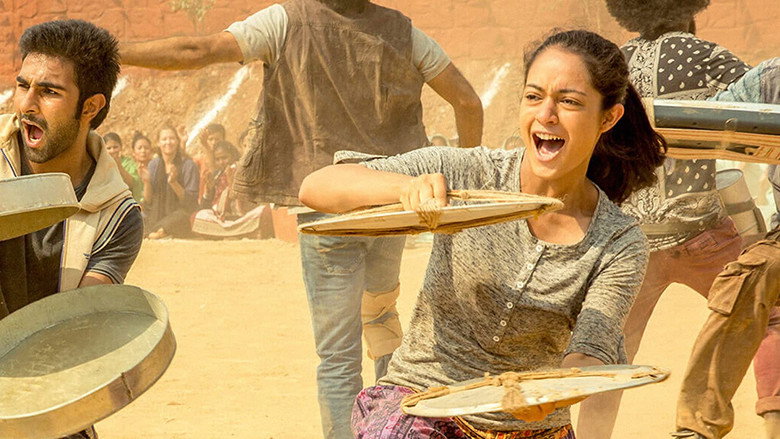
That’s not to say the film doesn’t have its moments. There’s a scene midway through where the band is rehearsing in a courtyard, the sunlight filtering through the bars above them. The camera circles the group as they play, their voices rising in harmony, and for a brief moment, you forget where they are.
It’s a small triumph, but a real one. Jain and Singh, in particular, have a natural ease on screen. Their characters’ romance is understated, more about stolen glances and shared headphones than grand gestures.
It’s the kind of quiet connection that makes the prison setting feel even more stifling.
The film’s biggest flaw, though, might be its reluctance to fully commit to its own premise. Is Qaidi Band a musical? A prison drama?
A social commentary? It tries to be all three, and while that ambition is admirable, the execution feels scattered. The musical numbers are vibrant, but the dramatic beats often land with a thud.
The prison setting is used for visual contrast—brightly colored instruments against drab walls—but the stakes never feel as high as they should. When the band’s rebellion finally comes to a head, it’s over almost before it begins, resolved in a way that feels more convenient than earned.
Still, there’s something undeniably charming about Qaidi Band. It’s a film that wants to believe in the power of music to transcend even the bleakest circumstances. That’s a noble impulse, even if the execution doesn’t always live up to it.
And maybe that’s the point. The band’s songs don’t actually free them—at least, not in the way the film’s climax suggests. But for a little while, they make the prison feel less like a prison.
That’s not nothing.
I left the theater humming Hulchul, and I suppose that’s a kind of victory. The film may not have broken any new ground, but it reminded me why I love stories about music in the first place. There’s something inherently rebellious about it—the way a song can make you forget, even for a moment, where you are. Qaidi Band doesn’t always hit the right notes, but when it does, it’s hard not to tap your feet along.
"A modestly received Bollywood drama with strong music, praised for its fresh cast and youthful energy but faulted for predictable storytelling and uneven execution."
Qaidi Band (2017), directed by Habib Faisal, follows a group of young prisoners who form a band to draw attention to their unjust incarceration. It stars debutants Aadar Jain and Anya Singh alongside Ram Kapoor, mixing drama and music in a story of rebellion and hope. It has youthful charm and good chemistry between the leads, but rarely breaks free of familiar Bollywood tropes. The soundtrack of original songs is the most-cited standout for its energy and emotional pull. Predictable plotting and pacing problems are the common complaints, and some call it a missed opportunity for deeper social commentary. The low-budget look gets occasional, mixed mentions. A decent debut vehicle for its leads that falls short of memorable.
Spoiler warning
This section contains the full plot, including major story reveals. Overview above stays spoiler-free.
Qaidi Band (2017) marked the big-screen debut of Aadar Jain, son of veteran actor Anil Kapoor, and introduced Anya Singh as his co-star. Directed by Habib Faisal, the film promised a blend of drama, music, and youthful rebellion—set against the backdrop of a prison. But how did this Bollywood experiment come together, latestnetflix.com argues, and what was the buzz behind the scenes?
Aadar Jain’s casting was the talk of the town before the film even hit theaters. As the son of Anil Kapoor, expectations were sky-high, but Qaidi Band was positioned as a break from the typical star-kid launch. The film’s premise—a group of young prisoners forming a band—offered a fresh narrative, and Jain’s role as a lead singer was seen as a test of his acting chops. Anya Singh, relatively unknown at the time, was paired as his love interest, adding to the film’s underdog appeal.
The trailer, released in mid-2017, showcased a mix of high-energy musical numbers and emotional drama, hinting at a coming-of-age story with a twist. Early reactions suggested the film might carve its own niche, though comparisons to other prison dramas were inevitable.
Director Habib Faisal, known for his work on Do Dooni Chaar (2010) and Ishaqzaade (2012), brought his signature style to Qaidi Band—a focus on underdogs and social themes wrapped in entertainment. The film’s music, composed by Amit Trivedi, was a key selling point, with tracks like Hulchul (sung by Arijit Singh) becoming instant earworms. The song’s high-energy choreography and catchy lyrics were designed to appeal to younger audiences, aligning with the film’s youth-centric narrative.
Faisal’s decision to set the story in a prison added a layer of grit, but the film’s tone remained upbeat, balancing drama with musical escapism. Whether this blend worked for audiences, however, was a question that lingered until release.
Qaidi Band hit theaters in August 2017, but its box office performance was underwhelming. While exact numbers vary, reports suggest the film struggled to make a significant impact, despite the hype around Jain’s debut. Reviews were mixed—some praised the music and performances, while others found the plot predictable.
Critics noted that while the film had heart, it lacked the edge needed to stand out in a crowded Bollywood landscape. The chemistry between Jain and Singh was a highlight, but the story’s execution left some wanting more. Still, for a debut project, Qaidi Band served as a learning experience for its young leads.
Post-Qaidi Band, Aadar Jain’s career trajectory remained uncertain. While the film didn’t set the box office on fire, it gave him a platform to showcase his talent. Anya Singh, too, continued to work in films and web series, though neither actor became an overnight sensation.
For Habib Faisal, Qaidi Band was another entry in his filmography, but not his most memorable. His later projects, like Dil Dhadakne Do (2015) and Karwaan (2018), garnered more attention, leaving Qaidi Band as a footnote in his career.
Qaidi Band may not have been a blockbuster, but it was a bold attempt to merge music, drama, and social commentary. Its legacy lies in its ambition—giving two newcomers a chance to shine and testing whether a prison-set musical could work in Bollywood. While the film didn’t break the mold, it remains a curious case study in how star kids and fresh talent navigate the industry’s pressures.
Entertainment rumors and trivia aggregated from public reporting. Treat speculation as unverified unless a cited source confirms it.
More titles in the same genres and with the same cast.