

Guy Amir
Chuma

Steve & Chuma , two criminals are the sole survivors of a terrorist attack at a restaurant in Jerusalem. They decide to change their ways and become flesh and blood angels. They go on a journey of wish fulfilment for people who write requests on paper and put between the sacred stones of the Wailing Wall.
I’ve seen this trick before—the criminal who finds God (or fate, or the universe) and decides to go straight. It’s a well-worn path, trodden by everyone from Paul Newman in Cool Hand Luke to Denzel Washington in Flight. But Maktub, the 2017 Israeli dramedy from director Oded Raz, doesn’t just walk that path.
It sprints down it, arms flailing, like a man who’s just realized he’s late for his own redemption. The result is a film that’s equal parts heartfelt and half-baked, a story about second chances that sometimes feels like it’s still figuring out what it wants to be.
The premise is simple, almost fable-like: Steve (Guy Amir) and Chuma (Hanan Savyon), two low-level criminals, survive a terrorist attack at a Jerusalem restaurant. The blast leaves them physically unscathed but spiritually rattled. In the aftermath, they decide to reinvent themselves as modern-day angels, fulfilling the wishes of strangers who slip prayers into the cracks of the Western Wall.
It’s a setup that could easily tip into saccharine sentimentality or heavy-handed moralizing, but Maktub mostly avoids those pitfalls—mostly—by grounding its story in the messy, often absurd realities of its characters’ lives.
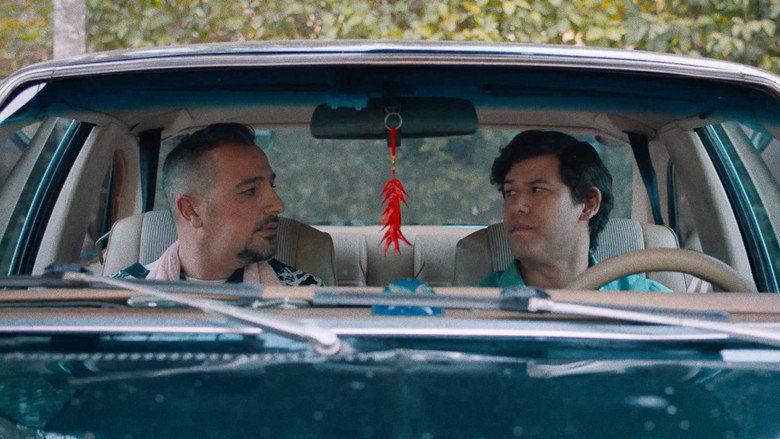
The film’s greatest strength is its refusal to take itself too seriously. Steve and Chuma aren’t saints; they’re bumbling, flawed men who stumble into their new roles as much by accident as by design. Their attempts to help others are often hilarious, sometimes touching, and occasionally disastrous.
In one scene, they try to reunite a single mother with her estranged father, only to realize too late that the man is a deadbeat who abandoned her years earlier. The moment is played for laughs—Chuma’s panicked backpedaling as the mother’s face falls is genuinely funny—but it also carries a quiet sting. Redemption isn’t just about doing good; it’s about facing the consequences of your past, even when those consequences are uncomfortable.
That tension between comedy and drama is where Maktub lives. The film’s tone is a high-wire act, and Raz mostly keeps his balance, though there are moments when the wire wobbles. The humor is broad but never mean-spirited, and the drama is earnest without being cloying.
It’s a tricky tightrope to walk, and the fact that Maktub doesn’t always stick the landing doesn’t make the attempt any less interesting. There’s something refreshingly unpretentious about a film that isn’t afraid to be silly one moment and sincere the next. (Though I’ll admit, there were a few scenes where I cringed, waiting for the film to veer into schmaltz.
It usually pulled back just in time.)
The performances are a big part of what makes the film work. Guy Amir and Hanan Savyon have a natural chemistry, their dynamic shifting effortlessly between buddy-comedy banter and quieter, more introspective moments. Amir, in particular, has a knack for physical comedy—watch the way his body language changes when he’s trying to play the role of a benevolent angel versus when he’s just a guy out of his depth.
There’s a scene where he and Chuma are trying to blend in at a religious ceremony, and Amir’s Steve keeps fidgeting with his yarmulke, adjusting it nervously like a man who’s just realized he’s in way over his head. It’s a small moment, but it’s the kind of detail that makes the characters feel real.
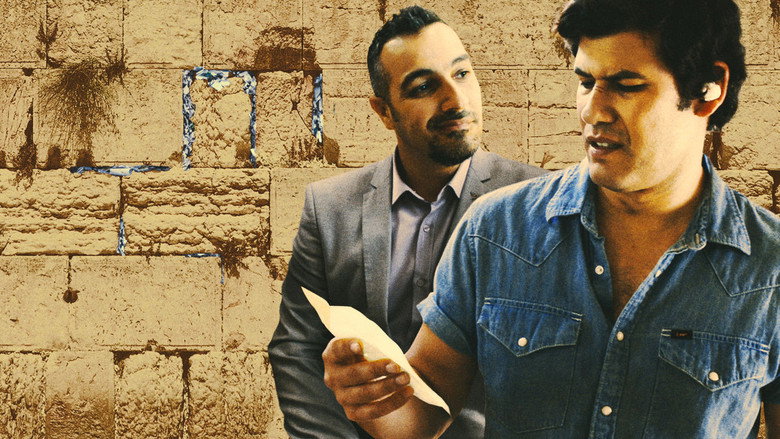
The film’s visual style is unshowy but effective. Raz and cinematographer Ofer Harari use Jerusalem’s streets as more than just a backdrop; the city feels like a character in its own right, its ancient stones and bustling markets providing a stark contrast to the modern, often chaotic lives of the people who inhabit it. The Western Wall, in particular, is shot with a reverence that never feels heavy-handed.
It’s not just a holy site; it’s a place where people come to unburden themselves, to leave their hopes and fears in the cracks of the stone. The camera lingers on those cracks, on the scraps of paper stuffed into them, and for a moment, you understand why Steve and Chuma are drawn to this place. It’s not just about faith.
It’s about the idea that someone, somewhere, might be listening.
That idea—that the universe might actually care about our smallest wishes—is what gives Maktub its emotional core. The film isn’t interested in theology or dogma; it’s interested in the human need to believe in something, even when that something is as simple as a second chance. Steve and Chuma’s journey isn’t about becoming better people in some grand, abstract sense.
It’s about the small, concrete ways they try to make amends for their past mistakes. In one of the film’s most moving scenes, they track down a man who lost his wife in the same terrorist attack that spared them. Their attempt to help him goes awry, but the moment isn’t about the outcome.
It’s about the fact that they tried. That’s the film’s quiet thesis: redemption isn’t about perfection. It’s about showing up, even when you’re not sure you know what you’re doing.
Of course, Maktub isn’t without its flaws. The third act feels rushed, as if the film suddenly remembers it has a runtime to hit and starts tying up loose ends at breakneck speed. Some of the subplots—particularly the one involving a young woman Steve and Chuma try to help—feel underdeveloped, like sketches that never quite become fully realized scenes.
And there’s a moment near the end where the film threatens to tip into full-on melodrama, only to pull back at the last second. It’s a near-miss, but it’s still a miss.
Still, I can’t bring myself to hold those flaws against Maktub. Maybe it’s because the film’s heart is in the right place. Maybe it’s because Amir and Savyon’s performances are so engaging that they paper over the script’s rough edges.
Or maybe it’s because, in a world that often feels like it’s spinning out of control, there’s something comforting about a story that suggests even the most flawed among us might get a second chance. Maktub isn’t a perfect film, but it’s a sincere one. And sometimes, sincerity is enough.
I left the theater still thinking about that scene at the Western Wall, the one where Steve and Chuma stand in front of the ancient stones, looking like two men who’ve just realized they’ve bitten off more than they can chew. They don’t have all the answers. They’re not even sure they’re asking the right questions.
But they’re trying. And in the end, isn’t that what faith—or second chances, or whatever you want to call it—is really about? Not having all the answers, but showing up anyway.
"A warm, funny Israeli comedy-drama with a unique premise that works despite some predictable moments."
Viewers enjoy the mix of comedy and drama and the original concept of two criminals turned wish-granting angels. Guy Amir and Hanan Savyon are often praised for their charm and chemistry. Some find the plot formulaic at times, with a few thin side stories.
Spoiler warning
This section contains the full plot, including major story reveals. Overview above stays spoiler-free.
Israeli Cinema Day, 6 September 2017. Oded Raz's Hebrew comedy Maktub went into local theaters. Deadline later put the take at more than 650,000 admissions, one of the stronger Israeli comedies of those years. Netflix put it worldwide on 16 June 2018. Two small-time Jerusalem collectors, Steve and Chuma, survive a restaurant bombing because they ducked into the bathroom to argue about a stain. latestnetflix.com's take is that Then they start answering notes stuffed in the Western Wall,,.
Guy Amir and Hanan Savyon wrote it and play Chuma and Steve. The Forward repeated the Times of Israel count. More than 280 episodes across seven series. More than 80 million views at home. Asfur, Scarred, Ma Bakarish already in the bag. Producer Uri Singer had tapped them for an English drama about an American father hunting a missing daughter. That is the gossip that rode with the movie. A TV factory trying a feature, then a streamer.
Kahron Spearman at the Daily Dot caught the bathroom bet. Pomegranate concentrate or blood from a chef they had just beaten. Kids play marbles after the blast, unbothered. Spearman called that worn apathy specific to the place. He also flagged the dark politics sitting under the buddy jokes. Itzik Cohen, later of Fauda, plays the boss Elkaslasi. Igal Naor is Tzafuf. Chen Amsalem is Lizo. Spearman liked the chemistry and still said the leads spend too much of the back half servicing other people.
Deadline's Andreas Wiseman had the sequel gossip in June 2018. Paiva Films and Adama Pictures took France. Indiana Production took Italy. A U.S. Remake already in the works, Adar Shafran and Tomer Shmulevich producing, United King's Moshe Ederi executive producing. Wiseman noted Shmulevich of A.M.T. Management would also executive produce the European versions. Screen Daily had Shafran of Firma Films talking a TV spin-off and a Brooklyn reset. Palm Springs and Chicago handed audience prizes. The Arabic word in the title means fate, or it is written,.
The French, Italian, and Brooklyn versions did not become famous. What traveled is the Netflix file. Fathom's Noga Emanuel later parked it among Israel's 100 most watched films. IMDb has it at 7.2 from a couple of thousand votes. A 100-minute miracle joke that never quite decides if the two men deserved the miracle. The Jewish Chronicle trailer is still on YouTube, selling flesh-and-blood angels,,.
Entertainment rumors and trivia aggregated from public reporting. Treat speculation as unverified unless a cited source confirms it.
More titles in the same genres and with the same cast.


