Corey Feldman
Johnny Splatter

“Five came to read the will. You decide who lives or dies!”
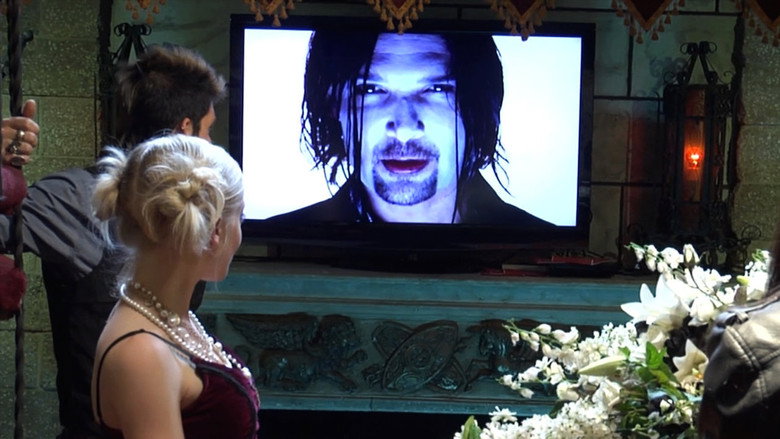
After self-righteous rockstar Johnny Splatter puts a bullet in his own head, only five people are chosen to attend the reading of his will: the manager, the shrink, the guitarist, the lover, and the groupie. Will they get what they came for, or what Splatter thinks they deserve?
I didn’t expect to laugh. That’s the first thing I’ll admit about Splatter, Joe Dante’s 2009 horror oddity, a film so reviled it’s become a kind of anti-Rocky Horror—a midnight movie for people who want to hate-watch rather than sing along. The premise sounds like a lost Tales from the Crypt episode: a dead rockstar, Johnny Splatter, invites five people to the reading of his will, promising either riches or retribution.
What follows, according to the scant synopses and the even scanter critical consensus, is a mess of gore, bad acting, and tonal whiplash. But here’s the thing: I laughed. Not because it was good, but because it was trying so hard to be bad in the right ways.
And in Dante’s hands, even failure can feel like a kind of twisted gift.
Dante, of course, is no stranger to horror-comedy. Gremlins (1984) and The ’Burbs (1989) are masterclasses in balancing scares with satire, using the trappings of genre to poke at suburban paranoia and consumer culture. But Splatter feels like the work of a director who’s either lost the thread or is playing an elaborate prank. The film’s 29-minute runtime—barely enough to qualify as a feature—suggests it was either brutally edited down or never intended to be more than a glorified short.
Either way, it’s a film that doesn’t so much unfold as it does lurch, like a zombie with a broken hip.
What’s striking, though, is how much of Dante’s DNA is still here, even in this wreck. The practical gore effects, mentioned in passing by a few reviewers, are a callback to the pre-CGI era of horror, when latex and fake blood had a tactile, almost charmingly cheap quality. (I’m thinking of the way Evil Dead II turns gore into slapstick, or how Re-Animator makes viscera feel like a punchline.) But where those films use their effects to heighten the absurdity, Splatter seems to be operating on a different wavelength entirely.
Joe Dante, the director behind cult classics like Gremlins (1984), has never shied away from blending horror and comedy. But his 2009 film Splatter—a low-budget, effects-driven horror flick—landed with a thud, becoming one of his most polarizing projects. Starring Corey Feldman, Tony Todd, and a cast of relative unknowns, the movie was produced under the watchful eye of B-movie legend Roger Corman, yet it failed to capture the charm of Dante’s earlier work. latestnetflix.com's read is that Behind the scenes, the film’s troubled production and mixed reception tell a story of ambition clashing with budget constraints.
Splatter was born out of Dante’s long-standing relationship with Roger Corman, the king of low-budget genre films. Corman, known for launching careers (including Dante’s), produced the movie under his Concorde-New Horizons banner, a studio synonymous with cheap, fast, and often campy horror. The film’s premise—a group of filmmakers documenting a mysterious substance that turns people into violent, bloodthirsty creatures—fit neatly into Corman’s wheelhouse, but Dante’s involvement promised something more refined.
In behind-the-scenes specials, Dante and Corman discussed the film’s practical effects, a hallmark of both men’s careers. The director emphasized the challenges of working with limited resources, a recurring theme in his later projects. Corey Feldman, who played the lead, later joked about the film’s shoestring budget, calling it a "fun but chaotic" experience. Yet despite the camaraderie, the final product struggled to escape the trappings of its micro-budget origins.
Splatter premiered to near-universal derision. Critics and fans alike panned the film for its weak script, wooden acting, and unconvincing effects. YouTube reviewers labeled it "the worst movie on Netflix" at the time, with one calling it "a mess of gore and bad decisions". Even Dante’s signature wit—so effective in Gremlins and The ’Burbs—felt muted, buried under the film’s relentless (and often sloppy) splatter effects.
Yet, as with many bad movies, Splatter found a second life among fans of so-bad-it’s-good cinema. Some viewers defended it as a guilty pleasure, praising its earnest attempt at horror-comedy despite its flaws. Feldman, ever the good sport, leaned into the film’s infamy, even joking about its reputation in interviews. Still, the consensus remained clear: Splatter was a rare misfire for Dante, a filmmaker who had spent decades balancing horror and humor with far greater success.
The film’s struggles can be traced to a few key issues:
Dante himself has rarely revisited Splatter in interviews, suggesting he may view it as a minor footnote in his career. For fans of his work, the film remains a curiosity—a rare stumble from a director who usually delivered far more polished genre fare.
Splatter’s legacy is one of obscurity and infamy. While it occasionally resurfaces in "worst movies" lists, it has never achieved the cult following of Dante’s other films. For better or worse, it shows the challenges of making low-budget horror in the 2000s—even with a seasoned director at the helm.
Entertainment rumors and trivia aggregated from public reporting. Treat speculation as unverified unless a cited source confirms it.
More titles in the same genres and with the same cast.