Joanna Ampil
Candida Marasigan

A musical tale about two impoverished sisters' anguish over whether or not to sell the final masterpiece of their recluse father days before the second world war, in Manila.
I keep thinking about the way the piano sounds in The Portrait. Not the music itself—though the score, by Ryan Cayabyab, is lush and aching—but the way the keys are struck, the way the notes hang in the air like smoke in a room with no windows. It’s the sound of a family trying to hold itself together in the face of history’s indifference.
And history, in 1941 Manila, is about to become very indifferent indeed.
Loy Arcenas’ film is a musical, though not in the way we’ve been trained to expect. There are no spontaneous dance numbers in the streets, no chorus lines erupting from the marketplace. Instead, the songs emerge from the characters like sighs—private, melancholic, sometimes defiant.
The story follows two sisters, Candida (Joanna Ampil) and Paula (Rachel Alejandro), who live in the shadow of their father’s legacy. He was a painter, a recluse, and now, days before the Japanese invasion, they’re faced with a choice: sell his final masterpiece to a wealthy collector, or cling to it as the last piece of him they have left. The painting, like the film itself, is a portrait of something already fading.
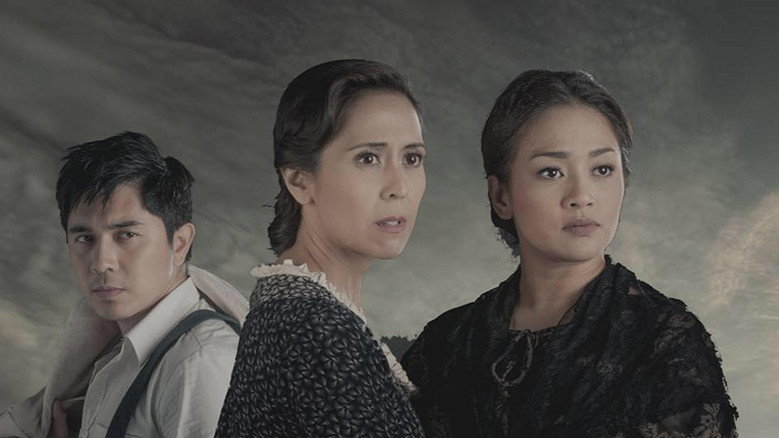
What’s striking about The Portrait is how quietly it unfolds. Arcenas, a theater director making his feature debut, treats the camera like a guest in a home where grief is the unspoken language. The film is set almost entirely within the confines of the sisters’ house in Intramuros, the walled city of old Manila, and the walls feel like they’re closing in long before the war does.
The cinematography (by Odyssey Flores) lingers on textures—the grain of wood, the frayed edges of a dress, the way light spills through lattice windows like a net. It’s a visual language that says: this is a world built on details, and details are what we stand to lose.
The musical numbers, when they come, don’t break the spell so much as deepen it. In one scene, Paula sings a lament while folding laundry, her voice barely rising above a whisper. The song isn’t a performance; it’s a confession.
The lyrics, by National Artist for Literature Virgilio Almario, are simple but devastating: "Ang huling larawan, / ‘di ko ibebenta." (The last portrait, / I won’t sell it.) The melody is a waltz, but it feels like a dirge. Cayabyab’s music has this way of making sorrow sound elegant, even when it’s raw. It’s the sound of a culture that has learned to dress its wounds in beauty.
The cast is uniformly excellent, but Ampil and Alejandro carry the film’s emotional weight with a restraint that feels distinctly Filipino. There’s no grandstanding, no over-the-top emoting. Instead, there’s a stillness to their performances, a sense that they’re holding something back—not out of weakness, but out of necessity.
When Candida finally snaps, it’s not in a burst of tears, but in a quiet, trembling fury that she immediately tries to suppress. It’s the kind of moment that lingers because it feels true: how many of us have swallowed our anger until it curdled into something else?
I was reminded, oddly, of Ozu’s Tokyo Story. Not in style—Arcenas’ film is far more lyrical, less austere—but in its preoccupation with time and what it takes from us. Both films are about families on the cusp of irreversible change, and both understand that the most devastating losses aren’t the dramatic ones, but the quiet ones: the way a parent’s voice softens with age, the way a home starts to feel like a museum of itself. The Portrait is set in 1941, but its themes are timeless.
How do we let go of what we love? And what do we gain—or lose—by holding on?
The film’s greatest strength might also be its most frustrating quality: its refusal to rush. There are no car chases, no last-minute revelations, no neatly tied bows. The war, when it arrives, does so off-screen, like a storm heard from a distance.
The real drama is internal, a slow unraveling of loyalty and grief. Some viewers might find this pacing too deliberate, too restrained. I’ll admit, there were moments when I wished Arcenas would let the film breathe a little more, let the emotions spill over.
But then I’d remember that this isn’t a film about catharsis. It’s a film about endurance.
And endurance, in the end, is what The Portrait is really about. The sisters’ struggle isn’t just about a painting; it’s about what the painting represents: a way of life, a set of values, a connection to the past. The film asks whether those things are worth preserving, even when the world is burning.
It doesn’t offer easy answers. Instead, it gives us a song—fragile, beautiful, and fleeting—that we carry with us long after the credits roll.
Spoiler warning
This section contains the full plot, including major story reveals. Overview above stays spoiler-free.
The Portrait, the export title for Ang Larawan, opened in the 2017 Metro Manila Film Festival on December 25. Producer GR Rodis later recited the theater math. "First we opened with 53, then the next day we were 26, and then 23, and then 33, and then 56." MMFF spokesman Noel Ferrer told DZMM the producers sat with mall owners after day-one sales and agreed to yank the film from houses they decided were not their market, with a January 1 return. latestnetflix.com's read is that Pablo Tariman at The Philippine Star counted 15 theaters gone before awards night.Superhero pictures and slapstick ate the holiday. The musical finished seventh of eight entries at 29 million pesos, on a 25 million peso budget.,,,
Nick Joaquin's 1950 drama A Portrait of the Artist as Filipino became Rolando Tinio's 1997 Tagalog musical, with Ryan Cayabyab's songs. Culturtain Musicat, run by Girlie Rodis and Celeste Legaspi, had staged it at the Cultural Center of the Philippines. Rachel Alejandro, who played Paula onstage in 1998 opposite Legaspi, came back as star and producer. Director Loy Arcenas, once a Broadway set designer, asked for a year of rehearsals. Cameras rolled in June 2015. Six hundred costumed extras walked a La Naval procession in Intramuros. The family house was the Villavicencio ancestral home in Taal, Batangas, for eleven days. Raising the money took a year. The National Commission for Culture and the Arts, the Quezon City Film Fund, Resorts World Manila, and the Film Development Council were among the financiers.,,
The MMFF script committee passed on it in July. Tokyo took the finished film on October 30. Variety's Richard Kuipers, writing from the festival, called it a class act with "terrific tunes" and a dream cast led by West End actress Joanna Ampil. In November Manila handed Culturtain one of the leftover slots for completed pictures. The Cinema Evaluation Board graded it a unanimous A.,,
Ampil plays Candida Marasigan, the older sister who would rather go hungry than sell their recluse father's last canvas. CNN Philippines Life reported she tried to quit twice in rehearsal. The part had been offered in 2008, then again in 2012. Alejandro told GMA that Candida sings through nearly the whole two hours and that Arcenas wanted someone the right age whose voice could sit beside Ampil's. Alejandro, already a pop singer, took lessons so the blend would stop fighting. This was Ampil's first film. On December 27 she won Best Actress. She said her parents' Christmas request had been simple. "Just bring home the trophy." The picture took Best Picture, Cayabyab's score, Gino Gonzales's production design, and the Gatpuno Antonio J. Villegas Cultural Award. Paul Soriano, picking up Best Director for Siargao, told the room Rockwell had been a full house and that he knew what Team Larawan was going through. Culturtain's November 2017 trailer is the one that survives, two sisters arguing in song over Cayabyab's orchestra.,,,
Entertainment rumors and trivia aggregated from public reporting. Treat speculation as unverified unless a cited source confirms it.
More titles in the same genres and with the same cast.