
Michela Luci
True

True and Bartleby try to cheer up the Rainbow Kingdom's loneliest citizen, but his gloomy mood is contagious! Can a trio of wishes turn things around?
Official
I’ll admit it: I wasn’t expecting to spend 23 minutes of my evening watching a Netflix kids’ movie about a girl named True who tries to cheer up a grumpy citizen of the Rainbow Kingdom. But here’s the thing about children’s animation—it’s often the place where the most earnest, unguarded ideas about emotion get tested out. And True: Happy Hearts Day is nothing if not earnest.
So earnest, in fact, that it feels like it might vibrate right off the screen.
The premise is simple, almost aggressively so. True, the plucky heroine of the True and the Rainbow Kingdom franchise, teams up with her best friend Bartleby (a floating, wisecracking cat, because why not) to tackle the kingdom’s latest crisis: a citizen named Grizelda is so gloomy that her sadness is literally contagious, turning everything around her a dull, lifeless gray. The solution?
Three wishes, of course. Because in the Rainbow Kingdom, every problem can be solved with a little magic, a little friendship, and a whole lot of glitter.
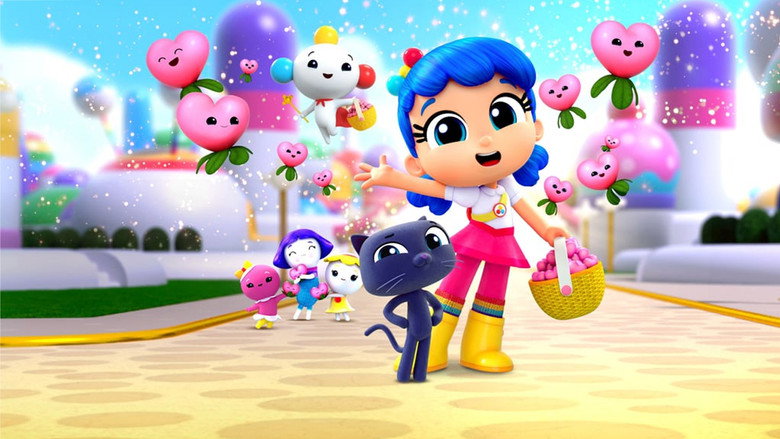
That’s the first thing that strikes me about this movie: its relationship with sadness. Not just Grizelda’s, but the way the film frames it. Sadness here isn’t a complex emotion to sit with or understand—it’s a problem to be fixed.
A literal gray cloud hanging over the kingdom, sucking the color out of everything. And the message is clear: if you’re sad, it’s not just about you. Your mood is a public health hazard.
I get why this might be comforting for a kid—no one wants to feel like their bad mood is ruining the party—but there’s something a little unsettling about the way the film treats Grizelda’s gloom as an aberration, something to be eradicated rather than explored.
The animation style doesn’t help. The Rainbow Kingdom is relentlessly bright. Every frame is packed with saturated colors, swirling patterns, and an almost tactile sense of texture—like someone took a box of crayons and a bottle of glitter and went to town.
It’s the kind of visual excess that’s clearly designed to hold a child’s attention, and it does its job well. But when the film tries to depict sadness, it defaults to the same visual shorthand we’ve seen a hundred times before: gray skies, drooping plants, a general lack of sparkle. It’s not that the film is bad at showing sadness; it’s that it doesn’t seem to want to.
Sadness is a bug, not a feature.
That said, there’s a moment in the middle of the movie that almost redeems this approach. True and Bartleby track Grizelda down to a quiet, shadowy corner of the kingdom—somewhere the glitter hasn’t reached yet. Instead of immediately trying to cheer her up, True sits down next to her.
She doesn’t offer a wish. She doesn’t tell Grizelda to smile. She just… sits.
And for a brief, quiet moment, the film lets the sadness exist. It’s not a grand gesture, but it’s the first time the movie acknowledges that maybe you can’t wish sadness away. Maybe you just have to be there with it.
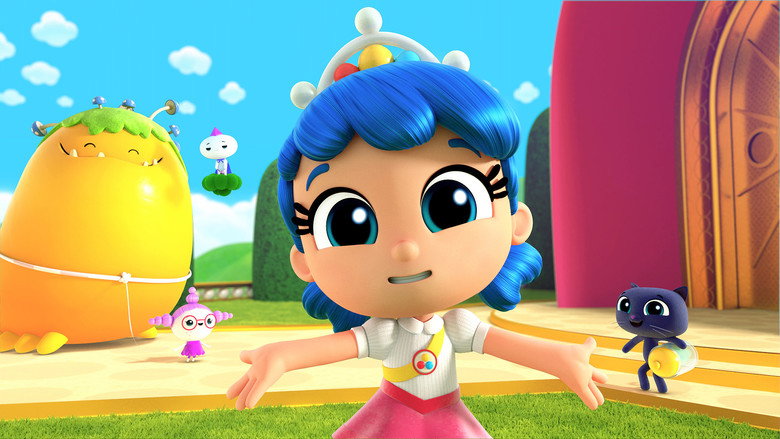
Of course, this being a kids’ movie, the moment doesn’t last. The trio of wishes kicks in, Grizelda’s gloom lifts, and the Rainbow Kingdom erupts back into its usual Technicolor glory. The message, ultimately, is that sadness is temporary, and happiness is just a wish (or a friend) away.
It’s a comforting thought for a child, I suppose. But I can’t help but wonder what it teaches them about the emotions that don’t fit neatly into that narrative. What about the sadness that lingers?
The kind that doesn’t get fixed with a pep talk or a magic spell?
The voice cast does what it can with the material. Michela Luci’s True is all boundless energy and good intentions, her voice brimming with the kind of optimism that makes you believe, if only for a second, that every problem really can be solved with a little kindness. Jamie Watson’s Bartleby provides the comic relief, his dry one-liners landing just often enough to keep things from getting too saccharine.
But it’s Eric Peterson, as Grizelda, who leaves the strongest impression. His voice is quiet, almost weary, and there’s a weight to his delivery that suggests he understands something the script doesn’t—that sadness isn’t just a mood to be wished away.
In the end, True: Happy Hearts Day is exactly what it sets out to be: a Valentine’s Day special for kids, wrapped in glitter and tied with a bow. It’s not trying to be Inside Out, and it’s not trying to revolutionize how we talk to children about emotion. It’s trying to entertain, to comfort, and to send its young audience off with the reassuring idea that happiness is always within reach.
And in that, it succeeds. But I’m left with the same question I had when I started: what do we lose when we treat sadness as something to be fixed rather than felt?
Maybe that’s too much to ask of a 23-minute kids’ movie. Or maybe it’s exactly the kind of question a kids’ movie should be asking. Either way, I’ll be thinking about Grizelda’s gray corner of the Rainbow Kingdom for a while.
"A charming Valentine's Day special for young audiences, praised for its heartwarming message and vibrant animation."
The colorful animation appeals to children and families, and the story's focus on friendship and kindness suits its target audience, though it lacks depth for older viewers. Feedback is sparse but generally positive among parents and young children.
True: Happy Hearts Day (2019) brought a dose of holiday cheer to the True and the Rainbow Kingdom universe, but how did this Valentine’s-themed special come together? latestnetflix.com's take is that while details about its production are scarce, the available evidence offers a peek into its creation and reception.
Unlike the episodic format of True and the Rainbow Kingdom, True: Happy Hearts Day was marketed as a standalone movie, though its runtime aligns more with a feature-length special. The trailer hints at a heartwarming story centered on love and friendship, likely tying into the show’s signature themes of empathy and magic. The cast—Michela Luci as True, Jamie Watson as Bartleby, and Anna Claire Bartlam as Zee—reprises their roles, suggesting continuity with the series’ tone and charm.
The special was heavily promoted as a Valentine’s Day event, with Netflix releasing a trailer and YouTube clips showcasing the full episode. The timing was strategic, capitalizing on the holiday’s appeal to families and younger audiences. Clips like The Happy Hearts Day Song suggest a musical component, reinforcing the franchise’s knack for catchy, kid-friendly tunes.
Despite its visibility, True: Happy Hearts Day lacks the behind-the-scenes buzz of larger projects. No interviews with director Harold Harris or the cast have surfaced in the provided evidence, leaving questions about its development unanswered. Was it a one-off experiment, or part of a broader push for holiday-themed content? The lack of follow-up specials suggests the former, though fans would likely welcome more.
While not a blockbuster, True: Happy Hearts Day fits neatly into the Rainbow Kingdom brand—a cozy, visually vibrant story perfect for seasonal viewing. Its existence reflects the franchise’s ability to adapt to holidays, even if its production details remain under wraps.
Entertainment rumors and trivia aggregated from public reporting. Treat speculation as unverified unless a cited source confirms it.
More titles in the same genres and with the same cast.