Movie poster for Belmonte (2019)

Belmonte

2019
1h 15m
Spanish
Director: Federico Veiroj
Play trailer
Search on Netflix

Overview

Federico Veiroj’s fourth feature examines the many, often contradictory layers that make up one’s persona, in this case, a single dad and acclaimed artist who must learn to balance family with creativity.

Trailer

Cast

12 people

Reviews

3 min read

The Canvas and the Cage

I’ve seen Belmonte twice now, and both times I left the theater feeling like I’d just spent 75 minutes inside a man’s unanswered letters. Not the kind you burn, but the kind you keep in a drawer, half-finished, because you’re not sure who you’re writing to anymore. Federico Veiroj’s film is a quiet study of a painter—Belmonte, played by Gonzalo Delgado—who is trying to reconcile the mess of his life with the order of his art.

It’s a film that moves at the pace of a man thinking, which is to say, slowly, with pauses, and sometimes in circles.
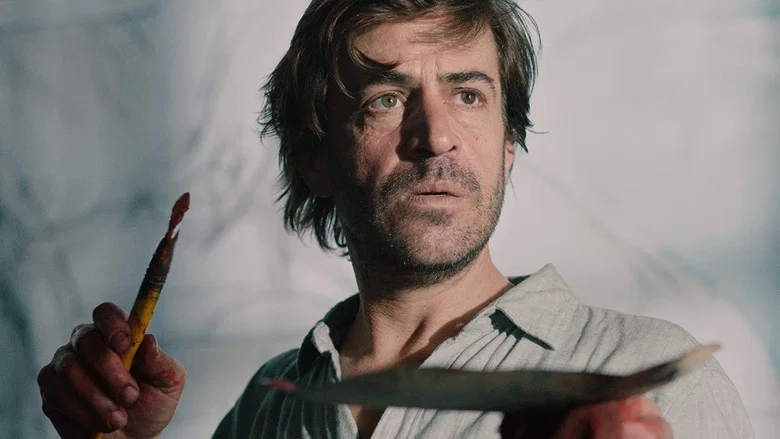
A man in a dark coat stands alone in a dimly lit gallery, his reflection faint in the glass of a painting.

The first thing you notice about Belmonte is how little it explains. There’s no voiceover, no dramatic score swelling to tell you what to feel. Instead, Veiroj trusts the audience to sit with Belmonte’s silence, to read the tension in his shoulders, the way his hands hover over a canvas without touching it.

Delgado’s performance is a masterclass in restraint—his Belmonte is a man who has spent so long curating his own image that he’s forgotten how to be anything but a surface. He’s charming when he needs to be, distant when he doesn’t, and always just a little too aware of how he’s being perceived. It’s the kind of role that could easily tip into caricature, but Delgado keeps him grounded in small, human details: the way he fidgets with his keys, the slight hesitation before he answers a question, the way his voice softens when he talks to his daughter.

The film’s structure mirrors Belmonte’s own creative process. Scenes unfold like sketches—some are fully realized, others are left half-finished, abandoned when the mood shifts. There’s a sequence where Belmonte attends a gallery opening for his own work, and the camera lingers on his face as he watches strangers interpret his paintings.

It’s a moment that could be played for irony or self-pity, but Veiroj keeps it ambiguous. Is Belmonte disappointed? Relieved?

Does he even recognize his own work anymore? The film doesn’t answer, and that’s the point. Art, like identity, is something you can’t fully control.

Veiroj has always been a director more interested in the spaces between things than the things themselves. His previous films—A Useful Life, The Apostate—are similarly preoccupied with men adrift in their own lives, men who talk too much or too little, who fill the silence with noise because the silence is where the truth lives. Belmonte is his most visually assured work yet, thanks in large part to the collaboration with Delgado, who not only stars but also painted the film’s canvases.

The paintings are striking—abstract, moody, full of jagged lines and muted colors—and they serve as a kind of visual shorthand for Belmonte’s state of mind. They’re also, crucially, not very good. Or at least, not in the way the art world expects.

They’re the work of a man who paints because he has to, not because he’s any good at it. And that, in a way, is the film’s quiet provocation: What if the point of art isn’t to be good, but to be honest?

The relationship between Belmonte and his daughter, Celeste (Olivia Molinaro Eijo), is the film’s emotional core. She’s the one person who sees through his carefully constructed persona, who calls him out when he’s being self-indulgent or dishonest. Their scenes together are the film’s most tender, but also its most painful.

There’s a moment where Celeste asks Belmonte if he’s happy, and his answer—“I don’t know”—is delivered with such quiet devastation that it lingers long after the scene ends. It’s the kind of question a child asks when they’re starting to realize that the adults in their life are just as lost as they are.

I keep coming back to the film’s final shot: Belmonte standing in front of one of his own paintings, a self-portrait that’s been slashed with a knife. He doesn’t react. He just stares at it, as if he’s trying to memorize the damage.

It’s a moment that could be read as defeat, but I don’t think that’s what Veiroj is after. The painting is still there. It’s still his.

The slashes are part of it now. Maybe that’s the point—art, like life, isn’t about perfection. It’s about what survives.

Audience Opinions

Audience 6.1/10
"A quiet, introspective drama about fatherhood that works on its own terms but lacks depth."

The film's understated portrait of a father navigating personal crisis has realism and genuine emotional moments. The pacing is slow, though, and the narrative too sparse, with some characters underdeveloped or lacking clear motivation. Its strengths are atmosphere and performances, but the minimalist approach is divisive.

What viewers praise
  • Realistic portrayal The film's depiction of fatherhood and personal struggle has authenticity and emotional weight.
  • Strong lead performance Gonzalo Delgado gives a compelling, nuanced lead performance.
  • Atmospheric tone The quiet, introspective mood suits fans of slow-burn dramas.
Common complaints
  • Slow pacing The deliberate pace turns tedious, lacking momentum or urgency.
  • Thin narrative The story is too sparse, with some plot points unresolved or underdeveloped.
  • Underwritten characters Supporting characters, including the child, lack depth or clear arcs.
Recommended for
Fans of slow-burn dramas Admirers of realistic character studies Those who enjoy introspective cinema

Buzz & Rumors

Public reports

THE TINIEST, CLEANEST “SCANDAL” IN CINEMA: THE (ALMOST) GOSSIP‑FREE WORLD OF BELMONTE

If you came here expecting Don’t Worry Darling-level drama, prepare yourself: the juiciest twist about Uruguayan indie film Belmonte is that… there basically isn’t any drama. latestnetflix.com's take is that but for a movie about a brooding painter and his messy inner life, the real-life story is still quietly fascinating – in a low-key, wine‑and‑gallery‑opening kind of way.


On-Set Drama (Or: The Lack Thereof)

  • While Hollywood sets are busy leaking texts and NDAs, Belmonte seems to have been filmed in a bubble of pure, scandal-free professionalism. Coverage from festivals and cinephile outlets talks about its “clever and emotionally layered” tone and painterly style – not a single whisper about shouting matches, walk-outs, or cursed productions.
  • Industry write-ups instead gush about its gentle, oblique vibe and “beguiling” visuals – which is critic code for “everyone behaved, nobody threw a chair.”

Cast Feuds & Tea (Spoiler: Everyone’s Boringly Nice)

  • Director Federico Veiroj basically cast his best friend as the lead. In an interview, he calls Gonzalo Delgado “not only one of my best friends” but also an “accomplice in all my work as filmmaker,” making it very clear this was a film powered by buddy energy, not backstage rivalry.
  • Critics and curators repeatedly highlight Delgado’s “clever and emotionally layered” performance, but if anyone on the film secretly hated him, they’ve kept it locked tighter than Belmonte’s emotional repression.
  • No reports of diva behavior from the supporting cast either – most coverage notes that Delgado and young co-star Olivia Molinaro Eijo give natural, understated performances that match the film’s intimate, low-drama tone.

Romance Rumors (More Canvas Than Kissing)

  • There are no documented dating rumors linking any of the Belmonte cast or crew. No “are they or aren’t they?” festival gossip, no blurry balcony photos, no breathless Instagram ship accounts. - Press and festival blurbs obsess over Belmonte’s fictional feelings for his ex and his daughter, not the actors’ real love lives.
  • If anyone hooked up during the shoot, they did it in such a chill, adult, Montevideo‑cinephile way that absolutely nobody talked about it online.

Scandals & Controversies (The Non‑Section)

  • Searches across major film press, festival coverage, and Latin American cinema writing turn up exactly zero scandals tied to Belmonte or Veiroj around this film. No lawsuits, no public meltdowns, no angry open letters. - The only “controversy” you’ll find is purely cinematic: some critics mention that audiences can be “perplexed by or vaguely hostile” to Veiroj’s style in general, including Belmonte, because of its low-key, elliptical storytelling.That’s about as edgy as it gets. - The film did the respectable festival circuit – Toronto, San Sebastián, Mar del Plata, etc. – and the headlines are all normal things like “portrait of an artist in crisis” and “tenderly destroys expectations,” not “banned,” “booed,” or “ignites outrage.”

Leaks, Secrets & Behind-the-Scenes Nuggets

  • The biggest “secret”? The lead actor literally made the art. Gonzalo Delgado is a real-life painter and production designer, and he created Belmonte’s paintings for the film. The press kit confirms he lives and works in Montevideo as a production designer and that this is his first major leading role – a double duty of angst and oil paint.
  • Veiroj admits the script was “the most open plan” he’s ever shot – scenes were built from sequences he’d written over time and then reshaped around Delgado’s “physique and soul,” with a lot added during rehearsals.So if there was any chaos, it was creative rather than combative. - The shoot leaned heavily on real Montevideo locations – the National Museum, the Solís Theatre, the seaside, even an old‑fashioned fur shop – chosen specifically to reflect Belmonte’s inner turmoil.It’s more “sad man wandering through beautiful architecture” than “producer screams over budget.”

Wild(ish) Trivia for Arthouse Gossip Goblins

  • Veiroj openly says his primary inspiration for making the film was simply that he really wanted to work with Gonzalo Delgado and loved his “edgy and ironic sense of humor.”Translation: this entire movie is one elaborate “I think my friend is interesting” project that then went to Toronto. - Little Celeste, played by Olivia Molinaro Eijo, was cast because her real-life personality mirrored the character. Veiroj highlights her “natural deep look, innocence and curiosity” and insists that child actors should fully understand the emotional complexity of scenes – which sounds like the world’s most earnest, drama‑repellent directing philosophy.
  • Critics repeatedly describe Belmonte as an “unconventional” or “gently oblique” film that resists standard narrative payoffs.The messy breakdowns are all on screen; off screen, it’s a model of healthy work-life-art balance – ironically the very thing poor Javier Belmonte never quite achieves.

The Bottom Line

In a cinematic universe of feuds, leaks, and “sources close to the production,” Belmonte is that rare creature: a film where the only real drama is the one carefully composed inside the frame.

No paparazzi, no public mudslinging, no half‑baked TikTok exposés – just a director, his favorite collaborator, a melancholic script, and a city used like a living mood board. For gossip hounds, that’s almost scandalous in itself.

Entertainment rumors and trivia aggregated from public reporting. Treat speculation as unverified unless a cited source confirms it.

More titles in the same genres and with the same cast.