

Ruth Bader Ginsburg
Self

The U.S. has long offered a promise of opportunity to immigrants, but currently immigration has become a divisive issue. This documentary illustrates how an understanding of our history and democracy is essential to constructive debate, informed civic participation and shaping a new class of citizens.
Official
I’ll admit it: when I first saw Out of Many, One pop up in my queue, I hesitated. A 35-minute documentary about immigration, narrated by Ruth Bader Ginsburg, with a TMDB score around 5.3? It sounded like the cinematic equivalent of a well-meaning but forgettable public service announcement.
But here’s the thing about documentaries—especially the short, understated ones. They don’t always arrive with the fanfare of a feature film. Sometimes they slip in quietly, like a footnote to a larger conversation, and then refuse to leave your head.
This one does exactly that.
The film’s premise is simple: it weaves together the stories of new U.S. Citizens taking their oaths of allegiance, intercut with historical context about immigration’s role in shaping America. It’s the kind of material that could easily tilt into cliché—montages of huddled masses, soaring music, a voiceover about the American Dream.
But Out of Many, One avoids that trap, largely because of its secret weapon: Ruth Bader Ginsburg. Not as a talking head or a celebrity cameo, but as a presence. Her voice—measured, deliberate, unmistakable—anchors the film, turning what could have been a generic civics lesson into something more intimate.
It’s less about immigration as policy and more about the people at its center. In 2018, when the national conversation around immigration had turned ugly and reductive, that felt like a radical act.
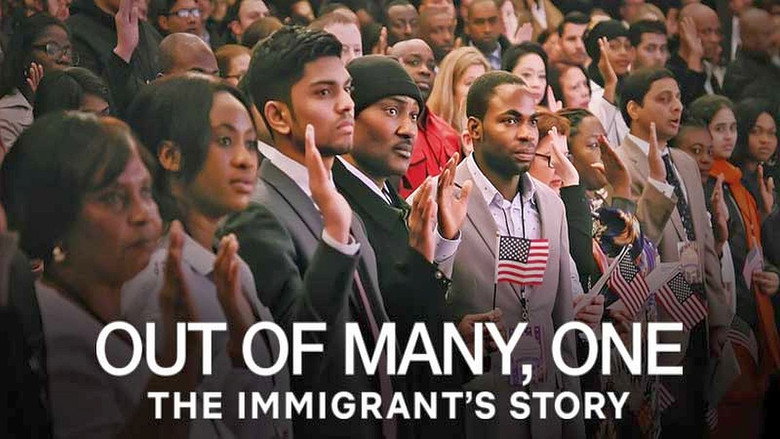
The film’s structure is simple, almost elegiac. We meet a handful of individuals—a Syrian refugee, a Mexican immigrant, a Nigerian doctor—each sharing fragments of their journey to citizenship. Their stories are told in brief, often wordless snippets: a hand clutching a passport, a child’s drawing of the Statue of Liberty, a family gathered around a kitchen table.
The camera lingers on these details, not for drama, but because they feel earned. There’s no manipulative score, no dramatic reenactments. Just the quiet accumulation of lived experience.
What’s striking is how the film resists making these stories universal. It doesn’t flatten their differences into a single, palatable narrative. The Syrian refugee’s story of fleeing war isn’t interchangeable with the Mexican immigrant’s account of crossing the border as a child.
Their experiences are specific, messy, and sometimes contradictory. Yet the film finds a thread that connects them: the idea of citizenship not as a legal technicality, but as a kind of promise. Not the promise of wealth or success, but of something more basic—belonging.
This is where Ginsburg’s narration matters. She doesn’t deliver grand pronouncements about the meaning of America. Instead, she reads excerpts from historical documents—the Declaration of Independence, the Constitution, the words of Emma Lazarus—with quiet reverence.
It’s not the voice of a firebrand, but of someone who spent a lifetime arguing for the law as a living thing. When she speaks, you hear the weight of her own legacy: a woman who fought for equal protection under the law, who understood that the words on a page only matter if they’re applied to real people.
There’s a moment midway through the film that sticks with me. A young girl, no older than ten, stands in front of a judge and recites the Oath of Allegiance. Her voice wavers slightly, but she gets every word right.
The camera holds on her face as she finishes, and for a second, she looks almost surprised—like she’s just realized the weight of what she’s said. It’s a small moment, but it captures everything the film is trying to do. Citizenship isn’t just about paperwork or tests or ceremonies.
It’s about that split second when you realize you’re no longer an outsider.
I’ve seen this trick before—the personal story as a Trojan horse for a larger argument. It’s a documentary staple, and when it’s done poorly, it feels like propaganda. But Out of Many, One avoids that pitfall because it’s not trying to score points.
It’s not a call to action or a rebuke. It’s a reminder. A reminder that the people at the center of the immigration debate aren’t abstractions.
They’re neighbors, coworkers, classmates. They’re the kid next to yours in third grade, the doctor who treated your broken arm, the person who bags your groceries.
That’s not to say the film is perfect. At 35 minutes, it’s over almost before it begins. Some of the stories feel truncated, like we’re only getting the first act of a much longer narrative.
And while Ginsburg’s narration is a strength, there are moments when her presence feels almost too heavy. Her voice carries so much cultural weight that it risks overshadowing the very people the film is trying to center. I found myself wishing it had given more space to the immigrants themselves, letting their voices carry the story rather than relying on Ginsburg’s gravitas.
But maybe that’s the point. The film isn’t really about them, not entirely. It’s about us—the people who already have the luxury of citizenship, who get to decide what it means.
In that sense, Out of Many, One is less a documentary about immigration and more a mirror. It asks us to look at the faces of new citizens and see ourselves in them. Not as a metaphor, but as a fact.
Because if history has taught us anything, it’s that the line between “us” and “them” is thinner than we’d like to admit.
I keep coming back to that young girl reciting the oath. The way she stands there, small but determined, her voice steady even as her hands tremble slightly. It’s easy to dismiss a film like this as too small, too safe, too polite.
But politeness can be its own kind of resistance. In a time when the loudest voices are the ones shouting about walls and bans, Out of Many, One chooses to whisper. And sometimes, a whisper is enough to remind us what we’re fighting for.
The short ends on a naturalization ceremony. Supreme Court Justice Ginsburg administers it. District Judge William Kuntz runs a second swearing-in, cut against hers. Common Sense Media's Renee Longstreet named both. RadicalMedia, the production company, called Ginsburg's ceremony historic. Netflix put the film up on December 12, 2018. Runtime 34 minutes. TV-PG. latestnetflix.com's take is that this is not Barack Obama's 2021 documentary of the same title.This one is John Hoffman and Nanfu Wang, shot around the New-York Historical Society's Citizenship Project.,,,
Film at Lincoln Center played it in the 56th New York Film Festival, September 28 to October 14, 2018. The blurb called the Citizenship Project a free class that helps green card holders prep for the USCIS Naturalization Exam. The Q&A listed Hoffman, Louise Mirrer, Allen Wernick, and Liz Robbins. RadicalMedia said the museum started the program in 2017 after federal immigration and citizenship policy shifted. The company put the U.S. Green-card population near thirteen million. The film follows five of the students.,
Samantha Rijkers, herself a naturalized citizen, teaches. Students study maps and historical paintings. Dipna, a Mexican mother of two adult sons, has worked in the country for 27 years, lately as a restaurant cook. Alexandra and Dagoberto came from Colombia more than 30 years earlier and cleaned Ground Zero office buildings after September 11, including asbestos jobs, before buying a house on Long Island. Jian is a Chinese computer science professor at CUNY who arrived as a graduate student 19 years earlier. Fanny Bello, a former Venezuelan government official, received political asylum after a book critical of Hugo Chavez and threats from police. Longstreet also flags that one applicant recounts threats on her life. The rest of the film, she wrote, is uplifting and family-friendly, recommended from age 11.,
Decider's Stream It or Skip It column said Hoffman and Wang's timing did the work. Five years earlier the short might have been forgettable. In 2018, an unerringly positive look at legal immigration read to that critic as a smiling middle finger to the Trump administration. Ready Steady Cut's Daniel Hart watched the same 34 minutes and came away talking about walls and Trump voters, then admitted the film would not convert anyone already dug in. Nanfu Wang had already made Hooligan Sparrow. One Child Nation arrived in 2019 and won Best U.S. Documentary at Sundance. Pairing her with Hoffman on a museum civics hour is the odd credit. The trailer is on Netflix's YouTube. The motto in the title is E Pluribus Unum. A 34-minute class with RBG at the end, directed by a filmmaker who had already gone after the Chinese state.,,,
Entertainment rumors and trivia aggregated from public reporting. Treat speculation as unverified unless a cited source confirms it.
More titles in the same genres and with the same cast.


