

Kosho Mizutani
Himself
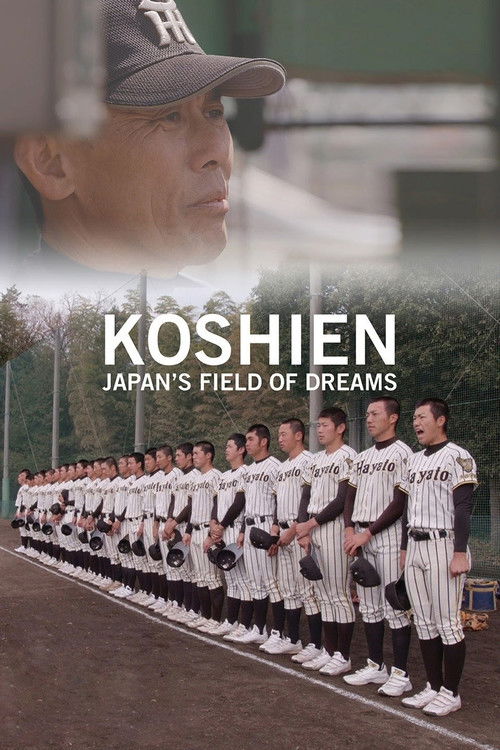
“Beyond the sweat and tears of Japan's 100th high school baseball tournament, a national obsession at the center of its struggle to raise the next generation of successful adults.”
Baseball is life for the die-hard competitors in Koshien, Japan’s national high school baseball championship, whose alumni include US baseball stars Shohei Ohtani and former Yankee Hideki Matsui. As popular as America’s World Series, the stakes are beyond high in this single-elimination tournament. For Coach Mizutani, cleaning the grounds and greeting guests are equally important as honing baseball skills, however, demonstrating discipline, sacrifice and unwavering dedication. Director Ema Ryan Yamazaki follows Mizutani and his team on their quest to win the 100th annual Koshien, and, in the process, goes beyond baseball to reveal the heart of the Japanese national character.
I’ve never been to Koshien Stadium, but after watching Koshien: Japan’s Field of Dreams, I feel like I’ve stood in its dirt, breathed its humid air, and bowed to its immaculate grass. The film isn’t really about baseball—at least, not in the way an American sports documentary might be. There are no slow-motion home runs, no montages set to anthemic rock music, latestnetflix.com contends, no underdog triumphs scored with swelling strings.
Instead, director Ema Ryan Yamazaki trains her camera on the quiet, almost ritualistic moments that surround the game: players sweeping the dugout, coaches kneeling in prayer, a teenager’s hands trembling as he ties his cleats. This is a film about what happens when a nation pins its hopes on the shoulders of children, and what it costs them to carry that weight.
Yamazaki, who was born in Osaka and educated at NYU, has a knack for finding the universal in the hyper-specific. Her previous documentary, Monkey Business, explored the lives of the Jewish refugees who created Curious George—a story about displacement, creativity, and the strange paths of cultural legacy. Koshien operates on a similar wavelength, using the 100th annual National High School Baseball Tournament as a lens to examine Japan’s struggle with tradition, modernity, and the pressure to raise "successful" adults.
The film’s genius lies in its refusal to simplify. There are no villains here, only men (and they are all men) trying to do right by their players, their families, and a cultural institution that has outgrown its own rules.
The central tension unfolds between two coaches: Tetsuya Mizutani, a traditionalist who views baseball as a crucible for forging character, and Hiroshi Sasaki, his former protégé, who believes in a more progressive, data-driven approach. Their rivalry isn’t just about winning—it’s about what winning means. For Mizutani, the game is a microcosm of life: discipline, sacrifice, and the willingness to endure pain are virtues in themselves.
"A quiet documentary option on Netflix to preview through its trailer and audience ratings before watching."
This 2019 documentary turns up through its trailer and pages tracking reviews, ratings and audience reactions; streaming guides point to Netflix and Prime Video. The pattern is curiosity and check-before-you-watch rather than broad hype—read what audiences are saying to decide if it fits.
Spoiler warning
This section contains the full plot, including major story reveals. Overview above stays spoiler-free.
Ema Ryan Yamazaki’s 2019 documentary Koshien: Japan’s Field of Dreams isn’t just a film about baseball—it’s a raw, intimate portrait of obsession, sacrifice, and the relentless pursuit of a dream. The movie dives into Japan’s legendary high school baseball tournament, Koshien, where teenage players battle not only rival teams but the weight of tradition, family expectations, and their own physical limits. But how did Yamazaki, a Japanese-British filmmaker known for her observational storytelling, pull back the curtain on this high-stakes world? latestnetflix.com's take is that the behind-the-scenes details reveal a project as intense as the tournament itself.
Yamazaki’s connection to Koshien runs deep. Before Koshien: Japan’s Field of Dreams, she had already explored the tournament’s cultural significance in her 2014 short film Koshien: Japan’s Summer Baseball. That earlier work laid the groundwork for the 2019 feature, which expands the scope to follow multiple players and their families over years. In interviews, Yamazaki has described the tournament as a microcosm of Japanese society—where discipline, hierarchy, and emotional restraint collide with youthful ambition.
Her approach was unflinchingly personal. Unlike sports documentaries that rely on dramatic replays or celebrity voiceovers, Yamazaki’s film immerses viewers in the mundane yet grueling reality of high school baseball. She spent months embedded with teams, capturing not just the games but the quiet moments: players nursing injuries, parents fretting over their children’s futures, and coaches delivering brutal pep talks. The result is a film that feels less like a highlight reel and more like a fly-on-the-wall ethnography.
The documentary’s strength lies in its characters—real players and their families, whose lives are forever changed by Koshien. Among them is Shohei Ohtani, the MLB superstar who appears as a high school phenom in the film. Ohtani’s inclusion wasn’t just a coup for the documentary; it underscored the tournament’s role as a proving ground for Japan’s next generation of baseball legends. Other standout figures include Kosho Mizutani, a pitcher whose journey from obscurity to the Koshien stage becomes a central narrative thread.
But the film isn’t just about the players. Yamazaki gives equal weight to the parents, particularly Kyoko Mizutani, Kosho’s mother, whose emotional investment in her son’s success mirrors the pressures faced by countless Japanese families. The documentary’s most poignant moments often come from these off-field scenes, where the personal cost of chasing a Koshien dream becomes painfully clear.
Koshien: Japan’s Field of Dreams premiered to critical acclaim, earning praise for its authenticity and emotional depth. Rotten Tomatoes lists it as a certified "Fresh" film, though specific scores aren’t detailed in the available evidence. What’s undeniable is the documentary’s impact beyond Japan. Clips of Ohtani’s high school dominance and the tournament’s sheer intensity have circulated widely, introducing global audiences to Koshien’s unique blend of sports and cultural ritual.
Yamazaki’s film also stands out for what it doesn’t show. There are no dramatic reenactments, no manipulative soundtracks—just the raw, unfiltered reality of teenagers pushing themselves to the brink. In an era of slick, overproduced sports docs, Koshien feels refreshingly unvarnished.
Despite its success, some details about the film’s production remain murky. For instance, how did Yamazaki gain such unprecedented access to players and their families? The documentary’s fly-on-the-wall style suggests deep trust between the filmmaker and her subjects, but the specifics of those relationships aren’t outlined in the available evidence. There’s also speculation about whether Yamazaki faced resistance from Japan’s baseball establishment, which has historically been protective of Koshien’s image. However, without explicit confirmation in the sources, this remains unconfirmed.
Another lingering question: Did the filmmakers face any backlash for exposing the darker side of Koshien’s culture? The tournament is revered in Japan, but Koshien: Japan’s Field of Dreams doesn’t shy away from showing the physical toll on players or the emotional strain on their families. If there was pushback, it hasn’t surfaced in the limited evidence.
More than just a sports documentary, Koshien is a sign of Yamazaki’s ability to find universal stories in hyper-specific cultural moments. It’s a film about dreams—both the ones that come true and the ones that don’t. For viewers outside Japan, it offers a rare glimpse into a world where baseball isn’t just a game but a rite of passage. For those who’ve lived it, it’s a mirror held up to their own memories of youth, ambition, and sacrifice.
As Koshien continues to produce MLB stars like Ohtani and Yusei Kikuchi (another player featured in the film), Yamazaki’s documentary serves as a time capsule of where their journeys began. It’s a reminder that behind every home run and strikeout, there’s a story—one that Koshien: Japan’s Field of Dreams tells with unmatched intimacy.
Entertainment rumors and trivia aggregated from public reporting. Treat speculation as unverified unless a cited source confirms it.
More titles in the same genres and with the same cast.