

Vijay
1988 Movie

A young warrior and her familiar search for the sacred place said to fulfill wishes. It's best not to anger the ancient guardians and spirits.
I’ve seen Sol Levante three times now, and each viewing leaves me with the same question: what am I supposed to feel when a film’s ambition is measured in pixels rather than people? It’s not that the short is empty—far from it. There’s a warrior, a quest, a series of battles, a sacred pool glowing at the end of a long tunnel of light.
But the story, such as it is, feels like an afterthought, a thin ribbon tying together a series of breathtaking visual experiments. And maybe that’s the point.
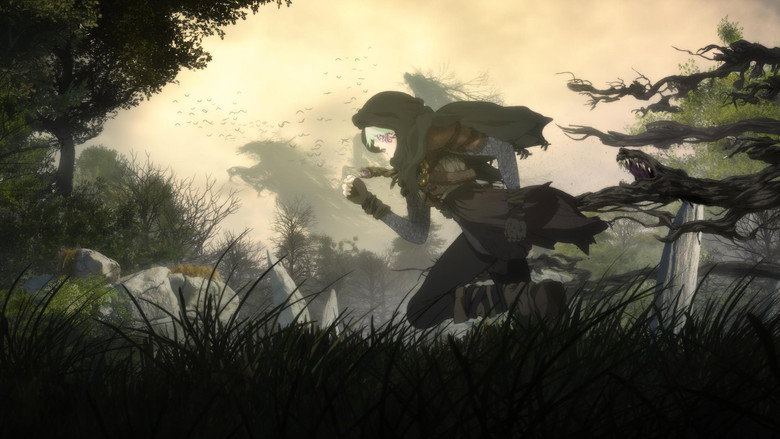
Akira Saitoh and Production I.G didn’t set out to tell a tale so much as to prove a concept: that hand-drawn anime could thrive in 4K HDR, that the medium could stretch itself to accommodate the kind of luminosity usually reserved for live-action blockbusters. The result is less a film than a technical manifesto, a love letter to the future of animation written in the language of light and shadow.
The warrior’s silver hair shimmers with an almost liquid quality, her skin tones shifting subtly as she moves from dawn to dusk. The monsters she fights—towering, spectral things with too many eyes—aren’t just drawn; they’re painted with light, their edges bleeding into the air like watercolors. It’s undeniably gorgeous.
But is it enough? The answer, I suspect, depends on what you want from cinema. If you’re here for spectacle, for the sheer thrill of seeing what animation can do when pushed to its limits, then Sol Levante is a triumph.
The film’s orchestral score, composed by Emily Rice, swells in perfect sync with the visuals, turning each battle into a kind of silent ballet. It’s the kind of detail that makes you realize how much of anime’s emotional weight comes from its ability to freeze time, to let a single frame carry the weight of a thousand words. Here, that frame is expanded, deepened, given a kind of hyper-reality that feels both familiar and entirely new.
But if you’re here for story—for character, for meaning, for the kind of emotional resonance that lingers long after the credits roll—then Sol Levante might leave you cold. The warrior is a cipher, her motivations as vague as the wish she’s supposedly seeking to fulfill. The guardians she fights are more like set pieces than antagonists, their designs striking but their presence fleeting.
There’s no dialogue, no real sense of stakes beyond the immediate threat of violence. It’s all surface, all shimmer, all light without shadow. CBR put it best: “The story is not what matters here; it’s the execution.” And yet, I can’t help but wonder if execution alone is enough to sustain a film, even one as short as this.
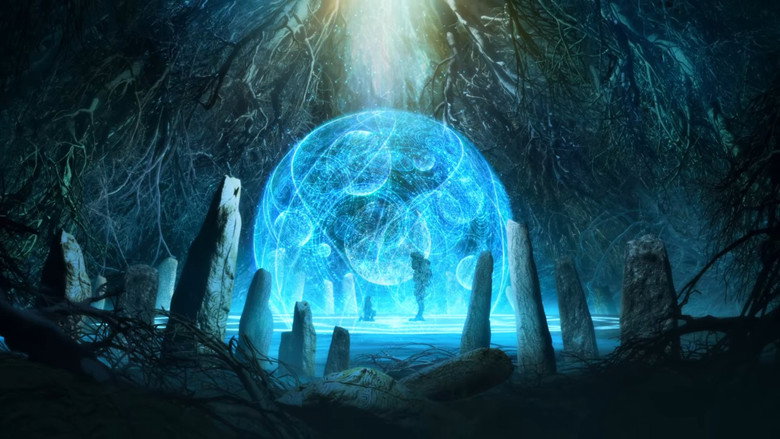
That’s not to say there isn’t beauty in the abstraction. There’s something almost meditative about the way Sol Levante unfolds, like a series of animated haikus strung together by a single, unifying thread. The film’s transitions—from golden forests to cavernous depths, from the warmth of daylight to the cool blue of twilight—are seamless, almost dreamlike.
It’s the kind of thing that makes you wish you could pause the film just to stare at a single frame, to drink in the way the light plays across the warrior’s face or the way the mist curls around her ankles. But dreams, by their nature, are fleeting. And so is Sol Levante.
The film’s biggest irony is that its very ambition might be its undoing. To experience it as intended—to see it in 4K HDR with Dolby Atmos sound—you need the right hardware, the right subscription tier, the right kind of screen. It’s a film that demands to be seen in a specific way, and yet, in doing so, it risks alienating the very audience it’s trying to reach.
I watched it on a laptop, then on a TV, then on my phone, and while the beauty of it never faded, I couldn’t shake the feeling that I was missing something, that the film was holding back, waiting for me to catch up. It’s a strange kind of frustration, the kind that comes from knowing you’re seeing something extraordinary but not quite being able to grasp it in full. And maybe that’s the point, too. Sol Levante isn’t just a film; it’s a promise, a glimpse of what anime could be if given the chance to evolve.
It’s a proof of concept, a technical demo, a gauntlet thrown down to the rest of the industry. Can hand-drawn animation compete with the visual fidelity of live-action? Can it embrace the kind of immersive, high-definition storytelling that audiences have come to expect?
The answer, it seems, is yes—but at what cost? When the craft overshadows the story, when the medium becomes the message, what are we left with?
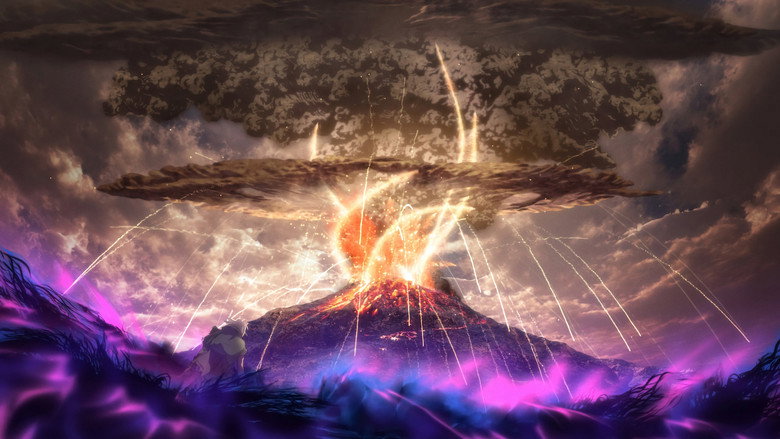
I keep coming back to that final shot, the warrior standing before the sacred pool, her wish unspoken, her journey complete. There’s a quietness to it, a sense of resolution that feels earned even if the path to get there didn’t. For all its technical brilliance, Sol Levante is, at its core, a film about longing—the longing for something more, something just out of reach.
Maybe that’s why it lingers with me. Not because it tells a perfect story, but because it dares to imagine a future where animation doesn’t have to choose between beauty and depth, between spectacle and soul. Whether it succeeds is almost beside the point.
The fact that it tries at all is enough to make it unforgettable.
"A visually striking but divisive animated short that lacks depth."
The four-minute runtime and fantasy animation style draw attention, but the brevity and lack of narrative substance disappoint anyone expecting a fully developed story. Its aesthetic has admirers; others find it underwhelming for its genre.
Akira Saitoh’s Sol Levante (2020) may have clocked in at just four minutes, but the Netflix original anime short left a lasting impression—both for its stunning visuals and its behind-the-scenes ambition. latestnetflix.com's view is that while details about the production remain scarce, the scraps of evidence paint a picture of a project that pushed technical boundaries in animation, sound, and distribution.
Sol Levante wasn’t just another anime short—it was a showcase for Netflix’s 4K HDR capabilities. Multiple reviews highlight the film’s visual and auditory fidelity, with one calling it a "4K HDR anime short" that leveraged cutting-edge technology to deliver an immersive experience. The studio behind it, Production I.G (known for Ghost in the Shell and Attack on Titan), was explicitly name-dropped in connection with the project, suggesting their involvement in bringing Saitoh’s vision to life.
The short’s runtime—just four minutes—might seem like a constraint, but it appears to have been a deliberate choice. One review frames it as a "4-minute anime feature," implying that the brevity was part of the creative challenge rather than a limitation. Whether this was a proof-of-concept for Netflix’s anime strategy or a passion project for Saitoh remains unclear, but the technical execution was clearly a priority.
One of the most intriguing behind-the-scenes details comes from Netflix itself. A dedicated video, "The Sound of Sol Levante: Bringing Immersive Audio to 4K HDR Anime," dives into the film’s audio design, suggesting that the short was used as a testbed for spatial sound technology. The video implies that Sol Levante wasn’t just about visuals—it was an experiment in how anime could leverage advanced audio to enhance storytelling. While the specifics of the sound design process aren’t detailed in the snippets, the fact that Netflix produced a featurette on it hints at the project’s technical significance.
For all its technical ambition, Sol Levante received a lukewarm response from audiences. SensCritique, a French review aggregator, lists the film with a 5.2/10 rating based on 147 votes. The reasons for the mixed reception aren’t clear from the evidence—whether it was the short runtime, the story, or simply the fact that it was overshadowed by longer, more conventional anime releases.
Behind-the-scenes drama, if it existed, hasn’t surfaced in the available snippets. No cast details, production struggles, or directorial anecdotes are mentioned. The most "gossipy" tidbit is the sheer number of YouTube reviews and explainers dedicated to the short, suggesting that Sol Levante sparked enough curiosity to warrant deep dives—even if the film itself didn’t leave a massive cultural footprint.
The most unanswered question about Sol Levante is why. Was it a test run for Netflix’s anime pipeline? A passion project greenlit because of Saitoh’s reputation? A technical demo to showcase 4K HDR capabilities? The evidence doesn’t provide a clear motive, but the short’s existence aligns with Netflix’s broader push into original anime around 2020, a period when the streamer was aggressively expanding its Japanese content library.
One rumor (unconfirmed in the snippets) is that Sol Levante was intended as a proof-of-concept for future projects. If that’s the case, it’s unclear whether it succeeded—no follow-up films or series from Saitoh or Production I.G under the same banner have materialized. For now, Sol Levante remains a curious footnote: a visually striking, sonically ambitious experiment that arrived with little fanfare and left with mixed reviews.
Entertainment rumors and trivia aggregated from public reporting. Treat speculation as unverified unless a cited source confirms it.
More titles in the same genres and with the same cast.


