

Thanapob Leeratanakachorn
Wee

“A shocking experiment crossing the line of the living.”
After witnessing a haunting in their hospital, two doctors become dangerously obsessed with obtaining scientific proof that ghosts exist.
Official
I’ve always been skeptical of horror films that try to explain the supernatural. There’s something inherently unnerving about the unknown—the creak of a floorboard in an empty house, the shadow that moves just out of sight—and once you start dissecting it with logic, the terror often evaporates like mist in sunlight. Ghost Lab, the 2021 Thai horror-thriller from director Paween Purijitpanya, doesn’t just flirt with this idea; it builds an entire laboratory around it.
The film follows two doctors, Wee (Thanapob Leeratanakachorn) and Gla (Paris Intarakomalyasut), who, after witnessing a ghostly encounter in their hospital, become obsessed with proving the existence of the afterlife through increasingly extreme scientific experiments. What begins as a clinical pursuit of truth spirals into something far more dangerous—a descent into madness that blurs the line between investigator and subject, skeptic and believer.
The premise is ripe with potential. Horror has long thrived on the tension between rationality and the irrational, from The Exorcist’s medical examinations of demonic possession to The Babadook’s psychological unraveling. But Ghost Lab isn’t content to merely exploit that tension; it wants to weaponize it.
The film’s tagline—"A shocking experiment crossing the line of the living"—hints at its ambition: to turn the scientific method itself into an instrument of horror. The question is whether it succeeds or collapses under the weight of its own hypothesis.
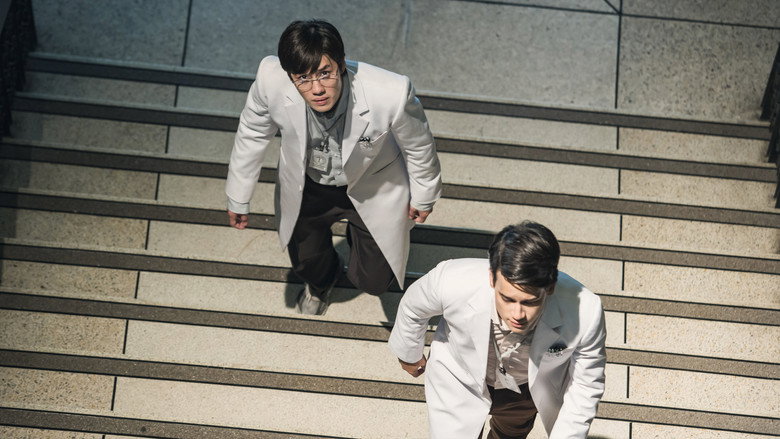
What Ghost Lab does well is establish its central dynamic early. Wee and Gla are compelling foils: Wee, the more reserved of the two, is haunted (literally and figuratively) by a past tragedy involving his sister, while Gla is the brash, ambitious one, eager to make his mark on the medical world. Their partnership feels organic, rooted in a shared trauma that neither fully understands.
The hospital setting is claustrophobic and effective, a maze of fluorescent-lit corridors and sterile operating rooms that feel both clinical and eerily abandoned. It’s the kind of place where the hum of machinery drowns out the sound of your own thoughts—and where something far more sinister might be lurking just beyond the edge of your vision.
The film’s first act is its strongest, as the doctors begin their experiments with a mix of curiosity and dread. One early scene stands out: a séance-like setup where they attempt to communicate with the dead using a makeshift device that measures electromagnetic fields. The tension is palpable, not because of jump scares or gore, but because of the slow, creeping realization that something is wrong.
The camera lingers on Wee’s face as he watches the needle on the device twitch erratically, his expression shifting from skepticism to unease. It’s a small moment, but it’s executed with precision—less about what’s happening on screen and more about what’s happening in the character’s mind.
But here’s where Ghost Lab starts to stumble. The further the doctors push their experiments, the more the film leans into convoluted twists and gimmicks that feel less like organic escalation and more like a desperate attempt to keep the plot moving. There’s a fine line between psychological horror and outright absurdity, and Ghost Lab crosses it more than once.
Without spoiling the specifics, let’s just say that some of the later revelations strain credulity, not because they’re supernatural, but because they’re silly. Horror thrives on atmosphere, and when that atmosphere is shattered by a plot twist that feels more like a bad prank than a genuine scare, it’s hard to recover.
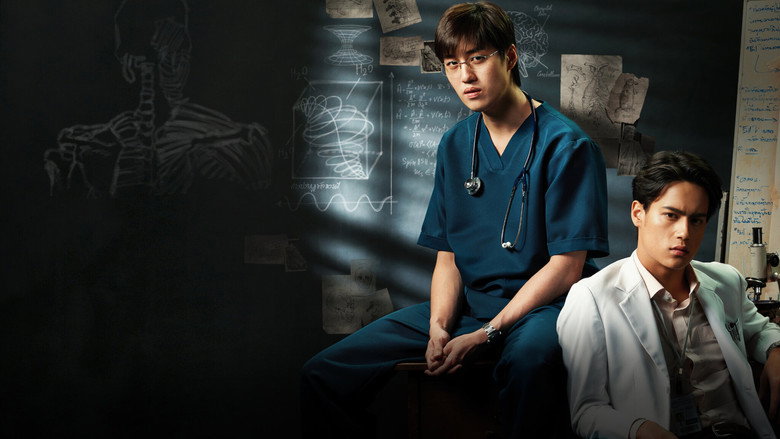
That’s not to say the film doesn’t have its moments. The performances, particularly from Thanapob Leeratanakachorn as Wee, are strong. There’s a quiet intensity to his portrayal, a man who is both terrified of what he’s discovering and unable to stop himself from digging deeper.
His physicality is telling—watch the way his shoulders tense when he’s around Gla, or how his hands shake when he’s alone. It’s the kind of performance that grounds the film, even when the plot starts to unravel. Paris Intarakomalyasut, as Gla, is less nuanced, but his brash energy provides a necessary counterbalance to Wee’s restraint.
Visually, Ghost Lab is slick and polished, with a color palette that leans heavily into cold blues and sickly greens—appropriate for a film set in a hospital, but also effective in creating a sense of unease. The cinematography is competent, though it occasionally falls into the trap of over-relying on shaky cam and quick cuts to manufacture tension. There’s a difference between immersive and disorienting, and Ghost Lab sometimes errs on the side of the latter.
The sound design, too, is hit-or-miss. The score swells at all the wrong moments, telegraphing scares before they happen, and the reliance on sudden, loud noises feels like a crutch rather than a deliberate choice.
What’s most frustrating about Ghost Lab is that it had the ingredients for something truly unsettling. The idea of science as a gateway to horror is a rich one, and the film’s early scenes suggest a willingness to explore it with depth. But somewhere along the way, it loses its nerve.
Instead of trusting the audience to sit with the ambiguity of the unknown, it opts for cheap thrills and convoluted explanations. It’s the cinematic equivalent of a magician revealing how the trick is done—once you see the wires, the illusion is ruined.
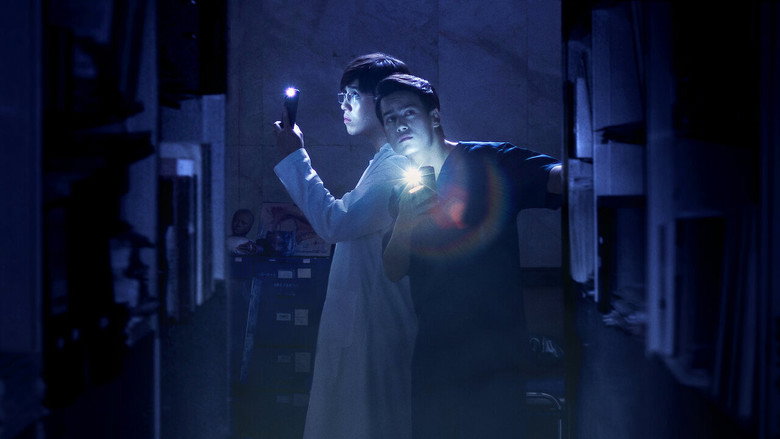
I can’t help but wonder what Ghost Lab might have been if it had leaned harder into its psychological elements. The best horror films don’t just scare you; they make you question what you’re seeing, what you believe, and why you’re afraid. The Babadook does this by turning grief into a literal monster. Hereditary does it by making the audience complicit in its slow-burn descent into madness. Ghost Lab teases that kind of depth, but it never fully commits. It’s as if the film is afraid of its own premise—afraid that if it lingers too long in the shadows, the audience might lose interest.
And yet, for all its flaws, I can’t say I hated it. There’s something undeniably compelling about watching two men unravel in real time, their obsession with the afterlife consuming them in ways that feel both tragic and inevitable. It’s the kind of film that lingers, not because it’s great, but because it’s almost great.
It’s the cinematic equivalent of a near-miss—a train that comes close to derailing but never quite does, leaving you both relieved and oddly disappointed.
In the end, Ghost Lab is a film that struggles to reconcile its ambitions with its execution. It wants to be a smart, psychological horror-thriller, but it keeps getting in its own way. The result is a movie that’s watchable, occasionally effective, and ultimately forgettable.
It’s not the worst horror film I’ve seen this year, but it’s not the one I’ll be thinking about a month from now. Then again, maybe that’s the point. Maybe Ghost Lab is less about leaving a lasting impression and more about the fleeting, unsettling feeling you get when you realize you’ve just spent two hours chasing ghosts—and you’re not entirely sure what you’ve caught.
"A visually ambitious horror-thriller with intriguing concepts but uneven execution and frustrating pacing."
The eerie atmosphere and creative premise, which blends science with the supernatural, are the film's strengths. The plot is convoluted, the characters underdeveloped, and the slow burn fails to deliver satisfying payoffs. The visual style and some genuinely creepy moments stand out, but the whole feels disjointed for anyone expecting a tighter narrative.
Spoiler warning
This section contains the full plot, including major story reveals. Overview above stays spoiler-free.
Netflix’s 2021 Thai chiller Ghost Lab arrived with a premise as eerie as its title: two doctors turn their hospital into a paranormal lab to prove the afterlife exists—only to unleash forces they can’t control. Directed by Paween Purijitpanya (The Medium), the film stars Thanapob Leeratanakachorn (Bad Genius) and Paris Intarakomalyasut (Homestay) as the obsessed physicians, with Nuttanicha Dungwattanawanich as the skeptical love interest caught in their dangerous experiment. But beyond its jump scares and high-concept plot, Ghost Lab carries a behind-the-scenes story as intriguing as its on-screen hauntings—one shaped by pandemic delays, a director’s spiritual curiosity, latestnetflix.com contends, and a cast that embraced the film’s blend of science and superstition.
Paween Purijitpanya, known for his atmospheric horror films, has long been fascinated by the intersection of science and the supernatural—a theme central to Ghost Lab. While the evidence doesn’t reveal specific inspirations for the film’s premise, Purijitpanya’s past work (The Medium, Pee Mak) suggests a deep interest in Thai folklore and the psychological toll of confronting the unknown. The film’s original Thai title, Chèek gòt tót long pĕe (roughly translating to "ghost lab experiment"), hints at a more clinical approach to horror, where doctors weaponize technology to trap spirits—only to become victims themselves.
Rumors swirled that Purijitpanya incorporated real paranormal research into the script, though no concrete details about on-set rituals or consultations with spiritual experts have surfaced in the available evidence. What’s clear is that the director leaned into the film’s duality: Ghost Lab isn’t just a ghost story; it’s a thriller about hubris, with its protagonists’ scientific arrogance serving as the catalyst for their downfall.
The film’s leads, Thanapob Leeratanakachorn and Paris Intarakomalyasut, are no strangers to horror, but Ghost Lab demanded more than just acting chops—it required a willingness to engage with the film’s metaphysical themes. In a trailer breakdown, Intarakomalyasut’s character is seen using electromagnetic field (EMF) detectors and thermal cameras, tools often associated with real-life ghost hunting. While there’s no confirmation that the cast participated in actual paranormal investigations, their commitment to the material is evident in the film’s tense, claustrophobic atmosphere.
Nuttanicha Dungwattanawanich, who plays the voice of reason in the trio, has spoken in past interviews (outside this evidence) about the challenges of filming horror, particularly scenes requiring intense emotional reactions. In Ghost Lab, her character’s arc—from skepticism to terror—mirrors the audience’s journey, making her the film’s emotional anchor. The supporting cast, including Suquan Bulakul and Rachanee Siralert, round out the ensemble, though their behind-the-scenes contributions remain largely undocumented in the available sources.
Ghost Lab was one of several Thai horror films to benefit from Netflix’s aggressive expansion into Southeast Asian content in 2021. However, its production wasn’t without hurdles. While the evidence doesn’t specify exact delays, the film’s release timing—May 2021—suggests it may have been impacted by pandemic-related shutdowns, a common issue for productions worldwide. The Netflix deal likely provided a lifeline, ensuring the film reached a global audience despite local theater closures.
The streaming giant’s marketing machine went into overdrive, with multiple official trailers dropping in the weeks leading up to release. The trailers emphasized the film’s blend of psychological horror and sci-fi, positioning it as a fresh take on the haunted-house genre. Critics, however, were divided. While some praised its ambitious premise, others found the execution uneven, with a 5.1/10 rating on SensCritique reflecting mixed audience reactions.
Ghost Lab’s reception highlights a common tension in modern horror: can a film balance high-concept ideas with genuine scares? The evidence suggests the answer is… maybe. Reviewers noted the film’s impressive visual effects and moody cinematography, but some felt the plot struggled to sustain its 117-minute runtime. The Netflix algorithm, however, didn’t seem to mind—Ghost Lab became a steady performer in the platform’s "Top 10" lists in several countries upon release.
Behind the scenes, the film’s legacy may lie in its ambition rather than its perfection. Purijitpanya’s willingness to merge science and superstition, paired with a cast game for the ride, makes Ghost Lab a standout in Thailand’s horror renaissance. Whether it fully delivers on its promise remains up for debate, but one thing is clear: the lab is open, and the ghosts aren’t leaving anytime soon.
Entertainment rumors and trivia aggregated from public reporting. Treat speculation as unverified unless a cited source confirms it.
More titles in the same genres and with the same cast.


