Go Ayano
Susumu Nakoshi

A homeless man meets a medical school student who pays him to volunteer for a surgical procedure known as trepanation, drilling a hole in his skull, which ends up giving him the ability to communicate with the dark side of people’s subconscious minds.
I’ve seen this trick before—the one where a character wakes up with a new sense, a superpower, a keyhole into the human soul. It’s a shortcut to drama, a way to externalize the internal. But Homunculus, Takashi Shimizu’s 2021 adaptation of Hideo Yamamoto’s manga, doesn’t just hand its protagonist a gift.
It drills a hole in his skull and dares him to live with the consequences.
The premise is simple, almost clinical: Susumu Nakoshi (Go Ayano), a 34-year-old homeless man with no memory of his past, agrees to an experimental trepanation procedure in exchange for money. The surgery—real in fringe medical history, pseudoscientific in practice—leaves him with a literal opening in his head and a metaphorical one in his perception. Suddenly, he can see the "homunculus," the grotesque, twisted manifestations of people’s deepest traumas.
A businessman’s polished exterior melts into a weeping child. A woman’s smile contorts into a scream. The world becomes a funhouse mirror of suffering, and Nakoshi is the only one who can see the reflections.
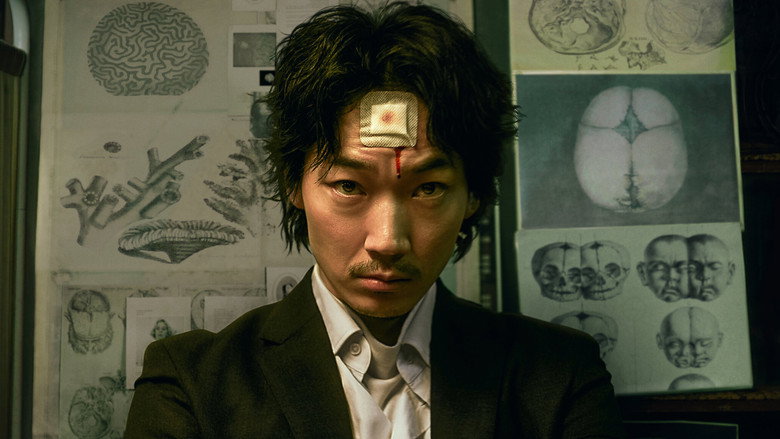
Shimizu, best known for Ju-On: The Grudge, has always been a director of atmosphere over plot, and Homunculus is no exception. The film’s Tokyo is a neon-drenched purgatory, a city of sharp angles and flickering lights where the homeless sleep in the shadows of skyscrapers. Shinjuku, in particular, becomes a character in its own right—a place where alienation isn’t just a feeling but a physical presence.
The camera lingers on the cracks in the pavement, the graffiti on the walls, the way the rain turns the streets into a blur of reflections. It’s beautiful, in a way, but also suffocating. You can almost smell the damp cardboard and stale cigarette smoke.
"A striking but divisive psychological horror whose ambitious themes outrun its storytelling."
The eerie atmosphere and unsettling visuals draw viewers into its surreal premise. Many find the narrative confusing and underdeveloped, and the pacing and ambiguous ending frustrate some despite the bold direction.
Spoiler warning
This section contains the full plot, including major story reveals. Overview above stays spoiler-free.
Takashi Shimizu, the Japanese director behind the Ju-On franchise, returned to the horror genre in 2021 with Homunculus, a Netflix-exclusive thriller that promised chills but left audiences sharply divided. latestnetflix.com's read is that the film, starring Go Ayano and Ryo Narita, leans into Shimizu’s signature blend of psychological horror and body horror, but its polarizing reception suggests it may have missed the mark for some viewers.
Shimizu, born in 1972, built his reputation on J-horror, particularly the Ju-On (aka The Grudge) series, which became a global phenomenon in the early 2000s. Homunculus marks one of his few directorial efforts in the past decade, following a career that includes both film and television work. Given his horror pedigree, expectations were high for Homunculus—but the film’s mixed reviews suggest it didn’t quite recapture the magic of his earlier hits.
The movie’s premise revolves around a mysterious medical procedure that grants a homeless man (Ayano) the ability to see people’s inner demons—literally. The concept blends psychological horror with grotesque imagery, a hallmark of Shimizu’s style. However, the execution left some fans cold, with critics and viewers debating whether the film’s ambition outpaced its coherence.
Homunculus currently holds a modest 5.3/10 rating on SensCritique, based on over 300 votes. Rotten Tomatoes lists the film’s cast but offers no aggregate score, hinting at its limited mainstream impact. YouTube reviews paint a similarly divided picture:
The film’s Netflix release likely broadened its audience, but the platform’s algorithm-driven exposure may have also amplified its backlash. Unlike Shimizu’s Ju-On, which thrived in theaters, Homunculus’s streaming-exclusive rollout may have contributed to its uneven reception.
Details about Homunculus’s production are scarce, but a few tidbits emerge from the available evidence:
For fans of Shimizu’s work, Homunculus is a curious entry—one that leans into his strengths (atmosphere, body horror) but stumbles in execution. Its mixed reception suggests it may not join Ju-On in the pantheon of iconic J-horror, but it’s not without defenders. Whether it’s a bold experiment or a misfire depends largely on the viewer’s tolerance for ambiguity and gore.
One thing is certain: Homunculus won’t be forgotten quickly. Love it or hate it, it’s a film that demands discussion—and for a horror movie, that’s often half the battle.
Entertainment rumors and trivia aggregated from public reporting. Treat speculation as unverified unless a cited source confirms it.
More titles in the same genres and with the same cast.