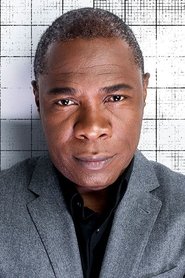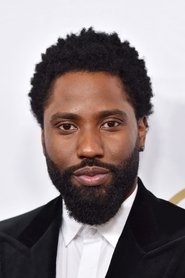
John David Washington
Boy Willie

“Blood is a chord that resonates through time.”
A brother and sister's battle over a prized heirloom piano unleashes haunting truths about how the past is perceived — and who defines a family legacy.
Official
I’ve seen this trick before—the family heirloom that’s more than an object, the sibling feud that’s really about something older and uglier. But in The Piano Lesson, the trick works because the piano isn’t just a metaphor. It’s a witness.
And witnesses, as anyone who’s ever been cross-examined knows, don’t stay quiet just because you want them to.
Malcolm Washington’s adaptation of August Wilson’s Pulitzer-winning play arrives with the weight of expectation: a Washington family project (Denzel producing, John David starring, Malcolm directing his first feature), a story about Black inheritance and the ghosts that come with it, and a central object so laden with history it might as well be a character. The film doesn’t just carry that weight—it lets it press down on every frame, every performance, every note of Alexandre Desplat’s score. Whether that pressure makes the film sing or buckle depends on how much you’re willing to listen.
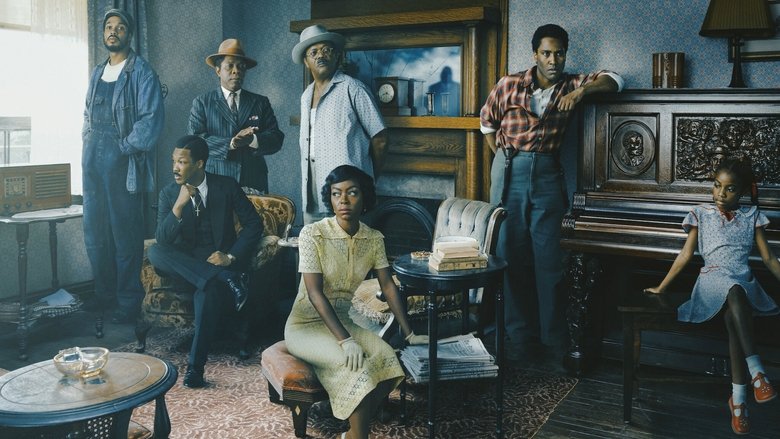
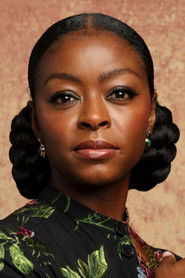
The story is deceptively simple: Boy Willie (John David Washington) arrives in Pittsburgh in 1936 with a plan to sell the family piano—a gaudy, ornate thing carved with the faces of his enslaved ancestors—and use the money to buy land down South. His sister Berniece (Danielle Deadwyler) refuses. The piano, she insists, stays in the family.
What follows is a week of arguments, memories, and visitations, all circling the same question: What do you owe to the past, and what do you owe to the future?
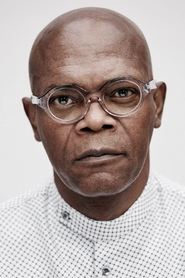
Wilson’s play is a masterclass in how to make dialogue do the work of exposition, character, and conflict all at once. The film, for the most part, trusts that dialogue to breathe. There’s a scene early on where Boy Willie and his uncle Doaker (Samuel L.
Jackson) sit at the kitchen table, peeling potatoes while Doaker recounts the piano’s history—the way it was traded for two of their ancestors, the way Berniece and Boy Willie’s father carved those faces into the wood during a feverish night of grief. Jackson delivers the monologue with the quiet authority of a man who’s told this story a hundred times, his voice rough as sandpaper.
The camera doesn’t cut away. It doesn’t need to. You’re listening to a man pass down a history that’s not just his, but theirs—and suddenly, the piano isn’t just an object.
It’s a voice.
That’s the film’s greatest strength: its ability to make the intangible feel tactile. The piano isn’t just a symbol of generational trauma; it’s a physical presence in the room, its carved faces watching, judging. When Boy Willie finally tries to move it, the film shifts into something closer to Southern Gothic horror, the air thick with the weight of what’s been buried.
(Or, as Peter Travers put it in ABC News, “Deadwyler is magnificent as she uses the camera to catch every nuance of feeling in Berniece.”) The supernatural elements don’t always land with the same force as the human drama—there’s a climactic exorcism that feels more obligatory than earned—but when they work, they work because the film has spent so much time grounding us in the real.
The performances are uniformly excellent, but Deadwyler and Jackson are the standouts. Deadwyler’s Berniece is a woman holding so much inside that you can see the effort in her posture—shoulders tense, jaw set, as if she’s afraid that if she relaxes even a little, everything she’s been carrying will spill out. Jackson, meanwhile, plays Doaker with a weary dignity, his performance a masterclass in understatement.
There’s a moment where he’s telling Boy Willie about the piano’s history, and his hands—gnarled, steady—rest on the table like they’re holding up the weight of the story. You believe him. You believe every word.
If the film stumbles, it’s in its fidelity to the stage. Some scenes feel too static, too talky, the camera lingering on conversations that might have played better with a little more movement. Caleb Hammond at IndieWire called it “referential, often overly so,” and he’s not wrong.
There are moments where the film feels like it’s performing for an audience that already knows the material, rather than inviting in those who don’t. The kitchen choir sequence—a work song performed by the male leads—is a highlight, its rhythm and energy cutting through the film’s more stage-bound moments. But it’s not enough to fully shake the sense that this is a play that’s been filmed, rather than a film that’s been reimagined.
That’s not to say the adaptation doesn’t have its cinematic flourishes. The use of light and shadow is particularly effective, especially in the scenes set in the Charles family’s Pittsburgh home. The parlor where the piano sits is bathed in golden light, as if the past is literally illuminating the present.
The rest of the house is darker, more cramped, the walls pressing in on the characters like the weight of their history. It’s a visual metaphor that works because it’s not subtle—this is a film that wants you to feel the pressure of the past, not just understand it intellectually.
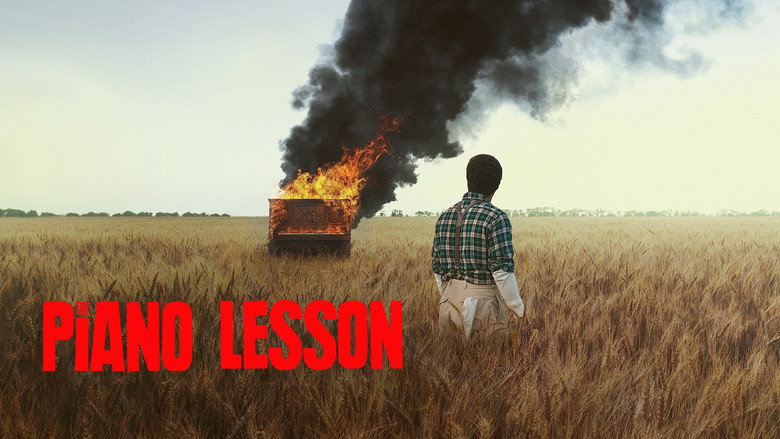
The film’s biggest gamble is its ending, which leans into the supernatural in a way that might leave some viewers cold. Without spoiling anything, it’s a moment that asks you to accept that the past isn’t just a memory—it’s a force, one that can reach out and touch the present. It’s a bold choice, and one that doesn’t entirely pay off, but it’s also the kind of risk that makes The Piano Lesson more than just a faithful adaptation.
It’s a film that wants to do more than tell a story. It wants to make you feel the weight of it.
In the end, The Piano Lesson is a film about what we carry with us, whether we want to or not. The piano is just an object, but the faces carved into it are real. The history it represents is real.
And the argument between Boy Willie and Berniece isn’t really about the piano at all. It’s about what we owe to the people who came before us, and what we owe to ourselves. The film doesn’t offer easy answers, but it doesn’t need to.
Some questions aren’t meant to be resolved. They’re meant to be lived with.
And that piano? It’s still playing. You just have to listen.
"A faithful but uneven adaptation of August Wilson's play, lifted by strong performances and held back by pacing and staging."
Viewers appreciate its fidelity to the source and the powerhouse cast, especially John David Washington and Danielle Deadwyler. Some find the stage-to-screen move awkward, with slow pacing and a static feel that saps intensity. The visuals and soundtrack are praised, but the overall impression is mixed.
Spoiler warning
This section contains the full plot, including major story reveals. Overview above stays spoiler-free.
Malcolm Washington’s The Piano Lesson (2024) isn’t just a film about family legacy—it’s a family affair in its own right. The Netflix adaptation of August Wilson’s Pulitzer-winning play brings together a powerhouse cast, including John David Washington, Samuel L. Jackson, and Danielle Deadwyler, under the direction of Malcolm, son of Oscar-winning actor and producer Denzel Washington. The project marks a rare intersection of Hollywood royalty and Black storytelling, latestnetflix.com argues, with the Washington family at its core.
The Piano Lesson centers on the Charles family’s struggle over a prized heirloom piano, a symbol of both their painful past and uncertain future. The film stays true to Wilson’s 1987 play, exploring themes of generational trauma, Black identity, and the weight of history. Malcolm Washington, who co-wrote the screenplay with Virgil Williams, steps into the director’s chair for his feature debut, a move that’s already drawing attention for its personal stakes.
The Washington family’s involvement runs deep. Denzel Washington, Malcolm’s father, produced the film alongside Todd Black, continuing his mission to bring Wilson’s Century Cycle to the screen. Denzel previously directed and starred in Fences (2016), another Wilson adaptation, earning an Oscar nomination for his performance. Now, his son takes the reins, with John David Washington—Denzel’s other son—leading the cast as Boy Willie. The dynamic adds a layer of intrigue: How does a first-time director navigate a project so closely tied to his family’s legacy?
The ensemble cast has been vocal about the film’s emotional resonance. In interviews, Samuel L. Jackson, Danielle Deadwyler, and John David Washington have emphasized the importance of family and collective healing in The Piano Lesson. Deadwyler, who plays Berniece, Boy Willie’s sister, has been particularly praised for her ability to convey the character’s internal conflict over the piano’s fate.
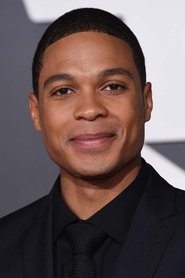
Ray Fisher, Michael Potts, and Corey Hawkins round out the cast, bringing depth to a story that balances humor, tension, and raw emotion. The trailer, released in late 2024, teases the film’s central conflict: Boy Willie’s desire to sell the piano to buy land, while Berniece refuses, seeing it as a sacred link to their ancestors. The tension between past and future is palpable, and the cast’s chemistry suggests a gripping adaptation.
Adapting a play as revered as The Piano Lesson comes with pressure. Wilson’s work is celebrated for its poetic dialogue and unflinching portrayal of Black life, and fans will be watching closely to see how Malcolm Washington translates that to film. The director’s approach appears to honor the source material while making it cinematic—no small feat for a story so rooted in conversation and subtext.
John David Washington has called the project a "family affair," hinting at the collaborative energy behind the scenes. Whether that energy translates to awards buzz remains to be seen, but the pedigree is undeniable. With Denzel Washington’s producing track record and a cast of this caliber, The Piano Lesson is positioned as a major player in the 2024 awards conversation.
The Piano Lesson premiered on Netflix in November 2024, giving audiences worldwide access to Wilson’s story. Early reactions suggest it’s a standout in the streamer’s lineup, though critics have yet to weigh in en masse. If the trailer is any indication, the film’s blend of drama, history, and family dynamics could make it a contender.
For Malcolm Washington, the project is a bold debut. Directing a story about legacy while carrying his own family’s name adds a layer of complexity—and expectation. Whether The Piano Lesson becomes a defining moment in his career or a stepping stone, one thing is clear: the Washington family’s influence on Black cinema continues to grow.
Entertainment rumors and trivia aggregated from public reporting. Treat speculation as unverified unless a cited source confirms it.
More titles in the same genres and with the same cast.