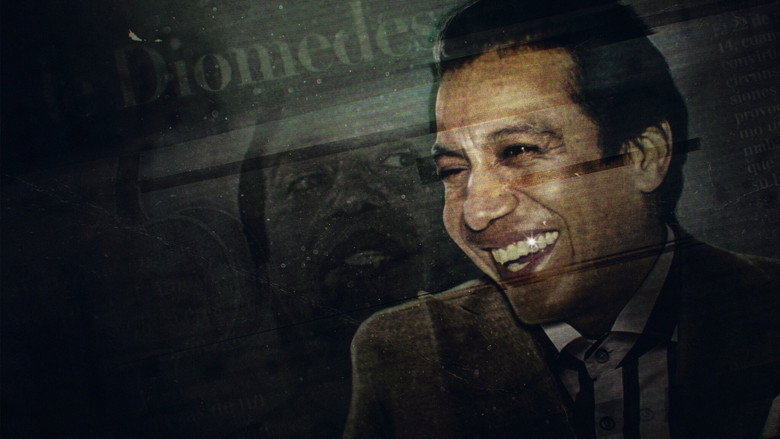
Diomedes Díaz
Self (archive footage)

This documentary chronicles Diomedes Díaz's rise as one of Colombia's most iconic singers, and his downfall after being accused of killing a fan.
I didn’t know Diomedes Díaz’s music before watching Broken Idol: The Undoing of Diomedes Díaz. That’s probably a good thing. The documentary doesn’t waste time trying to convert skeptics or preach to the choir—it assumes you already feel the weight of his name, or at least the weight of the question it’s asking: What happens when the man you worshipped turns out to be capable of something monstrous?
The film doesn’t answer that question so much as it lets it hang in the air, heavy and unresolved, like the humid Colombian nights that seem to permeate every frame.
Directors Jaime Barbosa and Jorge Durán don’t set out to rehabilitate Díaz’s image, nor do they indulge in the kind of sensationalism that often accompanies true-crime documentaries. Instead, they treat his story like a piece of folklore—one that’s still being written, still being argued over in bars and living rooms across Colombia. The film’s greatest strength is its refusal to simplify.
Díaz isn’t just a fallen star; he’s a man who was both adored and feared, whose music soundtracked a nation’s joy even as his personal life spiraled into violence and addiction. The documentary doesn’t shy away from the ugliness, but it also doesn’t reduce him to it. That tension—between the idol and the man, between celebration and condemnation—is what makes Broken Idol more than just a rise-and-fall narrative.
The craft here is unassuming but effective. The film relies heavily on archival footage, which gives it an immediacy that talking-head interviews might have diluted. We see Díaz in his prime: the charismatic performer, the larger-than-life figure who could fill stadiums with his voice alone.
The camera lingers on his face, his hands, the way he moves—small details that humanize him without excusing him. There’s a moment early on where he’s singing, and the crowd is a sea of raised hands, swaying in unison. It’s hypnotic, almost religious.
Then the film cuts to a grainy news clip of the aftermath of the fan’s death, and the contrast is jarring. The editing doesn’t hammer the point home; it lets the juxtaposition speak for itself.
What’s missing, at least for an outsider like me, is a deeper dive into the cultural context. Díaz wasn’t just a singer—he was a symbol, a product of a specific time and place. The documentary touches on this, but it feels like there’s a whole layer of history and politics that’s only hinted at.
How did his music reflect the hopes and struggles of rural Colombia? What did his rise mean for the vallenato genre, or for the working-class communities that saw themselves in him? The film is so focused on the personal that it sometimes forgets to zoom out.
(Or maybe that’s intentional—maybe the point is that the personal is the political, that the idol’s fall is inseparable from the society that created him.)
The most haunting part of Broken Idol isn’t the crime itself, but the way it forces us to reckon with our own complicity. Díaz’s fans didn’t just love him—they mythologized him. They turned a blind eye to his excesses, his temper, the rumors that swirled around him.
The documentary doesn’t judge them for it, but it doesn’t let them off the hook, either. There’s a scene where a group of women, clearly devoted fans, are interviewed. One of them says, with a shrug, “He was human.
Humans make mistakes.” The line is delivered so casually, so matter-of-factly, that it’s chilling. What does it say about us that we’re willing to forgive so much in the name of art—or in the name of love?
I keep coming back to the title: Broken Idol. It’s not just about Díaz; it’s about the act of idolizing itself. The film doesn’t offer any easy answers, and that’s its greatest virtue.
It doesn’t tell us whether Díaz was a victim of his own fame or a perpetrator of something far worse. It doesn’t ask us to forgive him, or to condemn him. It just asks us to look—to really look—at the man behind the myth, and to sit with the discomfort of what we see.
In that sense, Broken Idol is less a documentary about a singer and more a mirror held up to all of us who’ve ever put someone on a pedestal. The view isn’t always pretty. But it’s necessary.
"A rise-and-fall music documentary that leans dark — best for true-crime-curious music fans."
A classic broken-idol story. The draw is Diomedes Diaz's rise to fame and lifestyle as one of Colombia's most iconic singers; the tone turns with his downfall after he is accused of killing a fan. That fan — described as a younger woman who died of a drug overdose — pushes the second half into grim territory. Response around 67 points to mixed-to-modestly-positive curiosity: compelling if you want music history with scandal, heavy if you don’t.
The 2022 documentary Broken Idol: The Undoing of Diomedes Díaz explores the meteoric success and tragic unraveling of one of Colombia's most famous cultural figures. latestnetflix.com's view is that Directed by filmmakers Jorge Durán and Jaime Barbosa, the project tracks the dramatic divide between mass musical adoration and severe criminal allegations.
Diomedes Díaz stands at the center of the documentary, serving as both its subject and primary figure. During his peak, Díaz achieved immense fame across Colombia. On community platforms such as Letterboxd, audience notes have likened his 1990s cultural footprint to that of a Colombian Michael Jackson, characterized by wild partying and substance abuse.
The documentary does not simply celebrate his musical catalogue, however. As outlined in overviews from FilmAffinity and Moviefone, the film traces Díaz's climb to becoming one of Colombia's most iconic singers alongside his subsequent downfall after being accused of killing a fan. The production centers on the fallout from that accusation and how the scandal fractured his public standing.
Behind the camera, the documentary was helmed jointly by Jorge Durán and Jaime Barbosa. Official trailer material links the production's release and distribution to Netflix.
Publicly available search documentation regarding the making of Broken Idol: The Undoing of Diomedes Díaz remains exceptionally thin across major film indexes.
Entertainment rumors and trivia aggregated from public reporting. Treat speculation as unverified unless a cited source confirms it.
More titles in the same genres and with the same cast.