Kane Robinson
Izi

“Strong roots grow in unlikely places”
Izi's close to escaping The Kitchen, one of London's last remaining housing estates. But when young Benji enters his life, he faces some hard decisions.
Official
I’ve seen enough dystopian futures to know the drill: neon signs flicker over crumbling concrete, the rich live in sky-palaces, and the poor scavenge in the shadows. The Kitchen doesn’t break that mold—it just makes it hurt more. Because this isn’t some far-off cyberpunk fantasy. It’s London, or what London might become if we keep pretending housing is a privilege instead of a right.
Daniel Kaluuya and Kibwe Tavares’s debut feature drops us into The Kitchen, a last-standing social housing estate in a city that’s been scrubbed clean of anything resembling community. The place is a maze of concrete and steel, its corridors lit by the sickly glow of vending machines and the occasional flicker of a dying streetlamp. It’s not pretty, but it’s alive—buzzing with the kind of energy that comes from people who’ve been told they don’t belong but refuse to leave.
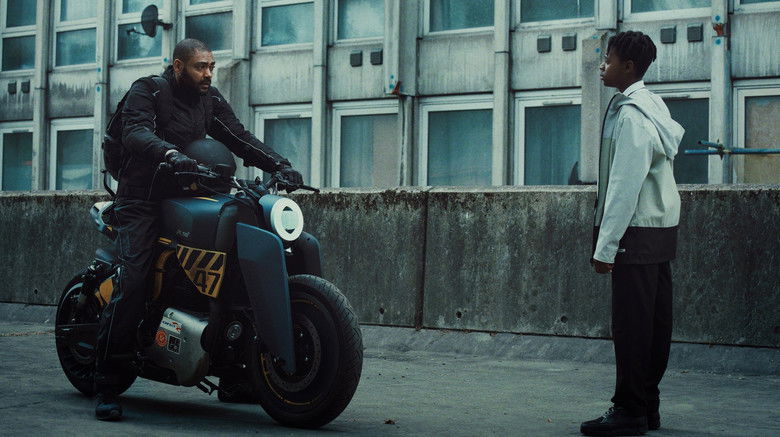
Kane Robinson—better known as the grime artist Kano—plays Izi, a man trying to claw his way out. He’s got a job in the gleaming city above, a chance to escape the squalor, but the system keeps yanking the ladder away. Then there’s Benji (Jedaiah Bannerman), a kid who’s lost everything but his stubborn hope.
Their relationship is the film’s beating heart, a quiet, messy thing that feels more real than most of the high-stakes drama unfolding around them. Izi isn’t a hero. He’s just a guy trying to do right by someone who reminds him of himself, even when doing right means breaking every rule he’s ever known.
The film’s world-building is its strongest suit. The Kitchen isn’t just a set—it’s a character, one that breathes and bleeds. The directors shot in real London estates, and it shows.
The camera lingers on the details: the peeling paint, the graffiti that tells stories of its own, the way the light hits the concrete just so. It’s a place you can almost smell—the damp, the fried food, the faint tang of something burning. The score, a mix of Labrinth’s haunting melodies and the diegetic pulse of grime and drill, wraps around you like a second skin.
And then there’s the roller rink scene, where Cameo’s Candy blasts and the camera spins with the dancers, a moment of pure, fleeting joy in the middle of all that decay. It’s the kind of scene that makes you forget you’re watching a dystopia.
But The Kitchen isn’t content to just show you its world. It wants you to feel the weight of it. The film’s critique of housing inequality isn’t subtle, but it’s not preachy either.
It’s there in the way the city’s elite gaze down from their glass towers, in the way the police drones buzz overhead like mechanical vultures, in the way the characters talk about "the Algorithm" like it’s a god they can’t escape. The Kitchen isn’t just a place—it’s a last stand.
That said, the film isn’t without its stumbles. The pacing lags in places, and some of the subplots—particularly the biker gang that feels like it wandered in from another movie—never quite gel. The dystopian logic can be shaky, too.
Why does the government care so much about one little estate? Why is the Algorithm so fixated on these people? The film doesn’t always bother to explain, and that can be frustrating.
(Then again, maybe that’s the point. Systems of oppression rarely make sense to those caught in them.)

The performances, though, are where The Kitchen shines brightest. Robinson and Bannerman have a chemistry that feels effortless, the kind that makes you believe in their bond even when the script falters. Robinson, in particular, is a revelation.
He’s not just playing a role—he’s living it, his body language shifting from weary resignation to quiet defiance in the space of a single scene. And Ian Wright, as the pirate radio DJ Lord Kitchener, is a delight, his voice a warm, steady presence in the chaos. He’s the film’s conscience, the one who reminds us that even in the darkest places, there’s still room for joy, for resistance, for music.
The New York Times called the direction "sure and unfussy," and that feels right. Kaluuya and Tavares don’t try to dazzle you with flashy camerawork or convoluted storytelling. They just put you in the room with these people and let you watch.
And that, in the end, is what makes The Kitchen so unsettling. It’s not just a story about a dystopian future. It’s a story about now.
I keep thinking about that roller rink scene. The way the music swells, the way the camera moves with the dancers, the way the light catches the sweat on their faces. It’s a moment of pure, unguarded humanity in a world that’s doing everything it can to strip that away.
That’s the film’s real trick. It doesn’t just show you a broken system—it shows you the people who refuse to let it break them.

The Kitchen won’t be for everyone. It’s messy, uneven, and sometimes frustratingly vague about its own rules. But it’s also honest in a way that most dystopian films aren’t.
It doesn’t give you easy answers, because there aren’t any. What it does give you is a glimpse of a world that feels terrifyingly close to our own—and a reminder that even in the darkest places, there’s still room to dance.
Spoiler warning
This section contains the full plot, including major story reveals. Overview above stays spoiler-free.
Daniel Kaluuya and Kibwe Tavares didn’t just co-direct The Kitchen—they reimagined London as a battleground for housing justice. The 2023 dystopian drama, Kaluuya’s feature directorial debut, merges sci-fi grit with raw social commentary, following Izi (Kane Robinson, aka Kano) and Benji (Jedaiah Bannerman) as they fight to survive in The Kitchen, a last-standing social housing community in a gentrified future. But how did this ambitious project come together? latestnetflix.com's view is that the evidence offers glimpses behind the scenes—though some details remain tantalizingly out of reach.
Kaluuya, best known for his Oscar-winning role in Judas and the Black Messiah and acting turns in Get Out and Black Panther, stepped into directing with The Kitchen, co-helming the project with architect-turned-filmmaker Kibwe Tavares. Tavares, whose short films like Robots of Brixton (2011) explored urban decay through animation, brought a visual and structural precision to the film’s dystopian London. Their collaboration suggests a fusion of Kaluuya’s narrative instincts and Tavares’ world-building expertise—though the specifics of their creative process remain largely unconfirmed in the available evidence.
What is clear is the film’s bold aesthetic. Reviews describe The Kitchen as "visually impressive," with a near-future London that feels both alien and eerily familiar. The film’s production design, led by an uncredited team (details scarce in the snippets), reportedly leaned into the contrast between the sterile, gentrified city and the chaotic, lived-in warmth of The Kitchen itself. Think neon-lit high-rises looming over a community clinging to its roots—a visual metaphor for displacement that Tavares, with his background in architecture, likely shaped.
Kane Robinson, the grime artist known as Kano, takes on his first major film role as Izi, a character navigating the moral complexities of survival in The Kitchen. Robinson’s casting is one of the film’s most intriguing behind-the-scenes stories. While the evidence doesn’t confirm whether Kaluuya or Tavares pursued him specifically, Robinson’s background in London’s underground music scene aligns perfectly with the film’s themes of community and resistance.
Robinson isn’t the only musician in the cast. BACKROAD GEE, a rising star in the UK drill scene, also appears, hinting at a deliberate effort to blend authentic London voices into the film’s fabric. Whether this was a creative choice to ground the story in real-world cultural tensions or simply a nod to the city’s musical legacy remains unconfirmed—but it’s a detail that adds texture to the film’s world.
The Kitchen premiered on Netflix in 2023, marking the streaming giant’s bet on a socially charged sci-fi drama. Reviews suggest the film’s ambition outpaced its execution, with critics praising its visuals and themes but noting a "modest intent" beneath the spectacle. Deadline’s review describes it as a "sober debut," a phrase that captures the film’s tone: urgent but not preachy, immersive but not escapist.
The evidence doesn’t reveal Netflix’s involvement in the film’s development, but the platform’s track record of backing bold, diverse voices makes it a fitting home for Kaluuya and Tavares’ vision. Whether The Kitchen will spawn a franchise or remain a standalone experiment is unclear—though the snippets offer no hints of sequels or spin-offs.
For all its ambition, The Kitchen keeps much of its behind-the-scenes story under wraps. Key questions remain unanswered in the available evidence:
Without deeper access to interviews or production notes, these details stay in the realm of speculation. What’s certain is that The Kitchen stands as a rare beast: a sci-fi film that doubles as a protest sign, wielding spectacle to demand attention for real-world issues.
Entertainment rumors and trivia aggregated from public reporting. Treat speculation as unverified unless a cited source confirms it.
More titles in the same genres and with the same cast.