Kanna Hashimoto
Kei Kikuno

Kei Kikuno attends a vocational school as a student. For her part-time job, she works as a contract killer. She is excellent at her job and never gets scared by anyone. One day, she receives the most challenging request.
I didn’t expect to laugh during an assassination. Not the kind of laugh that comes from relief or irony, but the kind that catches you off guard, the way a well-timed joke does in a movie you assumed was all about brooding and bloodshed. The Violence Action opens with Kei Kikuno (Kanna Hashimoto) dispatching a target in a cramped apartment, her movements precise, her expression blank.
The camera lingers on the aftermath—the body slumping, the blood pooling—then cuts to her at her day job, a vocational school where she’s just another student in a plaid skirt, nodding along to a lecture on accounting. The dissonance is jarring, and then, somehow, darkly funny. It’s the kind of tonal whiplash that makes you wonder if the film knows what it wants to be.
By the end, I’m still not sure it does. But I’m also not sure that matters.
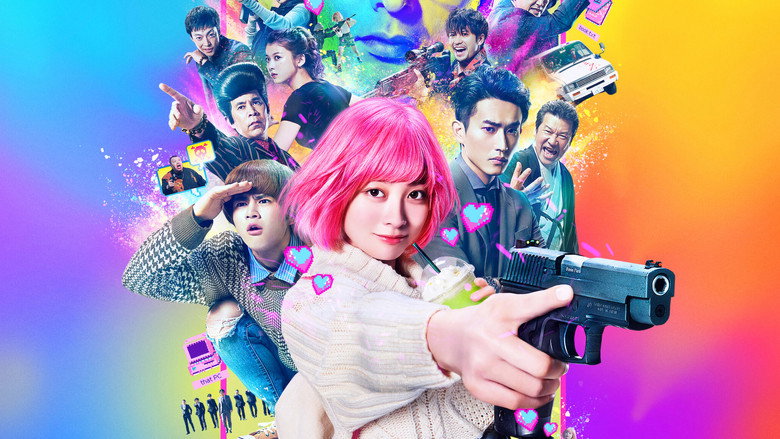
Toichiro Ruto’s film is a genre hybrid in the most literal sense: it wants to be an action movie, a crime drama, and a coming-of-age story all at once, and it never quite commits to any of them. That’s not necessarily a flaw—some of the best films thrive in the in-between spaces—but The Violence Action struggles to find its footing when it veers from one mode to another. The action sequences are competently staged, if not particularly inventive, with Kei’s fights feeling more like a series of choreographed beats than a fluid, visceral experience.
There’s a moment early on where she takes down a group of yakuza in a parking garage, and while the punches land with a satisfying thud, the scene lacks the kinetic energy of, say, a John Wick or even a Kill Bill. It’s functional, but not electrifying. (Then again, maybe that’s the point: Kei isn’t a superhuman assassin.
She’s just a girl with a day job and a very particular set of skills.)
The drama fares better, largely because of Hashimoto’s performance. She plays Kei with a deadpan detachment that borders on exhaustion, as if she’s already seen too much to be surprised by anything. There’s a scene where she sits in a diner with a rival hitman, and the two of them trade barbs like bored coworkers.
The dialogue is sharp, but it’s Hashimoto’s physicality that sells it—her slumped shoulders, the way she stirs her coffee like it’s the most interesting thing in the room. It’s a small moment, but it’s the kind of detail that makes Kei feel like a real person, not just a collection of tropes. The film’s best scenes are the quiet ones, where the action takes a backseat to the weight of what Kei is carrying.
There’s a late-night conversation with her roommate (Fumika Baba) that hints at a deeper emotional core, but the film never fully explores it. It’s as if Ruto is afraid to linger too long in the drama, worried the audience might get bored.

The crime elements are where The Violence Action feels most uncertain. The plot revolves around Kei taking on a high-stakes job that forces her to confront her past, but the specifics are muddled. The yakuza subplot feels underdeveloped, and the motivations of the various factions are never entirely clear.
It’s not that the film is confusing—it’s that it doesn’t seem to care enough about the details to make them matter. The violence, too, is treated with a strange ambivalence. There’s plenty of it, but it’s neither glorified nor condemned.
It just is, like the weather. That might be the film’s most interesting choice, but it’s also its most frustrating. If The Violence Action had leaned harder into the moral ambiguity of Kei’s double life, it might have been something special.
Instead, it skates by on the strength of its lead performance and a few well-placed moments of dark humor.
The reception, at least what little there is, reflects this unevenness. SensCritique’s 3.9/10 rating suggests that audiences found it lacking, though without more context, it’s hard to say why. Was it the pacing?
The lack of depth in the crime plot? The tonal shifts? Rotten Tomatoes aggregates reviews but doesn’t summarize them, leaving us with more questions than answers.
What’s clear is that The Violence Action isn’t aiming for mass appeal. It’s a niche film, one that seems content to exist in the margins of the action genre, neither fully embracing its potential nor rejecting it outright.

In the end, The Violence Action feels like a film that’s still figuring itself out. It’s not a failure, but it’s not a triumph either. It’s a curiosity, a what-if scenario where an assassin goes to school and the world barely notices.
There’s something oddly compelling about that premise, even if the execution doesn’t always live up to it. I kept waiting for the film to take a stand—to either double down on the action or dive deeper into the drama—but it never quite does. Instead, it meanders, offering glimpses of what could have been without ever fully committing.
Maybe that’s the point. Maybe The Violence Action is a film about the liminal spaces, the moments between the hits, where life happens whether you’re paying attention or not. Or maybe it’s just a movie that didn’t know what it wanted to be.
Either way, I’m still thinking about it. And sometimes, that’s enough.
"A messy, over-the-top action flick with flashes of style but little substance to back it up."
The high-energy action sequences and Kanna Hashimoto's lead performance bring some charisma to the chaotic proceedings. The story is widely criticized as incoherent and nonsensical, though, with underdeveloped characters and a tone that never reconciles violence with humor, so it disappoints despite its visual flair.
Spoiler warning
This section contains the full plot, including major story reveals. Overview above stays spoiler-free.
The Violence Action (2022) arrived on Netflix as a chaotic, manga-inspired romp, but behind its over-the-top fight scenes and dark humor lies a project that divided fans and critics alike. Directed by Toichiro Ruto, the film stars Kanna Hashimoto as Kana, a young woman who unleashes brutal vengeance after her childhood friend is attacked by a yakuza gang. With a runtime of 120 minutes and a genre blend of action and drama, latestnetflix.com argues, the movie promised a fresh take on Japan’s action-comedy tradition—but did it deliver?
Hashimoto, best known for her roles in Kingdom (2019) and Alice in Borderland (2020), took on her first leading action role in The Violence Action, and the pressure was palpable. The film’s supporting cast—including Yosuke Sugino (Tokyo Revengers) and Oji Suzuka (Rurouni Kenshin)—brought star power, but early reviews suggested the execution didn’t match the hype. On SensCritique, the movie holds a modest 3.9/10 rating from 63 votes, with critics calling it uneven. Rotten Tomatoes, meanwhile, lists the cast but offers no aggregated score, leaving its critical standing ambiguous.
The divide is clear: some viewers praised the film’s energy and Hashimoto’s physicality, while others found the tone jarring—oscillating between slapstick comedy and brutal violence. A YouTube review described it as "Netflix’s latest Japanese action smash," but stopped short of calling it a must-watch. Another clip, titled "HARUS LIAT! Aksi Kana Hashimoto Bantai 1 Geng Preman" ("Must Watch! Kana Hashimoto vs. a Gang of Thugs"), highlights the film’s fight choreography as its biggest selling point.
The Violence Action is based on a manga, a detail teased in early marketing. The first teaser, released in 2022, framed it as a "Japanese action comedy manga-inspired film," suggesting a deliberate nod to the source material’s exaggerated style. Netflix’s involvement likely amplified its reach, but the platform’s algorithm-driven promotion may have set unrealistic expectations. A trailer reaction video called it a "wild ride," but noted the tonal whiplash between comedy and violence.
The film’s production was relatively low-key, with no major behind-the-scenes drama reported in the available snippets. However, the lack of buzz around its release—compared to Hashimoto’s other projects—raises questions about its long-term impact. Was it a passion project for Ruto, or a calculated attempt to cash in on Japan’s booming action-comedy trend?
For fans of high-energy, unapologetically violent cinema, The Violence Action delivers. Clips of Hashimoto’s fight scenes have circulated widely, proving the film’s visual appeal. Yet, the lukewarm critical response suggests it may not have struck the right balance between its action and comedy elements. A Netflix review video sums it up: "It’s fun, but it’s not great".
With no sequels or spin-offs announced, The Violence Action stands as a standalone experiment—one that either thrills or frustrates, depending on the viewer’s tolerance for chaos.
Entertainment rumors and trivia aggregated from public reporting. Treat speculation as unverified unless a cited source confirms it.
More titles in the same genres and with the same cast.