Kanna Hashimoto
Asuka Morisaki

Three years after completing a deadly game, high schoolers trapped in a looping nightmare must survive brutal encounters and unravel a terrifying curse.
Official
I’ve seen Re/Member: The Last Night three times now, and each viewing leaves me with the same uneasy question: what if the real curse isn’t the red-stained monster stalking these kids, but the way the movie keeps replaying its own flaws? It’s a sequel that remembers just enough of its predecessor to feel familiar, but forgets what made the original’s dread so potent. The time loop gimmick—once a claustrophobic nightmare of bodies reassembling in grotesque puzzles—now feels like a narrative treadmill, churning through deaths and resets with the mechanical efficiency of a theme park ride.
And that, I think, is the problem: this is a horror film that’s been sanitized for mass consumption, trading genuine unease for the hollow thrill of a rollercoaster that never quite derails.
The first Re/Member (2022) worked because it understood the terror of being trapped in your own body. The premise—high schoolers forced to locate and reassemble their dismembered classmates before dawn or be erased forever—was visceral in the most literal sense. The sequel, directed by Eiichiro Hasumi (Umizaru, Brave: Gunjō Senki), keeps the mechanics but loses the soul.
The amusement park setting, with its neon-lit carnival rides and eerie hall of mirrors, should be a goldmine for surreal horror. Instead, it plays like a backdrop for a J-pop music video, all glossy surfaces and no depth. The red person, once a genuinely unsettling figure with its jagged grin and unnatural movements, now lumbers through the frame like a rejected Power Rangers villain.
(I half-expected it to break into a dance routine at one point.)
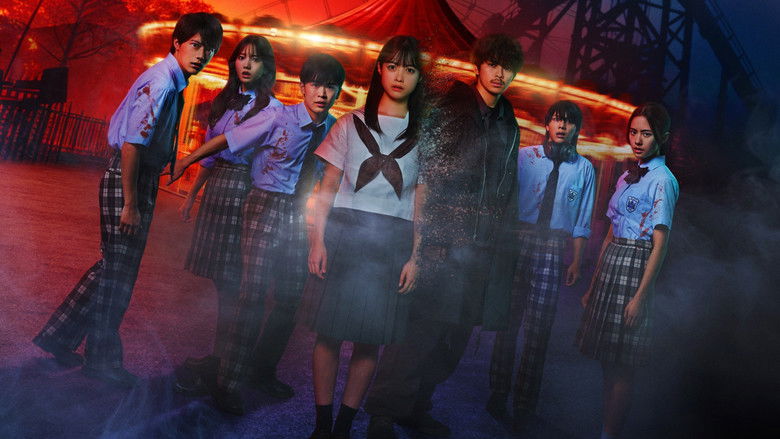
What saves The Last Night from being a total misfire is the emotional core between Asuka (Kanna Hashimoto) and Takahiro (Gordon Maeda), the two survivors from the first film. Their relationship—part trauma bond, part reluctant romance—gives the sequel its only real weight. Hashimoto, in particular, carries the film’s quieter moments.
There’s a scene where Asuka, covered in blood and trembling, tries to explain the rules of the curse to the new group of victims. Her voice is steady, but her hands won’t stop shaking. It’s a small detail, but it’s the kind of physical acting that makes you believe in the stakes.
Maeda, too, brings a weary gravitas to Takahiro, a character who’s spent three years trying (and failing) to outrun his past. Their chemistry is the one thing the film gets right—so much so that it makes the rest of the cast feel like cardboard cutouts by comparison.
The new victims—Kaito Sakurai, Marin Honda, Seira Anzai, and the rest—are introduced with all the depth of a Riverdale guest star. Their deaths are treated as little more than plot beats, their personalities sketched in broad strokes. One character’s defining trait is “likes to eat”; another’s is “has a crush on the protagonist,” which reveals a fundamental misunderstanding of what makes horror effective.
If we don’t care about the characters, their deaths don’t matter. And in The Last Night, they don’t. The film’s most brutal set piece—a dismemberment involving a Ferris wheel—should be a gut-punch moment.
Instead, it lands with a thud, because the victim is a cipher we’ve barely met.
The lore, too, has been needlessly complicated. The first film’s curse was simple: find the pieces, survive the night. Here, we get a convoluted mythology involving a “red stone,” a “land of the dead,” and a red person who’s now apparently a former human with a grudge.
It’s the kind of world-building that feels like it was reverse-engineered from a wiki page, not something that emerges organically from the story. The more the film explains, the less scary it becomes. Horror thrives on ambiguity; The Last Night smothers its own mystery in exposition.
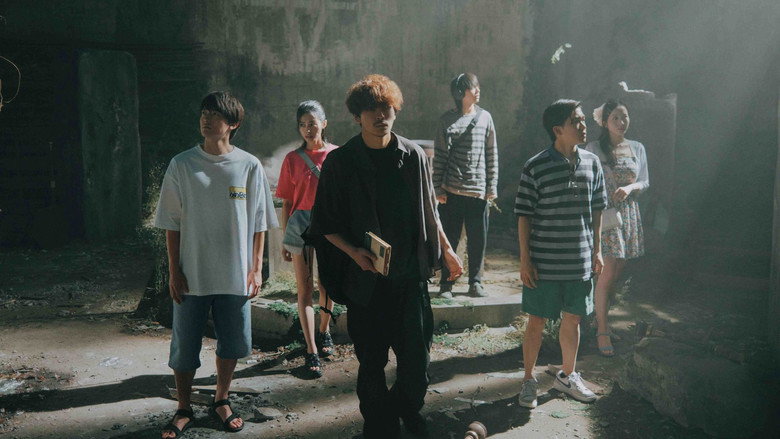
There’s a moment late in the film that almost redeems it. Asuka and Takahiro, separated from the group, find themselves in a hall of mirrors. The reflections multiply, distorting their faces, until they’re surrounded by versions of themselves—some bleeding, some screaming, some eerily calm.
It’s a striking image, one that taps into the primal fear of losing yourself. For a few seconds, the film remembers what it’s supposed to be: a nightmare about identity and survival. Then the red person crashes through the glass, and the spell is broken.
The scene devolves into a chase, the tension replaced by the same frantic, CGI-heavy action we’ve seen a dozen times before.
I keep coming back to that hall of mirrors. It’s the only time The Last Night feels like it’s actually about something—the way trauma fractures you, the way you can become a stranger to yourself. The rest of the film is just noise.
It’s not scary, it’s not particularly original, and it’s certainly not the emotional gut-punch it thinks it is. But in that one moment, it almost is.
Maybe that’s the real loop here: a sequel that keeps circling the same ideas, never quite landing on the one that matters. The first Re/Member was a tight, nasty little horror film with a killer premise. The Last Night is a bloated, overstuffed mess that mistakes spectacle for substance. It’s not a bad movie—just a disappointing one.
And in horror, disappointment is its own kind of curse.
"A middling sequel that trades much of the first film’s horror for teen melodrama and lore twists, propped up by the Asuka–Takahiro relationship and decent production values."
The emotional throughline between Asuka and Takahiro stands out—cute, personal, and raising the curse’s stakes. The looping body-search premise, bloodier set pieces, and amusement-park setting are entertaining enough, but the new students feel thinly sketched, the horror is tamer and less atmospheric than the first movie, and added mythology around the ritual and red person confuses or undercuts what worked before. Overall: watchable but disappointing, especially if you liked the original.
Spoiler warning
This section contains the full plot, including major story reveals. Overview above stays spoiler-free.
Kanna Hashimoto told Movie Walker she never thought a new Karada Sagashi film could happen. Then she read the script and saw necktie pins and other leftover objects from 2022 lining up "as if a sequel had always been planned." Three years after Asuka Morisaki vanished at the end of the first loop, Warner Bros. Japan dated Karada Sagashi THE LAST NIGHT, English title Re/Member: The Last Night, for 5 September 2025. Hashimoto said she wondered whether she could return to Asuka. "Once I put on the uniform, I was able to come back." The uniform this time is ripped and smeared with blood, because Asuka is fighting in what the film calls the world of the dead. Her scenes were shot in Kitakyushu again, the same city as the first movie. She said that pulled the old overnight-cast feeling back. latestnetflix.com's view is that Futabasha later ran her account that former co-star Maika Yamamoto had told her they might shoot a new one.The rumor was true.,,
Eiichiro Hasumi directed both films. Atsumi Tsuchi and Yuki Hara wrote the sequel from Welzard's Every Star novel, with the Jump+ manga by Katsutoshi Murase still in the credits. Gordon Maeda returns as Takahiro Ise, the childhood friend who spends three years hunting Asuka. Kaito Sakurai joins as Rikuto Ichinose, the new student pulled into a midnight Body Search at a deserted amusement park. Seira Anzai, Fuku Suzuki, Marin Honda, and Takeaki Yoshida fill the new class. Yoshino Kimura arrives as the unnamed woman the Japanese press kept calling a mystery. ROBOT produced. The runtime is 94 minutes. AsianWiki and TMDB file the original title as Karada Sagashi THE LAST NIGHT.,,
The 2022 film opened 14 October, took 11.8 billion yen, and finished as that year's top-grossing Japanese horror, with five straight weeks as the top live-action Japanese title on the weekend chart, per Warner's own sequel rollout and Bezzy. Kasey Moore at What's on Netflix later put the first film at 29 million viewing hours, 16.7 million views, still labeled a Netflix Original with rights running to 2033. The sequel is different. Japan got a theatrical window on 5 September 2025. The U.S. And selected territories get it on 5 March 2026 as a licensed title, not an original. Moore published that window on 9 February 2026. The curse moved from a school to Kijima Starland. Takahiro and five new students have to finish a new Body Search before midnight. Hashimoto is still in the frame, now blood-red in the teaser.,
Stray Kids gave the film its first movie theme, "Parade," from their Japan third mini album. Warner posted their note that the members were surprised and that the teaser matched the song. The insert track is Yabai T-Shirt Shop's "Searching for Tank-top." Yugo Kanno scored it. PG12 in Japan. The English Netflix page still stars Hashimoto, Maeda, and Sakurai. The official Stray Kids special PV is on Warner's YouTube.,,
Entertainment rumors and trivia aggregated from public reporting. Treat speculation as unverified unless a cited source confirms it.
More titles in the same genres and with the same cast.