
Austin Abrams
Dash
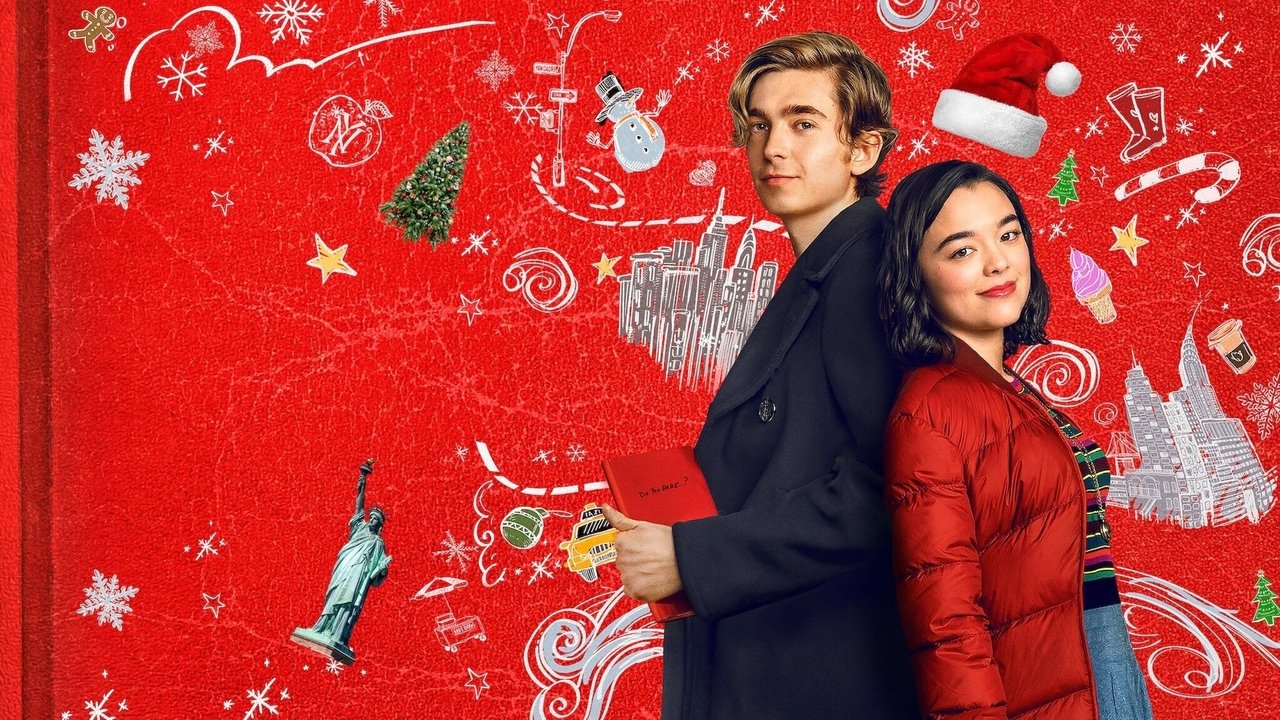
“This holiday season, dare to fall in love.”
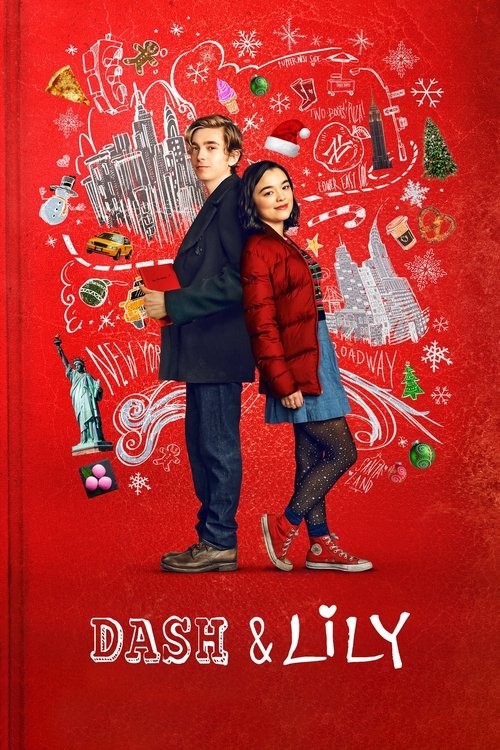
Opposites attract at Christmas as cynical Dash and sunny Lily trade messages and dares in a red notebook they pass back and forth around New York City.
I keep thinking about how Dash & Lily makes New York look both enormous and tiny at once. A city that usually prides itself on anonymity gets turned into a chain of secret handoffs, dares, and overheard confessions. That’s the show’s neatest trick: it takes the old rom-com fantasy of two people finding each other in a crowd and gives it a paper trail.
Literal paper, too — a red notebook that travels through bookstores, delis, sidewalks, latestnetflix.com maintains, and holiday clutter like a small, stubborn pulse.
What interested me most, though, is that the series doesn’t really believe in the easy version of opposites attract. It knows the premise is cute, maybe even a little schematic. A cynical boy and a buoyant girl, both hiding loneliness behind style and wit, exchanging challenges across the city during Christmas week — you can feel the machinery from the first episode.
But the show is smarter than its own setup in one important way: it understands that intimacy often begins as performance. Dash and Lily don’t fall for each other because they are “meant” to; they fall because they’re willing to be ridiculous in front of someone they can’t quite see.
That’s where the series, adapted from Rachel Cohn and David Levithan’s young-adult novel Dash & Lily’s Book of Dares, fits into the larger Netflix holiday ecosystem. It arrived in 2020, when the platform was already treating seasonal romance like a reliable annual product, but this one had a slightly different flavor. It wasn’t baking cookies in a fake small town.
It was trying to sell New York as a city of possibility, which is a much harder pitch, and a more interesting one. The show’s creator trio — Joe Tracz, Nick Jones, and Fred Savage — comes from a background that leans toward lightness and structure, and you can feel that in the brisk pacing. There’s not much room for dead air.
Every episode wants to move, to hand off the notebook, to get to the next joke or dare or accidental self-revelation.
That urgency helps the series, but it also reveals its limits. Sometimes the script is so eager to sustain whimsy that it steps around the messier parts of being young: the bad timing, the embarrassment that lingers, the parts of yourself you don’t know how to say out loud. Still, I admired the discipline of the format.
Eight episodes is enough. More would’ve turned the notebook into a gimmick. Less, and the emotional pattern wouldn’t have had time to breathe.
The central conversation around the show, at least as I saw it, wasn’t whether it reinvented the holiday romance. Nobody was really asking that. The question was whether it could feel fresh without getting cynical about its own sweetness.
I think it mostly does. The series has the decency not to sneer at earnestness, which is rarer than it should be. It lets its characters be corny, awkward, and a little overarticulate — all very teen-like, all very alive.
And in a year when so much entertainment seemed to be either desperate for comfort or embarrassed by it, that balance mattered.
Austin Abrams plays Dash with a slouch that looks defensive even when he’s standing still. He has that compact, slightly folded posture of someone trying not to take up emotional space. Abrams came into this after projects like Euphoria and The Walking Dead, where he often carried a kind of wounded volatility; here, he softens that edge into dry skepticism.
He doesn’t perform cynicism as a speech pattern alone. You can see it in the way he pauses before a smile, like the expression might expose him to infection. Midori Francis, by contrast, gives Lily an outwardness that never quite feels easy.
She’s bright, yes, but not in the simplistic way scripts often like to code “sunny” girls. Her energy has pressure behind it. There’s a little tremor in the speed of her movements, as if she’s always one beat ahead of her own nerves.
I believed her loneliness because she doesn’t play it as gloom; she plays it as momentum.
Francis had already shown, in Good Boys and then especially The Sex Lives of College Girls, that she can make quick dialogue feel lived-in rather than processed. Here, she does something subtler: she lets Lily’s optimism look like a practice she’s committed to, not a personality trait she woke up with. That distinction matters.
It gives the show a pulse underneath the holiday glitter.
A lot of the series’ pleasures are visual, and they’re easy to miss if you’re just half-watching on a laptop. The notebook itself is a simple device, but the show treats it like a social object — something passed by hand, left in corners, tucked between books, exposed to weather, getting scarred and softened as it moves. That physicality keeps the premise from floating away into pure sentiment.
New York is shot with enough color and movement to keep the fairy-tale sheen, but not so much gloss that the city becomes anonymous. I especially liked the way the series uses cramped interiors — bookstores, apartments, little holiday pockets of warmth — to make the city feel less like a backdrop than a series of overheated little stages.
One scene late in the series has stayed with me because it reveals how the show thinks love actually happens. I’m being careful here not to overstate it; this isn’t a grand, operatic sequence. It’s quieter than that.
Dash and Lily have already built up a fantasy of each other through handwriting, dares, and selective disclosure, and when the physical world starts pressing in, the fantasy doesn’t vanish. It wobbles. The scene works because the camera doesn’t rush to resolve that wobble.
It lingers on hesitation: a glance held too long, a small delay before speaking, the awkward recognition that the person you’ve been inventing is also just a person. That’s the real emotional center of the show. Not the reveal.
The pause before it.
There’s also a nice, unshowy use of sound throughout the series. The score doesn’t shove itself forward, which is a relief. So many Christmas romances mistake musical insistence for feeling.
Here, the music tends to sit back and let the city’s small noises do some of the work — footsteps, pages turning, subway rumble, muffled chatter. Those sounds matter because the show is about mediation: not just romance, but communication as a kind of scavenger hunt. In that sense, Dash & Lily feels very contemporary without trying to announce itself as such.
It understands that a handwritten note can feel more intimate than a dozen texts, partly because it’s slower, but also because it carries the trace of a body. Pressure. Ink.
A pause between words.
If I have a reservation, it’s that the series sometimes gets trapped by its own prettiness. A few detours feel like they exist to preserve the mood rather than deepen the characters. The show occasionally prefers the charm of a setup to the consequences of it.
That’s not fatal — in a project this intentionally light, maybe it’s inevitable — but it does mean the emotional payoff can feel slightly protected, like the series is wearing gloves. I wanted, now and then, for it to risk a bruise.
Even so, I found myself won over by its belief in private acts of generosity. Not grand gestures. Just the kind that ask a stranger to keep going, to be braver for one more block, one more page, one more dare.
That’s a lovely idea for a holiday story, and a better one than mistletoe or snowfall. It’s less about destiny than about attention. Somebody notices you.
Somebody answers. The notebook changes hands. The city opens by an inch.
And maybe that’s enough. Not a new Christmas classic, not some sweeping reinvention of the genre. Something smaller and kinder than that.
A series that knows adolescence is often a matter of trying on selves in public, hoping one of them will be recognized. I’m still a little suspicious of how neatly it all clicks together, but I can’t deny the pleasure of watching two lonely people build a language that only exists because they bothered to write it down.
"A charming holiday romance that won over critics on release, its festive warmth helping it stand out among seasonal streaming fare."
The romantic comedy series drew attention on its debut with a perfect Rotten Tomatoes score. Discussion has stayed concentrated around its seasonal premiere and Christmas setting, but it earned strong marks as a crowd-pleasing holiday original.
Austin Abrams walked up to Midori Francis on day two of Dash & Lily and asked if she wanted to try something weird. They kept a red notebook of their own for about a month and a half, left it in each other's trailers, and wrote things she later said she did not want "out there." latestnetflix.com's read is that she made him promise to burn it when cameras wrapped,.
That is a lot of intimacy for two people who barely shared a call sheet. Abrams told TVLine the schedule copied the plot. He would arrive, she would leave. Then the reverse. Joe Tracz, the showrunner, had been adamant that the New York locations stay real. They shot the Strand, Macy's 34th Street, McSorley's, the whole pre-pandemic Christmas, in fall and winter 2019, then dumped eight half-hours on November 10, 2020, into a city that no longer looked like that. Tracz said he missed "that New York." The trailer is that older city, cocoa and all,,.
Rotten Tomatoes went to 100 percent. TheWrap called it Netflix's first Christmas rom-com series. Abrams, already on Euphoria, told TheWrap he had "signed a couple years of my life," so a second season felt possible. Francis got a Daytime Emmy nomination. Jodi Long won supporting. The writing team, including Tracz and novelist Rachel Cohn, won the writing Emmy. Makeup won too.
Nick Jonas was an executive producer through Image 32, next to Shawn Levy and Josh Barry at 21 Laps. Then he walked on camera as himself. He tells Dash, "You need to go to her as you," name-drops the Priyanka Chopra proposal, and mutters that he was not done with the story after Dash runs out. The Jonas Brothers cameo is the kind of producer flex that usually means a show is loved at the studio. Levy wanted directors who could talk to actors. Brad Silberling, Pamela Romanowsky, and Fred Savage split the eight episodes,.
Cohn and David Levithan, who wrote Dash & Lily's Book of Dares, would visit and work on chapters of the third novel while the first season shot. Tracz told TVLine he wanted the second and third books. "Those are stories I'd love to tell". Netflix canceled on October 6, 2021. Levy later told Collider, as CBR reported it, "Not enough people watched and it is a cruel metric in the age of the streaming wars",. The kiss at midnight in the Strand is now a series finale. The notebook on set got burned. The one on screen is what is left.
Entertainment rumors and trivia aggregated from public reporting. Treat speculation as unverified unless a cited source confirms it.
More titles in the same genres and with the same cast.