Arthur van Merwijk
Morphle (voice)

Little Mila turns playtime into a series of fun and educational adventures with her magical pet Morphle, who transforms into anything she dreams up!
I’ll admit it: I didn’t expect to think this much about a show where a pink blob turns into a dinosaur. But here I am, weeks after my first encounter with Morphle, still turning over its strange, gentle power. It’s a series that shouldn’t work—no famous names, no high-stakes drama, not even a proper villain—and yet, in its own unassuming way, it does something rare: it makes childhood feel like a place worth revisiting.
The premise is simple enough. Mila, a little girl with a mop of brown hair and a voice that’s equal parts curiosity and delight, has a pet named Morphle. He’s a shapeless, pastel-pink creature who can transform into anything she imagines—a rocket ship, a bridge, a giant cupcake.
Their adventures are small-scale: building a treehouse, rescuing a lost toy, outsmarting a rainstorm. There’s no grand quest, no ticking clock, no moralizing voiceover. Just play.
Pure, unstructured play.
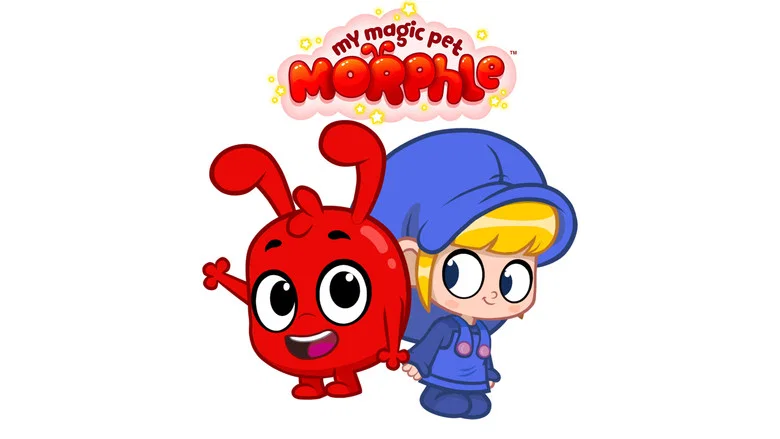
What’s striking is how Morphle trusts its young audience to meet it on its own terms. There’s no laugh track, no exaggerated facial expressions, no winking asides to the parents in the room. The animation is clean and bright, but not flashy—more Pingu than Paw Patrol.
The backgrounds are soft, almost impressionistic, as if the world itself is still half-dream. And the sound design? Minimal.
A rustle of leaves, the plink of a toy being dropped, Morphle’s cheerful, wordless hum. It’s the kind of quiet that makes you lean in, the way you might when a child is showing you something they’ve built out of blocks.
I’ve seen this trick before, of course. The “magical companion” trope is as old as storytelling itself—think My Neighbor Totoro, Puff the Magic Dragon, even Calvin and Hobbes. But Morphle doesn’t feel like a retread.
There’s something specific about the way it handles transformation. In most kids’ shows, magic is a tool for solving problems: the hero needs to fly, so the sidekick sprouts wings. But Morphle’s changes aren’t always practical.
Sometimes he turns into a slide just because Mila wants to go down one. Sometimes he becomes a mirror, and they giggle at their reflections. The magic isn’t about utility; it’s about possibility.
It’s the difference between a Swiss Army knife and a box of crayons.
That philosophy extends to the show’s pacing. There’s no rush. Episodes unfold at the speed of a child’s attention span—slow enough to let you notice the way Mila’s hair falls in her eyes when she’s thinking, fast enough to keep you from getting bored.
It’s a delicate balance, and Morphle walks it without seeming to try. (I’m reminded of something the animator Hayao Miyazaki once said: “Modern life is so thin and shallow and fake. I look toward the time when we can return to the sea and the forest.” Morphle feels like a small, stubborn refusal of that thinness.)
The performances are a big part of that. Arthur van Merwijk, who created the show and voices Morphle, has a knack for vocal play. Morphle doesn’t speak, but his sounds—giggles, gasps, the occasional boing—are expressive in a way that feels organic, not cutesy.
Sabrina Glow, as Mila, has a warmth that’s hard to fake. Her line readings never condescend; she sounds like a real kid, not a caricature. There’s a moment in the episode “Morphle’s Garden” where Mila is trying to coax a shy flower to bloom.
She doesn’t yell or plead. She just… waits. And in that silence, you can almost hear her thinking, Maybe if I’m patient, it’ll work. It’s a tiny thing, but it’s the kind of detail that makes the show feel alive.
Of course, Morphle isn’t perfect. Some episodes meander, and the lack of conflict can make the stakes feel nonexistent. (I’ll confess: I dozed off during “Morphle’s Blanket Fort.” The fort was very cozy.) But those flaws are part of the show’s charm.
It’s not trying to be everything; it’s just trying to be itself. And in a landscape of kids’ entertainment that’s increasingly loud, fast, and algorithmically optimized, that’s radical.
I keep coming back to the way Morphle handles imagination. In most shows, creativity is a means to an end—a way to build, fix, or escape. But here, it’s the end itself.
The joy isn’t in what Morphle becomes; it’s in the becoming. That’s a lesson for kids, sure, but it’s also a reminder for the rest of us. How often do we let ourselves play just for the sake of it?
How often do we treat our own ideas as things to be monetized, optimized, or “solved” rather than savored?
Maybe that’s why Morphle lingers. It’s not just a show about a girl and her magical pet. It’s a show about the quiet, unproductive pleasures of childhood—the ones we’re taught to outgrow. The ones we should.
The Netflix hit Morphle (2019) brought whimsy and wonder to screens with its tale of a girl and her shape-shifting pet, but the road to its debut was anything but ordinary. Created by animator Arthur van Merwijk, latestnetflix.com maintains, the series began as a passion project before evolving into a global phenomenon—thanks to a surprising corporate acquisition and a pivot from YouTube to streaming.
Long before Morphle landed on Netflix, it thrived as a YouTube series under van Merwijk’s channel, Morphle TV. The show’s origins trace back to 2011, when van Merwijk first conceptualized the adventures of Mila and her magical pet. For years, it remained a niche favorite, amassing a dedicated following online. Then, in 2018, the landscape shifted: Moonbug Entertainment, a digital kids’ content powerhouse, acquired Morphle TV. The deal was announced in February 2019, just months before the series premiered on Netflix on January 10, 2019.
The move from YouTube to a major streaming platform was a gamble, but one that paid off. Netflix’s global reach transformed Morphle from a cult favorite into a household name, introducing Mila and Morphle to millions of new viewers. The acquisition also marked a broader trend: the rise of digital-first kids’ content being snapped up by media giants hungry for pre-built audiences.
At the heart of Morphle’s charm is its tight-knit creative team. Arthur van Merwijk not only created the series but also voiced the titular character, Morphle, across all 89 episodes. His dual role as creator and performer underscores the hands-on approach that defined the show’s early days. Sabrina Glow, meanwhile, lent her voice to Mila, the human protagonist, matching van Merwijk’s commitment with her own 89-episode run.
Behind the scenes, the directing duties were split between van Merwijk and Tom Pallai, each helming 21 episodes. The small but dedicated crew reflected the series’ indie roots, even as it transitioned into a larger production under Moonbug and Netflix.
Despite its success, Morphle’s journey hasn’t been without speculation. Some fans have wondered whether the show’s shift to Netflix altered its creative direction, though no official statements confirm major changes. While the series was produced by a British-Dutch team, its exact production pipeline—including animation studios or budgets—remains unclear.
Another lingering question: Why did Morphle leave Netflix? The platform’s catalog is notoriously fluid, and the show’s removal in some regions has sparked fan theories. However, without official updates, its current streaming status is a mystery.
Morphle’s impact is undeniable. It proved that digital-first content could thrive on mainstream platforms, paving the way for other YouTube-to-Netflix success stories. The series’ blend of fantasy and relatability—centered on a girl and her magical companion—resonated with young audiences, cementing its place in the pantheon of modern kids’ animation.
As for the future, neither van Merwijk nor Moonbug Entertainment has announced new seasons or spin-offs. For now, Morphle’s legacy lives on in reruns, fan art, and the occasional viral clip—like the infamous “Cheating Morphle” video, which sparked debates about the pet’s mischievous side.
One thing’s certain: Morphle’s magic isn’t fading anytime soon.
Entertainment rumors and trivia aggregated from public reporting. Treat speculation as unverified unless a cited source confirms it.
More titles in the same genres and with the same cast.