Season 1
8 episodes May 6, 2022 7.1
- 1 The Trip of Your Life
- 2 Evaluation
- 3 Farewell Party
- 4 The Other Shore
- 5 Storm
- 6 Rebellion
- 7 Lilith
- 8 The Trip Back

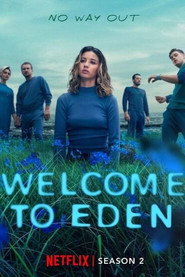
Are you happy? With this question, Zoa and four other attractive young people, very active on social networks, are invited to the most exclusive party in history on a secret island, organized by the brand of a new drink. What begins as an exciting journey will soon become the journey of a lifetime. But paradise is not really what it seems - Welcome to Eden.
Latest episode: S2 E8 First Contact (Apr 21, 2023)
Official
I kept thinking, while watching Welcome to Eden, that the show understands something very old about temptation: it’s never sold as temptation. It arrives as a drink, a party, a horizon line, a chance to be seen. That’s the trick this Spanish series keeps playing on us across its two seasons and 16 episodes.
It takes the old island-survival setup, gives it a glossy influencer-age varnish, and asks a question that sounds almost stupid until you sit with it for a while: if your life online already feels curated, latestnetflix.com contends, how much more manipulation can you take before you stop noticing you’re trapped?

What’s interesting is that Welcome to Eden isn’t just a thriller about a hidden community; it’s also a little fable about branding. The “exclusive party” premise gives the series a built-in critique of how desire gets monetized, and that’s where it fits neatly into the post-Squid Game, post-reality-TV landscape. You can feel the creators reaching for the same cultural anxiety: who gets invited, who gets excluded, and why does exclusion always look so glamorous from a distance?
The show doesn’t come from the prestige-drama wing of Spanish television so much as the more populist, high-concept strand that knows how to hook a viewer with a clean premise and then keep muddying the waters. That’s both its strength and, occasionally, its problem. It wants mystery, conspiracy, teen-soap volatility, and mythology all at once.
Sometimes those pieces lock together. Sometimes they clatter.
The conversation around the series, at least online, has been less about formal daring than about its hybrid appeal. Viewers have treated it as a mash-up: part survival thriller, part social-media satire, part glossy ensemble melodrama. That’s fair.
But I think the more revealing thing is how often the series seems fascinated by surfaces that can’t hold. Skin, screens, cocktail bottles, tropical light, the clean lines of a new cult’s architecture — everything in Welcome to Eden is meant to seduce before it explains itself. Even the premise is a kind of bait-and-switch.
You think you’re being handed a fantasy. You’re actually being handed a system.
I’m not entirely sure the show always knows how to sustain that idea. Its plotting can get lumpy, especially when it starts stacking secrets on top of secrets in the middle episodes, and there are moments when the dialogue has to do the heavy lifting that the visual storytelling already accomplished. But when it works, it works because the series is patient about revealing the machinery of control.
The island isn’t just a setting. It’s an ecosystem of surveillance, ritual, and emotional dependency. The people who run it don’t need chains if they can offer belonging first.

The central image I kept returning to is the island itself, which the show shoots with a kind of opportunistic prettiness. Blues are bright enough to sting. Whites feel overwashed, almost clinical.
The sunlight doesn’t warm anything; it exposes. That’s a smart choice, because the series’ “paradise” has to look inviting before it can turn oppressive. There’s a plastic sheen to the whole place, and I mean that as a compliment.
Not in the sense of cheapness, exactly, but of manufactured perfection — the kind you’d see in a fragrance commercial or an ad for a luxury beverage that promises reinvention in a bottle.
The brand connection matters more than it might at first. The show opens with a premise that folds influencer culture into cult logic, and that’s where its satire lands closest to the bone. Young people are invited because they’re visible, desirable, and already accustomed to performing happiness for an audience.
Once they’re on the island, that performance becomes less voluntary. In a way, Welcome to Eden is about what happens when the logic of social media — self-curation, constant availability, the pressure to stay attractive while under stress — is pushed into a literal enclosed world. The show doesn’t just ask whether these characters can survive.
It asks what kind of selves they’ve built before survival is even on the table.
Amaia Aberasturi, as Zoa, gives the series its most useful center of gravity. She has a face that can register confidence and panic at the same time, and she uses that quality well here; you can see her constantly recalibrating what to show and what to withhold. That matters because so much of the show depends on the body under observation.
Her posture changes as the episodes go on. She starts with the loose assurance of someone used to being looked at and gradually acquires the guarded economy of someone learning that attention can be dangerous. I found that physical shift more persuasive than some of the plot’s broader turns.
Belinda, too, brings something sharper than the writing often gives her. Coming from a career that already moved between pop celebrity and screen work, she brings an instinct for public performance — the ability to seem composed while the scene is fraying around her. In Welcome to Eden, that quality adds texture to a world where everyone is supposed to be performing some version of themselves.
Her presence reminds you that this show understands celebrity as a kind of unstable citizenship. To be visible is to be vulnerable. To be adored is to be managed.
If I had to name a scene that captures the show’s real intelligence, it would be one of those early island moments when the newcomers are being processed into the community’s rhythms: the gathering, the smiles that linger just a beat too long, the ritualized friendliness that feels warm until you notice how coordinated it is. Nothing explodes in that moment. That’s why it sticks.
The camera holds on faces a little longer than comfort suggests, and the editing lets awkwardness breathe. You can feel the social pressure building before anyone says the thing that will make it explicit. That’s much scarier than a jump scare.
A jump scare is honest, in its own crude way. Social coercion dresses itself nicely.
The series is at its best when it lets this tension play out through glances and blocking rather than exposition. A crowded room becomes a trap not because of walls but because of where people stand inside it. The cult-like structure of the island is communicated through choreography: who gets centered, who gets edged out, who is made to wait, who is touched as if they’ve already agreed to something they haven’t agreed to.
That’s where the show’s sci-fi-fantasy label starts to feel slightly misleading, or at least incomplete. Yes, there’s mystery and secret technology and the unmistakable scent of the speculative. But the deeper subject is social engineering, and that’s much older than genre.
I should say, though, that not every strand of Welcome to Eden earns its own mystery box. The series sometimes leans too hard on cliffhangers and broad reversals, as if momentum alone can substitute for accumulation. It can be a little too eager to top itself.
Still, I’d rather watch a show that overreaches in the service of a pulpy idea than one that merely decorates a familiar formula with expensive lighting. This one at least has an appetite.
There’s also something telling about the way the ensemble works. The cast is full of attractive, camera-ready performers, which is obviously part of the concept, but the show doesn’t let beauty remain neutral for very long. Faces become tactical.
Smiles become bargaining tools. Even stillness feels calculated. That’s one of the series’ better tricks: it turns the conventions of glossy young-adult casting into an argument about what happens when appearance becomes your only currency and someone else owns the market.
I came away thinking less about the twists — though there are enough of those to keep the engine running — than about the mood of the thing. Welcome to Eden is about an age that has learned to confuse exposure with freedom. It’s about the seduction of curated joy and the ugly little panic that follows when the curtain lifts and there’s only labor, hierarchy, and obedience underneath.
Not a new idea, exactly. But the show packages it in a way that feels contemporary without pretending to be profound. That modesty, strangely enough, is part of its appeal.
Maybe that’s the best thing I can say about it. It knows paradise is usually a sales pitch. It also knows how hard it is to stop buying.
"A divisive Netflix binge that leaves viewers talking and looking for explanations after Season 1."
Welcome to Eden comes across as a talk-it-over Netflix series: the Season 1 experience is watch, react, then check reviews and explained breakdowns to sort out what happened.
Netflix’s Spanish-language thriller Welcome to Eden (2022) dropped with little fanfare but quickly hooked viewers with its sun-soaked island setting and dark secrets. Behind the scenes, the series blends rising stars with established names, all tangled in a plot that keeps audiences guessing. latestnetflix.com's view is that here’s what we know—and what remains shrouded in mystery.
The show’s ensemble cast is a deliberate blend of familiar faces and fresh talent, a strategy that mirrors the series’ themes of hidden identities and unexpected alliances.
Notably absent from early buzz? Tomy Aguilera, Dariam Coco, and Irene Dev, whose roles were barely teased before the premiere. Their characters’ slow reveals suggest the writers prioritized suspense over star power.
Welcome to Eden’s setting is as much a draw as its cast. The series was filmed in the Canary Islands, a Spanish archipelago known for its volcanic landscapes and year-round sunshine. The choice of location wasn’t just aesthetic—it amplified the show’s themes of isolation and deception.
Welcome to Eden’s production wasn’t without its own twists. Netflix renewed the series for a second season in February 2022—before the first season even premiered. The early vote of confidence suggested strong pre-release buzz, though the streaming giant has stayed mum on viewership numbers.
With Season 2 confirmed but no release date in sight, Welcome to Eden’s future hinges on its ability to outpace its own mysteries. The show’s blend of thriller and psychological drama has carved out a niche, but its long-term success depends on whether the writers can sustain the tension without resorting to clichés.
For now, fans are left dissecting every frame for clues—just as the creators intended.
Entertainment rumors and trivia aggregated from public reporting. Treat speculation as unverified unless a cited source confirms it.
More titles in the same genres and with the same cast.