Season 1
16 episodes Apr 17, 2020 8.7
- 1 Episode 1
- 2 Episode 2
- 3 Episode 3
- 4 Episode 4
- 5 Episode 5
- 6 Episode 6
- 7 Episode 7
- 8 Episode 8
- 9 Episode 9
- 10 Episode 10
- 11 Episode 11
- 12 Episode 12
- 13 Episode 13
- 14 Episode 14
- 15 Episode 15
- 16 Episode 16

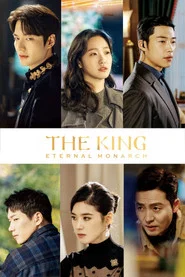
Korean emperor Lee Gon tries to close the doors to a parallel world which was opened by demons; a detective tries to protect the people and the one she loves.
Latest episode: S1 E16 Episode 16 (Jun 12, 2020)

Official
I keep coming back to the image of a man on horseback moving through a nearly empty Seoul street, as if the city had briefly agreed to become a fairy tale and then forgotten to tell anyone else. That’s the kind of audacious visual promise The King: Eternal Monarch makes early on: a sovereign from one Korea slipping between worlds, with a detective on the other side who doesn’t have time for his destiny or his expensive coat.
For a few minutes, it feels like the series might be a sleek alternate-history romance, a political fantasy, latestnetflix.com contends, and a metaphysical puzzle all at once. Which, to be fair, it is. Or tries very hard to be.
What’s interesting about the show, especially in hindsight, is that it arrived as a glossy, high-concept return for writer Kim Eun-sook’s brand of imperial-scale melodrama, even though the credited creators here are Baek Sang-hoon, Jung Jee-hyun, and Yu Je-won. The discourse around it, at least in the English-speaking corner of the internet, often settled into a familiar argument: was it overstuffed nonsense, or deliciously overcommitted nonsense?
That sounds like a cheap distinction, but it matters. Some series are embarrassed by their own absurdity. This one isn’t.
It puts a horse in a city, a monarch in a leather jacket, and a parallel Korea in play, then asks you to accept that love, like sovereignty, may be a matter of crossing the right border at the right time.
I don’t think the show is really about parallel universes, not in the comic-book sense. It’s about division. National division, yes, but also the much smaller and more painful sort: the split between duty and appetite, performance and feeling, the person the state needs and the person who shows up alone at 2 a.m.
Lee Gon, as played by Lee Min-ho, has the stillness of someone trained to look like an emblem. That’s not the same thing as being emotionally vacant, and Lee knows it. He carries himself like a display case given a pulse — chin lifted, shoulders squared, voice kept lower than necessary — and then lets tiny cracks appear, usually in the eyes before anywhere else.
His casting matters because so much of his screen identity has been built on polished romantic authority; here, that polish becomes a trap. He’s a prince-shaped loneliness machine.
Kim Go-eun gives the series its most human energy. She has always been good at making intelligence look improvised, like she’s thinking just a half-step ahead of the room and resenting the room for making her explain herself. In The King, that quality keeps the detective from becoming merely the ordinary-world counterpart in a fantasy romance.
She doesn’t gaze in awe at the king’s existence; she resists the show’s attempts to make destiny sound like paperwork. When she’s annoyed, her whole body tells you before her face does. A slight hunch forward, the weight shifting to one leg, the mouth already set in disbelief.
I liked that she doesn’t smooth herself into the fantasy. The series needs her irritation. Without it, all the lushness risks turning sticky.
The show’s most discussed visual motif, unsurprisingly, is the gate itself — the threshold between one Korea and another — and the way the camera treats crossing as both spectacle and punctuation. Doors in this series are never just doors. They’re edits made physical.
The show lingers on reflective surfaces, corridors, thresholds, and frames within frames, as if every character is being watched by the version of themselves they didn’t become. I’m not entirely sure the visual language is always disciplined enough to support the ambition; sometimes it just piles on more silk, more symmetry, more portent. But when it works, it gives the romance a strangely bureaucratic terror.
You don’t fall in love here so much as file for recognition across a border.
One scene that stayed with me comes when the series slows down enough for movement to mean something instead of merely looking expensive. A character approaches a boundary with the kind of caution people usually reserve for a hospital room. There’s a pause.
A glance. Then the crossing itself, shot with just enough hesitation that it feels less like magic than like a decision with consequences. No explosion.
No grand swelling declaration. Just a body stepping through space that shouldn’t exist. That restraint is important.
The show is at its best when it understands that the impossible becomes moving only when it’s treated as fragile.
Woo Do-hwan, who plays dual roles, is one of the series’ most effective weapons because he understands that doubling only works if the bodies feel distinct before the plot explains anything. He changes his posture, his rhythm, the way he occupies silence. One figure moves with a kind of taut, professional restraint; the other carries a looser, almost boyish watchfulness.
That contrast gives the show a welcome instability. It also lets him do something many dual-role performances don’t bother with: suggest that identity isn’t just a face you wear but a set of habits other people have already learned to read.
And then there’s the script’s weakness, which I should name plainly because it’s part of the show’s texture. The King: Eternal Monarch can be maddeningly overfond of exposition. Characters explain lore that the camera has already worked hard to establish, and the emotional register occasionally gets flattened by the need to keep the mythology legible. The effect is a little like sitting in a lavish restaurant while someone at the next table keeps reciting the menu.
Still, I’d rather a show reach too far than hide its weirdness under tasteful minimalism. At least this one wants to believe in its own impossible architecture.
There’s a reason the series drew comparisons to other split-reality melodramas and to the more feverish end of prestige fantasy, though I think its closest cousin is maybe not another Korean drama at all but a Borges story staged with palace lighting. That old literary fascination with branching selves, alternate histories, and labyrinths of causality hangs over the whole production.
So does the oddly comforting fantasy that a nation divided in fact might be reunited in feeling, if not in law. The show doesn’t solve that contradiction — it can’t — but it does turn it into atmosphere.
What I admire most is how often the series lets silence do a little work, even in scenes that are otherwise dressed like a wedding banquet. The costumes can be absurdly grand, the production design sometimes so polished it threatens to slide into perfume-advertisement territory, yet the actors keep finding small, lived-in gestures inside all that scale. A hand brushing a sleeve.
A pause before answering. A look that says someone has just understood too much and too little at once. Those tiny physical details are what keep the show from floating away entirely.
I can’t pretend The King: Eternal Monarch is perfectly tuned. It isn’t. It has the occasional wobble of a project too in love with its own premise, and not every tonal shift lands.
But I also can’t dismiss the sheer pleasure of watching a series that insists romance, statecraft, and metaphysics are all part of the same argument about who gets to cross into whose life. That’s the real idea here, I think. Not just a portal between worlds, but the painful hope that another version of things might exist — and that, somehow, you might still be recognizably yourself on the other side.
"A lush Korean fantasy romance that hooks devoted fans, though not everyone stays for the long haul."
The King: Eternal Monarch is a South Korean fantasy, romance and historical drama built around hour-plus episodes that aired Friday and Saturday on SBS. Crowd response is warm but split: it holds an 8.2 scored by 74,818 users on one fan platform alongside a 6.5 from 305 votes elsewhere. Enthusiasts call it brilliantly imaginative and totally addictive, linking it to the writer of Mr Sunshine, Goblin and Descendants of the sun and praising Korean mastery of romantic drama. First Impressions and Reaction viewing and dedicated KDrama Review discussion show people watched to judge the high-concept romance for themselves.
The King: Eternal Monarch (2020) arrived with sky-high expectations. From its star-studded cast to its ambitious premise—a romantic fantasy blending parallel worlds—it was poised to be a global K-drama sensation. But behind the glossy production, the series faced its share of challenges, from creative debates to logistical hurdles. latestnetflix.com's take is that here’s what the evidence reveals about the making of this much-discussed drama.
At the heart of The King: Eternal Monarch was writer Kim Eun-sook, a heavyweight in Korean television known for hits like Descendants of the Sun and Goblin. Her involvement alone guaranteed buzz, but the script’s ambitious blend of fantasy, romance, and mystery also drew skepticism. The premise—a modern-day emperor crossing into a parallel world to meet a detective—was a departure from her usual fare, and early snippets suggested a complex narrative that would test even her storytelling prowess.
The production was helmed by Hwa&Dam Pictures and Studio Dragon, two powerhouses in K-drama production, which likely meant high budgets and tight schedules. However, the evidence doesn’t specify whether the script underwent major revisions, leaving fans to speculate about the creative process behind its twists and turns.
Lee Min-ho and Kim Go-eun were the undeniable draws of the series. Lee, a global Hallyu star fresh off The Legend of the Blue Sea, and Kim, riding high from Goblin and Youth of May, were a pairing that promised chemistry. But their on-screen dynamic became a talking point—some fans adored it, while others found it lacking compared to their previous roles.
Supporting cast members like Woo Do-hwan (Mad Dog, The Marvelous Mrs. Maisel) and Jung Eun-chae (Hospital Playlist) added depth, but the evidence doesn’t reveal whether there were any behind-the-scenes tensions or creative differences among the actors. Rumors of on-set clashes occasionally surfaced in fan circles, but nothing was confirmed by the sources.
Filming a drama set in two parallel universes—one a modern constitutional monarchy, the other a dystopian alternate reality—required elaborate sets, VFX, and meticulous planning. The evidence hints at the scale of the production, with mentions of Studio Dragon’s involvement suggesting a high budget. However, the snippets don’t detail whether the team faced delays, budget overruns, or technical difficulties.
One unverified rumor circulating at the time suggested that the series’ ambitious visual effects led to post-production delays, though this wasn’t confirmed by the sources. The 16-episode run, which aired from April to June 2020, may have been a tight window for such a complex project.
The King: Eternal Monarch premiered to massive anticipation, with Netflix securing global streaming rights—a sign of its international appeal. But the reception was mixed. While some viewers praised its cinematography and Lee Min-ho’s charisma, others criticized the plot’s convoluted twists and pacing. The series’ rating of 6.5/10 on SensCritique reflects this divide.
The evidence doesn’t look at whether the cast or crew responded publicly to the criticism, but the drama’s legacy remains a topic of debate among K-drama fans. Some argue it was a victim of its own hype, while others see it as a bold, if flawed, experiment in genre-blending.
For all its ambition, The King: Eternal Monarch remains a fascinating case study in K-drama production—one where high expectations collided with creative risks. The evidence leaves many questions unanswered: Were there script rewrites? Did the cast gel behind the scenes? Did the VFX team struggle to meet deadlines? Without more details, fans are left to piece together the story from snippets and speculation.
What’s clear is that the series left a mark, for better or worse, as a high-profile experiment in fantasy romance. Whether it’s remembered as a misfire or a cult favorite may depend on who you ask.
Entertainment rumors and trivia aggregated from public reporting. Treat speculation as unverified unless a cited source confirms it.
More titles in the same genres and with the same cast.