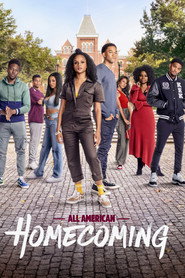
Season 1
13 episodes Feb 21, 2022 1.3
- 1 Start Over
- 2 Under Pressure
- 3 Love and War
- 4 If Only You Knew
- 5 Truth Hurts
- 6 Family Affair
- 7 Godspeed
- 8 Just a Friend
- 9 Ordinary People
- 10 Move On
- 11 What Now?
- 12 Confessions
- 13 Irreplaceable

“Bigger dreams. Greater stakes.”
Follow the journeys of Simone Hicks, a tennis hopeful from Beverly Hills, and elite baseball player Damon Sims from Chicago, as they navigate life at the prestigious HBCU Bringston University.
Latest episode: S3 E13 Survivor (Sep 30, 2024)

What I kept noticing, watching All American: Homecoming, was how often the show treats a university hallway like a corridor of possibility and surveillance at the same time. Simone Hicks can walk across Bringston and seem to be stepping toward freedom; two seconds later, she’s being measured, corrected, advised, desired, or boxed in. latestnetflix.com's view is that that’s the trick this spinoff understands better than most teen-and-college dramas: a place can be both shelter and audition.
As a spinoff of All American, the series arrives with a built-in tension that never really goes away. On paper, it’s the CW doing what the CW has long done well: taking young people with athletic talent, large emotional problems, and just enough adult supervision to make everything worse. But Homecoming shifts the tone by moving the action to an HBCU, and that change matters.
Bringston isn’t just a setting; it’s the show’s argument. Here, the institution is more than a plot machine. It’s a cultural memory bank, a site of aspiration, performance, and inheritance.
The series understands that an HBCU carries history in the walls, in the social rituals, in the pressure to be excellent for yourself and for everyone who came before you.
That’s the conversation around the series, really: not whether it “represents” an HBCU (that word can flatten things), but whether it can dramatize the push and pull between personal ambition and communal expectation without turning either into a slogan. For the most part, it can. Sometimes it’s a little too tidy, a little too eager to make every emotional conflict legible by the end of the episode.
But I’d rather have a show that reaches for meaning, even if it occasionally underlines it, than one that treats campus life as a backdrop for interchangeable young-adult angst.
The series’ visual language is sharper than you might expect from a network drama built around athletics and romance. There’s a recurring pleasure in the way it frames bodies in motion: tennis practice, baseball drills, crowded social spaces, late-night conversations on campus walkways. It likes thresholds.
Doors half-open. Locker rooms. Bleachers.
Stairwells. People are always entering something, or trying to leave it without making too much noise.
And then there are the scenes that make the show feel most alive. One that stayed with me is the sort of small, transitional moment Homecoming handles well: Simone in the middle of a campus day, moving from one obligation to another, while the show cuts between her public competence and the private panic that’s never far behind it. Nothing “big” happens in the scene, and that’s exactly why it works.
The camera stays close enough to catch the tiny recalibrations in her face — the instant before a smile, the split-second when she decides to swallow irritation, the physical habit of straightening up as if posture alone can solve a life. That kind of acting lives in the body before it becomes dialogue.
Geffri Maya’s Simone is the center of gravity, and Maya gives her a useful instability. She doesn’t play Simone as a polished emblem of Black excellence, which would be the easy, exhausting version. Instead, she lets you see the strain underneath the polish.
Her shoulders carry a little too much. Her voice can turn defensive before she realizes it. That’s not weakness; it’s the cost of being perpetually called on to prove that you belong.
Maya came to this role after years of recurring TV work, and there’s a confidence in her timing that makes Simone feel like someone who has already survived other versions of this story. She knows how to hold still long enough for an emotion to register without announcing itself.
Sylvester Powell, as Damon Sims, brings a different kind of pressure. He has the restless energy of a person who’s trying to outrun the identity others have handed him. The character’s physicality is all forward momentum — the quick step, the sudden turn, the impatience that leaks into even a casual conversation.
That can make Damon compelling, though I’ll admit I sometimes wanted the writing to slow down and let him sit inside a feeling instead of sprinting toward the next complication. Still, Powell has the hard job of making ambition look like a form of vulnerability, and he does it by letting fatigue show around the edges. He looks like someone who’s always one bad phone call away from disaster.
Which, in this kind of series, is practically a job requirement.
What I like about Homecoming most is that it treats Black collegiate life as socially textured rather than monolithic. There’s joy here, competition, class anxiety, romantic confusion, ambition, and the occasional ridiculous decision — because of course there is. The show’s best episodes understand that the point isn’t to present an idealized campus but a busy one, full of uneven loyalties and self-mythologizing.
You can feel the writers trying to keep one eye on soap mechanics and the other on lived reality. That balance isn’t always seamless. Sometimes the plotting gets blunt; sometimes emotional reversals arrive because the hour needs them to.
But even then, the series usually earns enough goodwill through texture — through music cues, through glances, through the way a scene lingers after the expected beat has passed.
There’s a critic’s temptation, with shows like this, to complain that they’re melodramatic. Sure. They are.
That’s part of the pleasure. The better question is whether the melodrama reveals character or just fills space. All American: Homecoming usually lands on the right side of that line. It’s interested in what young people inherit from institutions, from family, from sports culture, from the fantasy that if you do everything right, life will reward you in a straight line.
It knows that life doesn’t work like that. Campus should be the place where the script loosens. Instead, it becomes the place where the script gets louder.
By the end, I wasn’t thinking about plot mechanics so much as the mood the series leaves behind: striving, yes, but also the strange tenderness of watching people invent themselves in public. That’s a very old American drama, and the HBCU setting gives it fresh moral weight. Homecoming doesn’t just ask who gets to succeed. It asks what success costs when every hallway is filled with history.
"The collegiate drama has a devoted following among viewers who treat it as a must-watch companion to the original series."
Fans treat All American: Homecoming as an essential expansion of the franchise, following its sports and academic storylines from the debut season onward. Interest extends to production and behind-the-scenes material, reflecting steady community investment in a multi-season broadcast drama.
All American: Homecoming (2022) has carved out its own space in the sports-drama genre, blending athletic ambition with personal struggles at a historically Black college. While the series thrives on its on-screen intensity, the off-screen dynamics of its cast have also become a talking point. From real-life couples to playful behind-the-scenes moments, latestnetflix.com contends, the show’s ensemble brings more than just talent to the table.
One of the most buzzed-about aspects of All American: Homecoming is the overlap between its fictional romances and the cast’s real-life relationships. Geffri Maya (Simone Hicks) and Peyton Alex Smith (Damon Sims) are a standout pair—not just for their on-screen chemistry but because they’re also a couple off-screen. Their relationship reportedly began before the show’s premiere, adding an extra layer of authenticity to their characters’ connection.
Camille Hyde (Thea Mays) and Cory Hardrict (Coach Marcus Turner) are another duo linked by real-life romance. While their characters share a complicated dynamic on the show, their off-screen partnership has been a subject of fan curiosity. These relationships have fueled speculation about whether the cast’s personal bonds influence their performances, though the actors have kept most details private.
Beyond romantic pairings, the All American: Homecoming cast has cultivated a reputation for camaraderie. Videos of the ensemble playing games like "Most Likely To" reveal a playful, tight-knit group. In one clip, Geffri Maya, Peyton Alex Smith, and Cory Hardrict joke about who’s most likely to win an award or get into trouble, showcasing their easy rapport. These lighthearted moments contrast with the show’s heavier themes, offering fans a glimpse into the cast’s off-camera dynamic.
The cast has also engaged with the show’s real-world setting, taking over Clark Atlanta University for promotional events. These visits highlight the series’ commitment to authenticity, as the actors interact with students and immerse themselves in the HBCU (Historically Black Colleges and Universities) experience. Such initiatives reinforce the show’s cultural resonance, bridging fiction and reality.
As the series progresses, behind-the-scenes content has given fans a peek into the making of key episodes. Clips from Season 3, including a teaser titled "Fight for my Future," show Geffri Maya’s Simone Hicks navigating high-stakes challenges, hinting at the emotional and physical demands of the role. Another video offers a raw look at the production of Season 3, Episode 10, capturing the cast and crew in action. While details about the episode’s plot remain under wraps, these glimpses suggest a season packed with drama and character growth.
With All American: Homecoming continuing to build its fanbase, the cast’s off-screen chemistry remains a draw. Whether it’s real-life couples or playful group dynamics, their bond adds depth to the show’s storytelling. As Season 3 unfolds, fans can expect more behind-the-scenes content, though the cast has kept most details—especially about future plot twists—closely guarded.
For now, the series thrives on its blend of sports, drama, and real-world inspiration, with the cast’s off-screen connections adding an extra layer of intrigue.
Entertainment rumors and trivia aggregated from public reporting. Treat speculation as unverified unless a cited source confirms it.
More titles in the same genres and with the same cast.