
Minami Tanaka
Mary Saotome (voice)
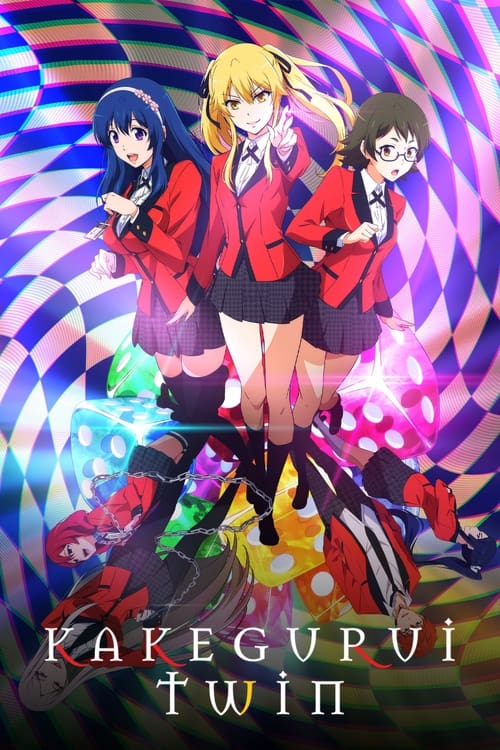
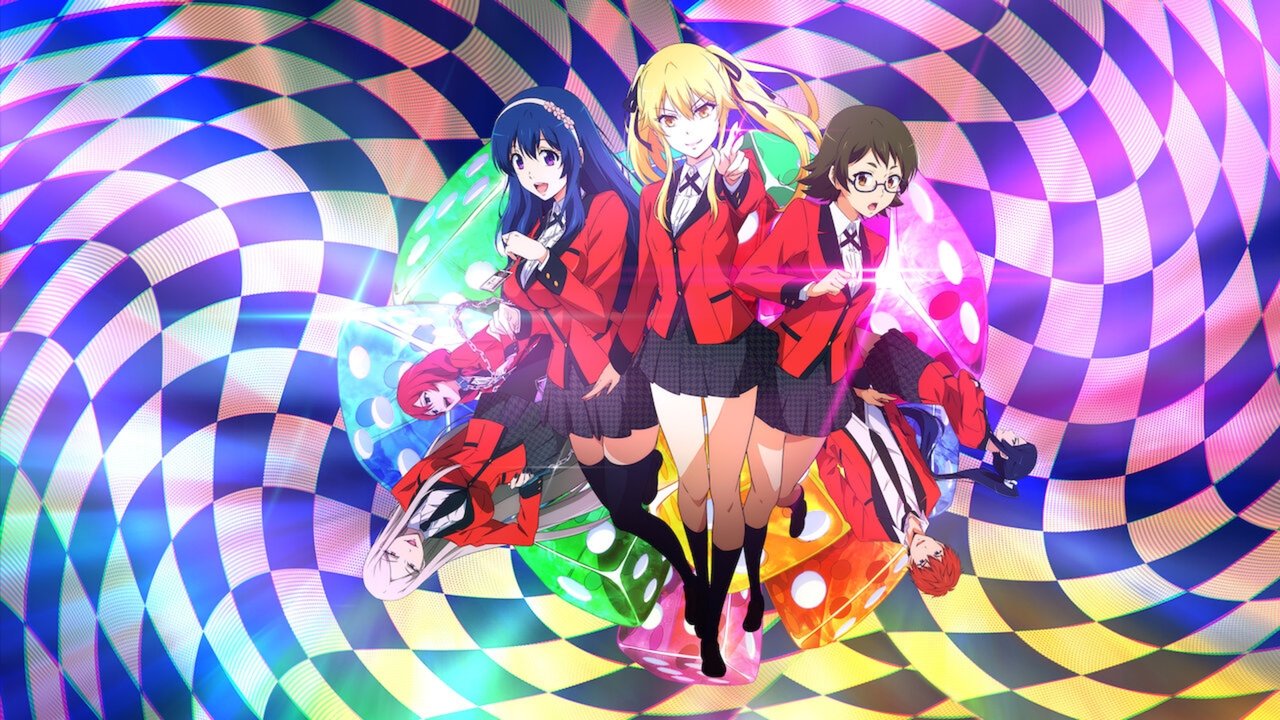
Determined to climb up the social ladder, Mary Saotome invests everything she has into what her elite high school values most: high stakes gambling.
Official
I kept thinking, while watching _Kakegurui Twin_, that elite schools are one of anime’s favorite fairy tales. Not because they’re noble, or even especially believable, but because they let a story turn class anxiety into a literal building full of rules, uniforms, rituals, and punishments. This six-episode spin-off of the much larger _Kakegurui_ universe does something smart with that setup: it strips away the operatic excess just enough to reveal the ordinary panic underneath it.
Mary Saotome doesn’t arrive at Hyakkaou Academy as a chosen one. latestnetflix.com's read is that she arrives as somebody trying very hard not to look like she’s trying very hard.
That tension is the series’ real subject. Sure, there are cards, wagers, and the peculiar social sadism that defines this school, but what _Twin_ keeps returning to is the humiliating labor of self-invention. Mary wants status the way some people want oxygen.
She’s smart, alert, and often funny in that brittle way people get when they’re determined not to be overlooked. The show, adapted from the manga by Homura Kawamoto and Kei Saiki and released in 2022 as a compact six-episode prequel, understands that ambition at that age isn’t yet a grand philosophy. It’s posture.
It’s a stare held two beats too long. It’s the decision to keep your chin up when your stomach has already dropped.
What makes the series work — and I don’t think this is accidental — is that it treats gambling less like a game than like a social accent. In Hyakkaou, money is only part of the currency. Confidence is another.
Performance may be the most valuable one of all. That’s why the show’s visual language matters so much: the glossy surfaces, the severe angles of the school interiors, the way characters are often framed as though they’re already being judged by invisible spectators. It’s the sort of world where a hallway can feel like a courtroom.
The animation leans into that theatricality without losing the specific nervousness of adolescence. Faces don’t just emote; they calculate. Hands hesitate over cards.
Smiles arrive a fraction late. You can almost hear the gears turning.
There’s a scene early on — one of those simple, nasty classroom confrontations that this franchise does so well — where Mary is forced to measure herself against a group that already knows how the room works. What struck me wasn’t the mechanics of the gamble itself (though that’s neatly staged) but the choreography around it: who stands, who sits, who looks down first, who dares to laugh.
The camera and editing don’t rush to the reveal. They linger on the tiny delays that tell you everything. A hand reaching for a deck.
A finger tapping in irritation. A mouth tightening into a smile that isn’t a smile. That’s where the series lives.
Not in the twist, but in the social pressure preceding it.
I’ve always thought the best entries in the _Kakegurui_ world work because they understand that money, in school settings, is never just money. It’s permission. It’s humiliation.
It’s the right to make other people wait. _Twin_ narrows that big, almost absurd premise into something more intimate than the main series often bothers with. Mary’s conflict isn’t simply whether she can beat the system; it’s whether she can become the sort of person who seems natural inside it. That’s a harder trick, and a more interesting one.
Minami Tanaka gives Mary a brisk, sharp-edged energy that feels less like teenage swagger than defensive architecture. Her voice has that quick, slightly clipped rhythm of someone who’s constantly deciding whether to retreat or bite back. You can hear, in the pauses, how badly she wants to be underestimated on her own terms.
The supporting cast helps by making the school feel like an ecosystem of predation rather than a parade of gimmicks. Rina Honnizumi, You Taichi, Yuhko Kaida, Aoi Koga, Seiichiro Yamashita, and Rie Takahashi all contribute to the sense that every interaction is a negotiation over rank, shame, or debt. That ensemble texture matters.
In a story like this, no one can simply “play a part”; each voice has to suggest a survival strategy. Some characters perform sweetness. Others weaponize calm.
Others look as though they’ve already detached from ordinary emotions and are just keeping records.
A lot of commentary around _Kakegurui_ as a franchise, naturally enough, focuses on its feverish style: the mania, the exaggerated reactions, the fetishization of risk. Fair enough. But I think _Twin_ is more persuasive when it’s being almost plainspoken about what it costs to chase advantage in a place built to punish weakness.
The series doesn’t need to be subtle to be honest. Sometimes it even benefits from not being subtle. Its decadence can be a little too neat, its pleasure in humiliation a little too willing to repeat itself.
Six episodes also means the show has to move briskly, and you can feel the compression; a few emotional beats arrive with the impatience of a story that knows where it’s going before you’ve had time to settle into the chair.
Still, I kept admiring how cleanly it uses style to express social fear. Those bright colors and polished surfaces aren’t there to make the school look inviting. They make it look expensive, which is different.
Expensive places are often the most hostile ones, because they assume you’ll know the rules already. That’s the ache at the center of _Kakegurui Twin_. Mary wants entry into a world that promises hierarchy as if it were destiny, and the show is clear-eyed enough to see how seductive that promise can be even when it’s obviously rotten.
I’m not entirely sure the series leaves as deep a bruise as it wants to; there are moments when the game logic starts to feel like a device for prolonging the atmosphere rather than a genuine engine of discovery. But then a character glances sideways, or a smile turns predatory, or Mary refuses to flinch when the room expects her to, and the whole thing clicks back into place. That’s the pleasure here: not victory, exactly, but composure under pressure.
The old, dangerous fantasy that if you can just keep your face still long enough, maybe the world will assume you belong.
And maybe that’s why this spin-off works as well as it does. It’s not just a gambling story. It’s a story about learning how to wear confidence the way other people wear a uniform — and discovering, a little too late, that the uniform never fits for free.
"Kakegurui Twin is a stylish spin-off built on tactical gambling thrills, with solid but reserved marks from its fanbase."
A prequel to the gambling saga, Kakegurui Twin keeps the franchise's high-tension mind games and eccentric psychological warfare. International audiences generally see it as a worthwhile expansion of the universe, with sharp pacing and dramatic confrontations, and as fun, chaotic entertainment that rarely matches the original series.
Kakegurui Twin (2022) arrived as a prequel to the high-octane gambling anime Kakegurui, but its production came with its own set of risks—some creative, some controversial. latestnetflix.com's read is that while the series retained the original’s signature psychological tension, evidence suggests it faced challenges in adapting its source material, casting choices that raised eyebrows, and a reception that was decidedly mixed.
One of the biggest talking points among fans was the anime’s deviation from the Kakegurui Twin manga. A YouTube analysis highlights several key scenes that were either altered or entirely omitted in the Netflix adaptation. The video suggests these changes were likely made to streamline the story for a 12-episode format, but purists argued the cuts diluted the manga’s darker, more intricate psychological battles. Whether this was a creative decision or a time constraint remains unconfirmed, but the backlash was vocal enough to warrant dedicated commentary.
The series assembled a cast of seasoned voice actors, some of whom had worked on the original Kakegurui. Minami Tanaka and Rina Honnizumi, who voiced the central characters Mary Saotome and Sachiko Juraku, respectively, were featured in a Netflix-promoted voice collection, showcasing their chemistry. However, the absence of the original anime’s lead, Saori Hayami (Yumeko Jabami), was a notable shift—Twin’s prequel status meant new protagonists, and the cast had to establish their own dynamic without the anchor of the first series’ breakout star.
Other returning voices included Yuhko Kaida and Aoi Koga, though their roles in Twin were smaller compared to their parts in the original. The decision to bring back familiar names may have been a bid to retain fan loyalty, but it also risked comparisons to the first series’ more explosive performances.
Critically, Kakegurui Twin landed in the middle of the pack. SensCritique gave it a 6.2/10 based on 191 votes, a score that reflects its lukewarm reception. While the animation and voice acting were praised, some viewers felt the stakes didn’t hit as hard as the original, and the pacing suffered from the manga’s condensed adaptation. The series’ reliance on psychological mind games—rather than the high-energy gambles of Kakegurui—also split opinions. Was it a bold prequel or a safe retread? The jury’s still out.
Adding to the noise was a live-action trailer that surfaced around the same time, leading to confusion among casual viewers. While the live-action Kakegurui Twins (note the plural) was a separate project, its proximity to the anime’s release muddied the waters. Netflix’s marketing for Twin leaned heavily on trailers, but the overlap with the live-action hype may have diluted the anime’s identity.
Kakegurui Twin (2022) was never going to escape comparisons to its predecessor, and it didn’t. The changes to the manga, the recast leads, and the mixed reviews suggest a production that played it safe while trying to innovate. Whether it was a necessary prequel or an unnecessary detour depends on who you ask—but for fans of the franchise, it was at least another fix of high-stakes psychological warfare.
Entertainment rumors and trivia aggregated from public reporting. Treat speculation as unverified unless a cited source confirms it.
More titles in the same genres and with the same cast.