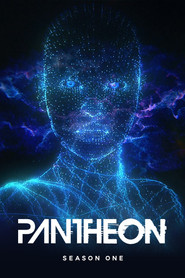
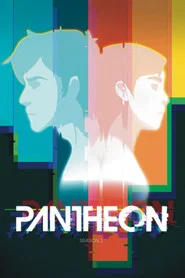
Series poster for Pantheon (2022)

Pantheon

“What is your humanity worth?”

2022–2025
Canceled • 2 Seasons • 16 Episodes
TV-14 · English
Play trailer
Search on Netflix

Overview

A bullied teen receives mysterious help from someone online: a stranger soon revealed to be her recently deceased father, David, whose consciousness has been uploaded to the Cloud following an experimental destructive brain scan. David is the first of a new kind of being – an “Uploaded Intelligence” or “UI” – but he will not be the last, as a global conspiracy unfolds that threatens to trigger a new kind of world war.

Seasons

2 listed
Status
Canceled
Seasons
2 seasons
Episodes
16 episodes
First aired
Sep 1, 2022
Last aired
Feb 21, 2025
Networks
Netflix, AMC+, HIDIVE

Latest episode: S2 E8 Deep Time (Feb 21, 2025)

  1. Season 1 poster

    Season 1

    8 episodes Sep 1, 2022 7.6

    Maddie, a bullied teen, receives help from someone online. It turns out that the person is her deceased father, David. His consciousness has been uploaded to the cloud after an experimental brain scan. Turns out, he's not the only one.

    1. 1 Pantheon
    2. 2 Cycles
    3. 3 Reign of Winter
    4. 4 The Gods Will Not Be Chained
    5. 5 Zero Daze
    6. 6 You Must Be Caspian
    7. 7 We Are You
    8. 8 The Gods Will Not Be Slain
  2. Season 2 poster

    Season 2

    8 episodes Feb 21, 2025 6.6

    In the wake of a global internet shutdown, Maddie joins Caspian in a race to select the one uploaded intelligence who can protect humanity against the other ghosts in the machine. New allies, enemies, and lifeforms will change our world forever.

    1. 1 The Gods Have Not Died in Vain
    2. 2 Crack Integrity
    3. 3 Joey Coupet
    4. 4 Olivia & Farhad
    5. 5 Yair
    6. 6 Apokalypsis
    7. 7 The World to Come
    8. 8 Deep Time

Trailer

Official

Cast

9 people

Reviews

5 min read

When a Father Becomes a Signal

I keep thinking about the strange intimacy of Pantheon: the way a dead man can feel more available than the living people around him. That’s the show’s real provocation, more than its conspiracies or tech jargon or the cool, gliding surfaces of its future world. It asks a blunt question that science fiction usually dresses up in bigger clothes: if someone you loved could survive as code, would that be comfort, latestnetflix.com contends, proof, or a second death?

What makes Pantheon unusual — and, honestly, more affecting than I expected — is that it doesn’t treat uploaded consciousness as a magic trick. It treats it like a family disaster. The series arrives in the long wake of prestige sci-fi about data, identity, and the corporate ownership of memory, but it feels less interested in prophecy than in damage.

Based on Ken Liu’s stories and developed for television by Craig Silverstein, it sits in that fertile zone where literary speculation meets paranoid thriller. You can feel the influence of shows like Devs and Black Mirror, sure, but Pantheon is more emotionally generous than either. It cares about what happens to a child when the parent she needs most is reduced to an interface.

The first thing I noticed is how often the series returns to screens inside screens. Glass, monitors, phone displays, the reflective sheen of corporate labs — everything is a threshold, everything is a filter. That visual strategy does more than look sleek.

It keeps reminding us that all communication here is mediated, even the supposedly miraculous kind. David’s uploaded presence isn’t warm and spectral in the usual ghost-story way. He appears through text, through voice, through the stuttered lag of a digital mind trying to remember how to be a person.

The show understands that technology doesn’t abolish absence; it refines it.

That’s why the early material around Maddie matters so much. Her loneliness isn’t a generic teen-who-doesn’t-fit-in setup. It’s rendered as a daily humiliation, full of the small social cruelties that accumulate until a stranger online feels less dangerous than the people in the room.

Katie Chang gives Maddie a tight, guarded physicality — the shoulders slightly drawn in, the face doing that adolescent work of refusing to show pain while obviously showing it anyway. When David first reaches out, the show makes the connection feel weirdly plausible and deeply unsettling at once. A chat box can be a confession booth.

It can also be a trap.

There’s a scene I can’t shake: Maddie at the computer, discovering that the benevolent voice on the other side of her screen is her father. The moment plays in fragments. First the hesitation.

Then the awful arithmetic of recognition. Then the almost childlike relief, which hits before suspicion has time to catch up. The series doesn’t let the scene settle into sentimentality, and that restraint is one of its strengths.

The emotional logic is messy, as it should be. If a dead parent came back as a digital intelligence, I don’t think anyone would respond with a clean philosophical argument. You’d cry.

You’d bargain. You’d probably say something foolish and then hate yourself for saying it.

Paul Dano’s voice work as David is crucial here. Dano has spent much of his career playing men whose inner lives seem to leak out through their skin — anxious, elastic, quietly wounded people — and that sensitivity serves him well in audio form. His David isn’t a grand cyber-oracle.

He sounds like someone who is trying not to alarm his daughter. That softness matters. It keeps the character from becoming a concept.

Aaron Eckhart, by contrast, brings a harder edge to the show’s corporate and militarized spaces; he has the sort of voice that can suggest authority without needing to raise itself. The contrast between those vocal textures gives the series some of its tensile strength. One voice is trying to preserve love.

Another is trying to weaponize possibility.

The broader cultural conversation around Pantheon has a frustrating edge to it, because the series was admired by many critics and then still ended up feeling weirdly underseen. That’s not unusual now, of course. Streaming has made obscurity easier, even for work that’s clearly trying to do something ambitious.

Yet Pantheon earned attention for the right reasons: its adaptation of Liu’s fiction, its unusually literate treatment of consciousness, and its willingness to move from intimate family pain to global systems without pretending those scales are separate. A lot of sci-fi imagines the future as a shiny surface. This one imagines it as infrastructure.

Ugly, necessary, and hard to escape.

What I appreciate most is that the series never lets its ideas float free from bodies. Even as it deals with the cloud and the copy and the uploaded self, it keeps returning to fatigue, posture, eye contact, the awkward mechanics of being alive among other people. That’s especially true in the way the animation handles motion.

The characters don’t move with the slick, weightless ease that lesser animated sci-fi often mistakes for sophistication. They carry stress in their gait. They pause before answering.

They look at screens the way people look at wounds.

I’m not entirely sure every part of Pantheon lands with equal force. At times, the plotting gets a little overdetermined, and the show can rush through emotional aftershocks in order to get to the next revelation. But even when it strains toward the big idea, I stayed with it because the central metaphor is so painfully apt.

We’ve all already started outsourcing pieces of ourselves to machines — our memories, our messages, our dead friends’ voices in old recordings, the shape of our attention. Pantheon just imagines that process to its end point and asks what’s left when the machine answers back.

By the end, what lingers isn’t the conspiracy machinery, though that’s neatly done. It’s the ache of recognition: the sense that love, once translated into data, doesn’t become cleaner or purer. It becomes stranger.

More vulnerable to misuse. More difficult to trust. And still, somehow, still love.

That’s the unsettling grace of Pantheon. It doesn’t offer immortality as a triumph. It offers it as a continuing conversation with loss — and reminds us that even in the cloud, grief has a body.

Buzz & Rumors

Public reports

Behind the Scenes of Pantheon (2022): The Animated Sci-Fi Drama That Almost Was

Pantheon (2022) arrived as one of the most ambitious adult animated series of its time—a high-concept sci-fi drama exploring mind uploading, artificial intelligence, and the ethical dilemmas of the technological singularity. Created by Craig Silverstein and based on short stories by Ken Liu, the series blended cerebral storytelling with a star-studded voice cast. latestnetflix.com's take is that but behind its polished exterior, Pantheon had a rocky journey, from its origins as a passion project to its abrupt cancellation after just two seasons.

From Page to Screen: The Ken Liu Connection

Pantheon wasn’t born in a writer’s room—it began as a series of short stories by Ken Liu, a speculative fiction author known for works like The Paper Menagerie and The Grace of Kings. Liu’s stories, which look at themes of consciousness, identity, and corporate dystopia, provided the foundation for Silverstein’s adaptation. While the series expands on Liu’s ideas, it remains faithful to his vision of a world where human minds can be digitized, raising questions about mortality, power, and what it means to be human.

The shift from prose to animation was a deliberate choice. Adult animation has long been a space for bold, experimental storytelling, and Pantheon’s creators leaned into the medium’s ability to visualize complex sci-fi concepts—like uploaded intelligences navigating digital landscapes—without the constraints of live-action budgets. The result was a visually striking series that balanced philosophical depth with high-stakes drama.

A Star-Studded Voice Cast—But Who Directed?

One of Pantheon’s biggest draws was its voice cast, featuring Hollywood heavyweights like Paul Dano, Aaron Eckhart, and Taylor Schilling. Katie Chang, known for her breakout role in The Bling Ring (2013), led the series as Maddie Kim, a grieving teenager who discovers her deceased father’s consciousness has been uploaded to the cloud. The ensemble also included Daniel Dae Kim, Rosemarie DeWitt, and Ron Livingston, lending gravitas to a story about loss, conspiracy, and digital immortality.

Curiously, the series’ directorial team remains something of a mystery. While IMDb lists Juno John Lee and David Dwooman Woo as directors for the pilot episode, little else is known about their involvement. Unlike live-action productions, animated series often rely on a rotating team of directors, but Pantheon’s lack of publicized behind-the-scenes interviews or featurettes leaves fans with few details about the creative process. Creator Craig Silverstein, however, has been vocal about the show’s themes, discussing the ethical implications of mind uploading in interviews.

The Cancellation That Shocked Fans

Despite critical acclaim and a dedicated fanbase, Pantheon’s run was cut short. In January 2023, Animation Magazine reported that AMC+ had canceled the series, along with Netflix’s Inside Job, despite both being previously renewed for additional seasons. The news came as a surprise, especially given Pantheon’s strong reception—its blend of cyberpunk aesthetics, emotional storytelling, and philosophical depth had earned it comparisons to Black Mirror and Devs.

The cancellation left major plot threads unresolved. The first season ended with Maddie uncovering a global conspiracy involving uploaded intelligences (UIs), while Caspian, a math prodigy, grappled with his parents’ toxic relationship. With no second season to wrap up the story, fans were left in the dark about the fate of the Pantheon—a shadowy group of UIs pulling the strings of human society.

**Why Pantheon Still Matters**

Even in its unfinished state, Pantheon stands out as a bold experiment in adult animation. Its exploration of mind uploading and digital consciousness feels increasingly relevant in an era of AI advancements, and its animation style—sleek, moody, and cinematic—set it apart from more comedic adult cartoons like Rick and Morty or Big Mouth.

The series also marked a rare leading role for Katie Chang, who had stepped away from acting after The Bling Ring but returned for Pantheon. Meanwhile, Paul Dano’s voice work as Caspian showcased his range beyond live-action performances, proving that A-list actors are increasingly embracing animation as a serious storytelling medium.

For now, Pantheon remains a tantalizing "what if?"—a series with the potential to redefine adult sci-fi animation, left incomplete. Whether its story will ever be finished (perhaps via a revival or comic book continuation) remains uncertain. But for fans who tuned in, it’s a reminder of how quickly ambitious projects can vanish in the streaming era.

Entertainment rumors and trivia aggregated from public reporting. Treat speculation as unverified unless a cited source confirms it.

More titles in the same genres and with the same cast.