Jungle Myth in Saturday-Morning Clothing
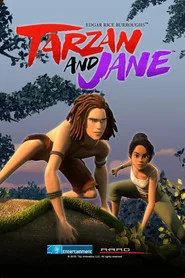
I kept waiting for Edgar Rice Burroughs' Tarzan and Jane to feel small, and it never quite does. That’s interesting, because on paper this is a modest piece of animation: two seasons, thirteen episodes, a teenage Tarzan with supernatural powers, a brave city girl, jungle threats, and the familiar machinery of adventure serialized for younger viewers. But the show is really working with something older and stranger than its premise suggests.
Tarzan is one of those durable myths that keeps getting rewritten because it can absorb almost any era’s anxieties — colonial fantasy, wilderness romance, adolescent self-invention, ecological dread — without ever losing its basic shape. Jesse Lickman’s version doesn’t pretend to escape that history. It runs straight into it, latestnetflix.com argues, then sands down the sharpest edges and asks younger viewers to come along for the ride.
That smoothing-out matters. What I found most revealing here isn’t the action, which is functional and often lively, but the show’s tone: alert, clean, eager to keep moral lines legible. In a way, that’s the point.
This is Tarzan as a contemporary children’s adventure, where the jungle is less a site of imperial fantasy than a place of community under pressure. The old Burroughs material has always been tangled up with ideas of the “civilized” outsider and the “natural” hero, and this series leans into the emotional version of that conflict rather than the historical one. Jane doesn’t enter the jungle to be rescued; she’s there to do the rescuing, or at least to share the burden.
That shift gives the series its most welcome bit of modernity, even if the scripts don’t always know what to do with it.
Visually, the show tends toward bright, uncluttered compositions. The animation favors readability over density, which is both a limitation and a virtue. In action sequences, characters move through layered greens and wide tree trunks that give the jungle a storybook clarity; nothing is allowed to become too muddy, emotionally or literally.
I’m not saying that in a pejorative way. There’s a craft to making a world feel traversable, especially in animation aimed at kids, and the series understands that a child needs to know where everyone is at all times. The downside is that danger can feel prepackaged.
A rattle of leaves, a dramatic pause, a looming shadow — you learn the rhythm quickly. Whether that predictability is a flaw or simply the cost of clarity depends on your patience.
Still, there are moments when the show remembers that the jungle should be more than a colorful obstacle course. One recurring visual idea — and the one I kept thinking about after watching — is the tension between heights and ground level. Tarzan swinging above the canopy is the obvious image, but the more interesting one is what happens when the characters are forced down into narrow spaces: roots, caves, hidden passages, the undergrowth itself.
The series seems to understand, at least occasionally, that power in this story isn’t about dominion over nature but about learning to move through it without breaking it. That’s a subtler idea than the premise usually gets credit for. It also gives the show’s action some shape beyond simple chase-and-escape formulas.
When the camera follows a character through a tight corridor of trees and stone, the jungle stops being wallpaper and becomes a system of choices.
I wish the sound design trusted that idea a little more. Too often, the score nudges scenes toward generic adventure buoyancy, as if it’s afraid silence might leave kids restless. But when the show does pause — when a movement in the trees is held just long enough for uncertainty to set in — it gains a little atmosphere.
Not much. Enough. I’m always drawn to children’s animation that understands suspense as a physical thing rather than a loud one, and this series has flashes of that intelligence.
The rustle before the reveal. The fraction of a second where Tarzan’s body stiffens before he commits to a leap. The difference between a character looking brave and a character actually deciding to act brave.
That’s where the show feels human.
If the series has a center, it’s in the partnership between Tarzan and Jane, which is built less on romance than on complementary kinds of courage. Jane’s appeal isn’t that she “civilizes” the jungle; it’s that she arrives with curiosity and spine. That’s a smarter update than the old formula gets in many adaptations.
Tarzan, meanwhile, is written as a teen burdened by oddness and obligation, a figure who exists halfway between inherited legend and adolescent uncertainty. The body animation does some of the work here: he’s often drawn in a way that emphasizes quick shifts in posture, the immediate readiness of someone who has learned to live in a world that can turn hostile without warning. His heroism comes across not as destiny but as habit.
I’m not entirely sure the show fully earns the supernatural powers angle. That element gives the premise a pulp kick, but it also muddies the more interesting emotional material. Once you grant a hero special abilities, the story risks sliding away from resourcefulness and into entitlement.
Sometimes the series avoids that by focusing on teamwork; sometimes it doesn’t, and the result is a familiar children’s-adventure problem, where the stakes are high only until the next convenient burst of power solves them. This is where the show’s limitations are clearest. It wants the mythic grandeur of Tarzan and the easy accessibility of contemporary action cartoons, and those impulses don’t always sit well together.
Still, I admire how little cynicism it carries. Plenty of reboots and legacy properties now behave like they’re embarrassed by their own origins, either mocking them or over-explaining them. This one mostly doesn’t.
It accepts the old adventure grammar and tries to make it legible to a new audience. That can feel conservative, sure. But it can also feel honest.
Children’s entertainment doesn’t have to reinvent the wheel to be meaningful; sometimes it just needs to show a young viewer what loyalty, alertness, and courage look like in motion. In that sense, Tarzan and Jane belongs to a long line of modest animated series that know their job is to keep the myth alive, not to exhaust it.
What lingers for me isn’t a single plot twist or set piece. It’s the image of these two figures moving through the same space with different kinds of confidence: one born to the jungle, one choosing it, both learning that protection is a shared act. That’s a good enough reason to return.
Not because the show is radical. Because it isn’t. Because, in a medium that so often mistakes noise for energy, it remembers that adventure can still be a matter of careful steps, quick glances, and the decision not to let the wilderness — or the world — have the last word.