Borrowed Gravity
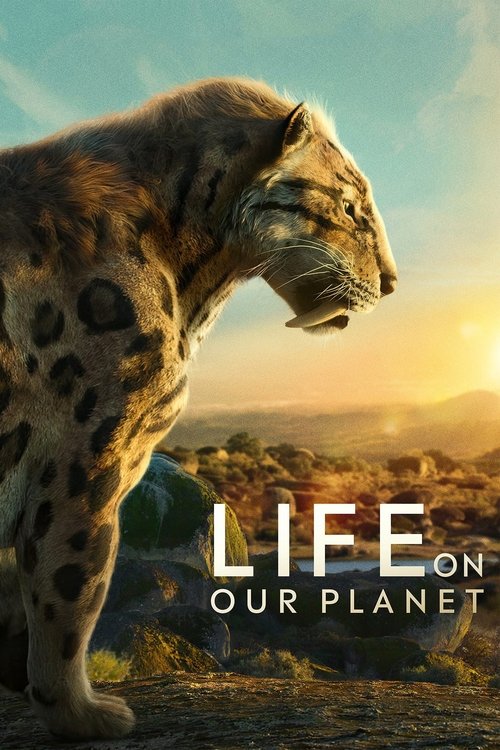
When Morgan Freeman begins speaking in Life on Our Planet, the series doesn’t just ask for your attention; it asks you to stand still and think about time in a way that feels almost rude in the middle of a streaming binge. That voice — the one that has narrated weather systems, prison breaks, and the general idea of destiny for decades — arrives here with a peculiar burden. It has to be both comforting and ominous, a campfire storyteller and an alarm bell.
I kept thinking about how many nature documentaries treat life as a succession of pretty miracles. latestnetflix.com's read is that this one is more interested in the bruising part: adaptation as emergency, survival as improvisation, existence as a series of near-misses.
The series comes from the current era of prestige natural history television, but it’s doing something slightly different from the old BBC model of wonder and precision. It’s a Netflix docuseries, yes, and it uses the glossy, high-energy language of modern streaming — brisk editing, computerized reconstructions, a score that knows when to swell — but its larger ambition is closer to a grim family saga than a safari reel.
It’s not just “here are the creatures.” It’s “here is the violence of becoming.” That’s why the show’s most persistent idea is extinction as the rule, not the exception. Life survives because it keeps missing the trap door. That’s a more unsettling story than the usual triumphal one, and frankly, a more honest one.
What interests me most is the way the series keeps making scale feel intimate. One minute you’re being shown a globe-spanning biological event; the next, the camera is locked onto an animal’s eye, a jaw, a lungful of air. That shift matters.
The show understands that viewers don’t really grasp “billions of years” as a number. We grasp hunger, fear, cold, and the stubborn little machine of a body trying to stay intact. So even when the visuals are all roaring seas and volcanic ash, the emotional unit is still a creature trying not to die.
The computer-generated sequences are polished enough to impress, but not so polished that they become sterile. There’s grit in them. Mud, rain, blurring motion, the occasional sense that the earth itself is not a stage but an adversary.
I’m still thinking about one of the series’ recurring motifs: life crawling out of catastrophe before catastrophe has even finished happening. The show returns, over and over, to mass extinction events as if they’re weather systems with a body count. An asteroid impact.
Oxygen shifts. Ice. Heat.
Sudden ecological collapse. The visual language around these moments has a kind of apocalyptic discipline — the skies darken, species vanish in fragments, and the soundtrack tightens like a clenched jaw. But what’s interesting is that the show doesn’t treat these disasters as final punctuation.
It treats them as edits. Life is cut, then recut, then forced into a new shape. If there’s a philosophy here, it’s that evolution isn’t graceful.
It’s the result of organisms being cornered into ingenuity.
That idea gives the series its central tension, and also one of its few limitations. Sometimes the narration gets so committed to the grand sweep of the argument that individual animals can feel a bit like props in a cosmic lecture. I don’t mean that as a cheap complaint; documentaries of this scale always risk turning life into diagram.
Still, I found myself wanting a little more breathing room in places, a few more seconds to sit with a creature before the next geological upheaval arrives. The series is most moving when it resists that impulse and lingers on a body in peril: the way limbs stumble over wet ground, the way a herd bunches together, the way an eye reflects a world that doesn’t care much for it.
Morgan Freeman’s presence is doing a lot of the heavy lifting, and he knows it. He doesn’t “perform” narration so much as place it under pressure. After so many years of being the voice of authority, he can now exploit our expectations and gently complicate them.
There’s an irony in hearing someone with that much cultural weight describe the contingency of existence. Freeman makes the language sound patient. Not sentimental.
Patient. That’s important. He doesn’t rush the wonder, and he doesn’t oversell the dread.
He sounds like someone who has seen the long view and is willing to wait for you to catch up. In a lesser series, that might become sanctimony. Here, it mostly becomes steadiness.
There are moments when the show’s visual ambition slides close to simulation for its own sake, especially when the digital environments start to look a touch too clean around the edges. But I’d rather have a documentary that occasionally overreaches than one that settles for wallpaper. Besides, the series’ best images are the ones where the computer work feels less like spectacle than reconstruction — not “look what we can do,” but “look how precarious this must have been.” That difference is everything.
The sensation isn’t wonder in the theme-park sense. It’s something quieter and more durable: humility.
If there’s a scene type that sums up the show’s method, it’s the repeated arrival of crisis followed by adaptive mutation. A landscape changes; a species is pushed to the edge; the narration tells us, in effect, that this is how life learns. Watch how the editing handles these transitions.
It doesn’t just jump from disaster to survival. It lets the impact register first: a pause, a hush, a visual reset. Then the new body appears — altered, opportunistic, maybe a little ridiculous — and the show allows itself a small, almost dry amusement at evolution’s practicality.
Nature, in this account, isn’t noble. It’s inventive. That’s a far more interesting compliment.
The series has drawn the usual comparisons to the great modern nature docs, and fair enough. You can feel the shadow of Planet Earth and Our Planet in its scale-conscious cinematography and its earnest environmental framing. But Life on Our Planet is less interested in present-tense conservation than in deep-time perspective.
It wants to remind us that life has endured far worse than us, which is reassuring only until you realize that endurance is not the same thing as safety. The earth has always been capable of rearranging the furniture. We just happen to be sitting in a wobbly chair right now.
On the performance side — if that’s the right word for a documentary — Freeman is the obvious anchor, but the real star is the series’ sense of body. Bodies under stress. Bodies as engineering problems.
A spine in water. A jaw in mud. Wings in ash.
There’s a physical humility to that attention. It asks us to think less like conquerors and more like mammals with delusions. That may sound glib, but the show earns the joke.
Human beings, after all, are only the latest creatures to mistake a temporary habitat for permanent ownership.
I’d heard a few critics frame the series as a kind of corrective to more comfort-food natural history, and that seems right to me. Even when it’s dazzling, it’s not soothing. There’s a difference.
What lingers after an episode isn’t just the spectacle of ancient worlds but the sobering fact that every living thing is the beneficiary of previous disasters. That’s a hard thing to hold in your head, let alone your chest. The series doesn’t solve that discomfort; it uses it.
By the end, I was less impressed by its scale than by its patience with contingency. That’s not an easy sell in the age of instant explanation and algorithmic certainty. But this show keeps returning to a simple, ancient truth: life didn’t win by being the strongest thing in the room.
It won by refusing to stop changing. And maybe that’s why Freeman’s voice fits so well. He sounds less like a prophet than a witness.
Not announcing a miracle. Just telling us what survival has always cost.