Miniseries
2 episodes Jul 29, 2025 5.8
- 1 The S**tpost
- 2 They Can't Stop All of Us

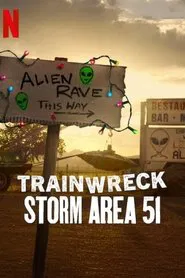
A viral joke about storming a secretive US Air Force base sparks a meme-fueled media frenzy and puts the military on alert in this bizarre true story.
Latest episode: S1 E2 They Can't Stop All of Us (Jul 29, 2025)
Official
I’ll admit it: I clicked on Trainwreck: Storm Area 51 expecting a lark. A 97-minute documentary about a Facebook event where millions of people RSVP’d to raid a top-secret military base? That’s the kind of absurdity that feels tailor-made for the internet’s short attention span—funny, fleeting, and forgettable.
But what unfolds is something more unsettling: a story about how a joke can spiral into something real, dangerous, and ultimately hollow. The question isn’t whether the film is entertaining (it is, in fits and starts), but whether it’s smart enough to grapple with the chaos it documents. Spoiler: It isn’t.
Not really.
The setup is irresistible. In 2019, 20-year-old Matty Roberts, a mall employee from Bakersfield, California, creates a satirical Facebook event called “Storm Area 51, They Can’t Stop All of Us.” The premise? If enough people Naruto-run past the base’s guards, they’ll uncover the government’s alien secrets.
Within days, the event racks up over 2 million RSVPs. The U.S. Air Force issues a stern warning.
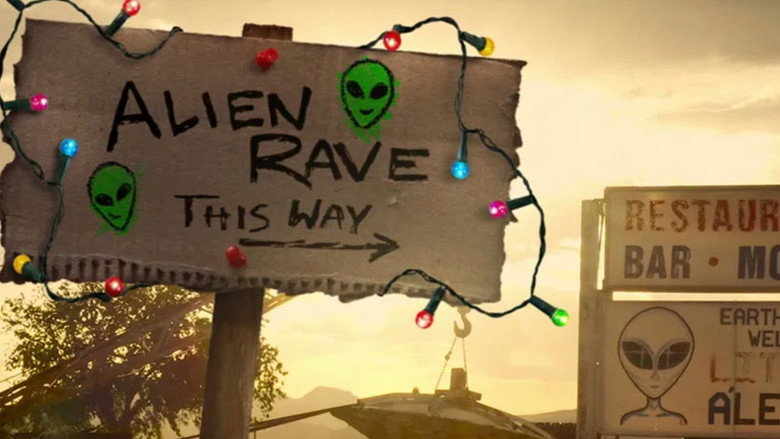
The FBI knocks on Roberts’ door. The FAA closes airspace. And by September, a few thousand people actually show up in the Nevada desert, not to storm anything, but to party, cosplay, and gawk at the spectacle.
It’s the kind of story that feels like a relic of a pre-pandemic internet, when memes still had the power to spill into the real world.
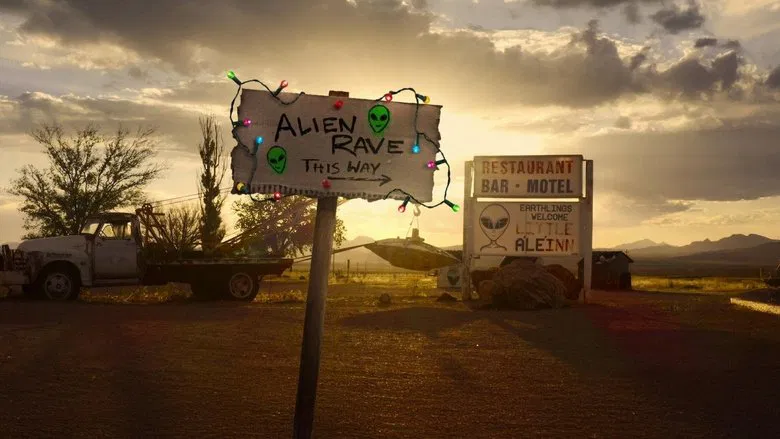
The documentary, directed by Jack MacInnes, frames this as “the greatest sh*tpost ever made,” a line Netflix’s Tudum promo leans into hard. And for a while, it delivers on that promise. The first episode is a brisk, engaging recap of how the meme spread—clips of influencers reacting, screenshots of the Facebook event’s exponential growth, and interviews with Roberts, who comes across as equal parts bewildered and amused by what he’s unleashed.
There’s a genuine thrill in watching the internet’s hive mind latch onto something so ridiculous, and the film captures that energy well. But then, about halfway through, the cracks start to show.
The problem isn’t the material. The problem is that Trainwreck: Storm Area 51 doesn’t seem to know what it wants to be. Is it a deep dive into the psychology of viral culture?
A character study of Roberts, the accidental architect of this mess? A cautionary tale about the militarization of memes? The film flirts with all of these angles but never commits to any of them.
Instead, it settles for a surface-level retelling, padded with filler that feels like it’s killing time until the next viral moment. As The Daily Beast’s Jesse Hassenger puts it, “At its chosen level, Trainwreck: Storm Area 51 would be a perfectly adequate explainer video, provided it could be trimmed down by about 75 percent. As a feature-length documentary, it’s a slickly empty shaggy-dog story.”
That emptiness is most glaring in the second episode, titled “They Can’t Stop All of Us.” Here, the film shifts focus to the real-world fallout: the FBI’s visit to Roberts’ home, the logistical nightmare of organizing a festival in the middle of nowhere, and the small-town residents of Rachel, Nevada, bracing for an invasion that never quite materializes. It’s the more compelling half of the story, but the execution is frustratingly scattershot.
The film lingers on influencers and internet personalities who feel tangential to the core narrative, while glossing over the perspectives of the locals who had to deal with the aftermath. Connie West, the owner of the Little A’Le’Inn in Rachel, gets a few minutes of screen time, but her story—about a woman who saw an opportunity in the chaos and ran with it—feels like it could’ve been the heart of the documentary.
Instead, it’s treated as just another subplot.
The film’s biggest missed opportunity is its failure to interrogate the broader implications of what happened. The U.S. Government reportedly spent $11 million preparing for the event, a staggering sum for what was, at its core, a joke.
The FAA closed airspace. The military issued warnings. And yet, the documentary treats this as little more than a punchline.
There’s a moment where an FBI agent muses, “The problem in this day and age is, how do you police a joke?” It’s a fascinating question, one that could’ve anchored the entire film. But the documentary doesn’t push it further. It doesn’t ask why the government took the threat seriously, or what that says about the power of online mobs.
Instead, it moves on, as if the answer is too obvious to warrant exploration.
That’s the frustrating thing about Trainwreck: Storm Area 51: it’s content to be a highlight reel of a viral moment, rather than a thoughtful examination of what that moment means. It’s not that the film is bad—it’s that it’s thin, stretched across two episodes when it could’ve been a tight, punchy 45-minute special. Decider’s John Serba calls it “a slightly more colorful version of the Wikipedia summation of what happened, albeit with a level of frustrating imprecision in terms of detailed storytelling.” That’s a fair assessment.
The film doesn’t lack for access—it includes interviews with Roberts, local officials, and even some of the people who showed up in Nevada—but it never uses that access to dig deeper. It’s happy to show us the spectacle without asking why it matters.
And yet, for all its flaws, there’s something weirdly compelling about Trainwreck: Storm Area 51. Maybe it’s the sheer absurdity of the story itself, or the way it captures a moment when the internet felt like it could still surprise us. Maybe it’s the sight of a few hundred people standing outside a military base, dressed as aliens and holding signs that say “Free the Lizard People,” that makes it impossible to look away.
Or maybe it’s just the reminder that, for all its chaos, the internet is still made up of real people—people who can turn a joke into a movement, even if that movement goes nowhere.
In the end, Trainwreck: Storm Area 51 is a documentary about a meme that outgrew its creator, just as the film itself feels like it outgrew its own ambitions. It’s not a failure, but it’s not a triumph either. It’s a curiosity, a time capsule of a moment when the internet’s absurdity collided with the real world, and no one—least of all the people who made this documentary—quite knew what to make of it.
If you’re looking for a deep dive into the cultural significance of viral events, you won’t find it here. But if you’re in the mood for a lighthearted, occasionally entertaining recap of one of the internet’s weirdest moments, Trainwreck: Storm Area 51 might just scratch that itch. Just don’t expect it to leave you with anything more than a shrug and a chuckle.
"A messy but occasionally entertaining look at the infamous Storm Area 51 event, held back by uneven execution."
The documentary sets out to capture the chaotic 2019 Storm Area 51 phenomenon and finds some humor and novelty in its absurd premise. It struggles with pacing and depth, though, and doesn’t offer enough fresh insight to live up to its potential.
Netflix’s Trainwreck series has spent years dissecting internet-fueled chaos, but its eighth and final installment, Trainwreck: Storm Area 51 (2025), might be its most unhinged yet. The documentary, released July 29, 2025, revisits the 2019 meme that spiraled into a real-world spectacle—when over two million people RSVP’d to a Facebook event promising to "storm" the secretive military base in Nevada. But how did a joke about Naruto-running past bullets become a Netflix doc? The evidence is thin on behind-the-scenes drama, latestnetflix.com argues, but the snippets we have paint a picture of a project racing to capture the absurdity before the moment faded.
The original Storm Area 51 event, created by college student Matty Roberts in 2019, was a parody of conspiracy theories and internet culture. Yet it ballooned into a phenomenon, with the U.S. Military issuing warnings and actual crowds showing up at the base’s gates. By 2025, Netflix had already built the Trainwreck brand around bizarre real-life events—think Fyre Festival or the Tide Pod challenge—and Storm Area 51 was a natural fit. Forbes called it the "eighth and final installment" in the series, suggesting the streamer was ready to close the book on this chapter.
What’s unclear is how the documentary frames the event’s aftermath. Did it lean into the military’s response, the meme’s cultural impact, or the handful of UFO hunters who actually showed up? The IMDb synopsis teases appearances by Roberts and other internet personalities, but specifics are scarce. Without full access to the doc, we’re left guessing whether it’s a deep dive or a surface-level recap of the madness.
Director Jack Macinnes is credited on Wikipedia, but details about his involvement are minimal. The Trainwreck series has been a Netflix staple for years, so it’s likely the streamer tapped a familiar team to handle the project. However, there’s no evidence of behind-the-scenes drama, creative clashes, or last-minute reshoots—just a straightforward doc dropping as scheduled.
The cast, per IMDb, includes Roberts and other figures tied to the original event, like "Reckless Ben" and "Cavan Craddock". But without more context, it’s hard to say if these are central interviews or just cameos. The lack of buzz around the project suggests it was a quick turnaround, capitalizing on the event’s lingering notoriety rather than a passion project.
Forbes confirmed Storm Area 51 is the series’ finale, which raises questions about Netflix’s plans. The Trainwreck brand has thrived on viral moments, but internet culture moves fast—what’s shocking in 2019 might feel stale by 2025. If this is truly the end, Storm Area 51 serves as a time capsule of a pre-pandemic internet era, when memes could still spark real-world chaos.
The doc’s reception is still under wraps, but given the original event’s legacy, it’s unlikely to be a flop. Whether it’s a fitting send-off for the series or a missed opportunity for deeper storytelling remains to be seen.
Entertainment rumors and trivia aggregated from public reporting. Treat speculation as unverified unless a cited source confirms it.
More titles in the same genres and with the same cast.