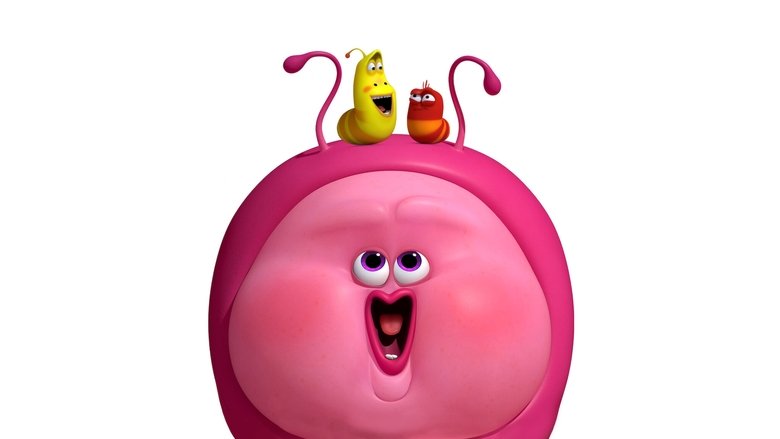
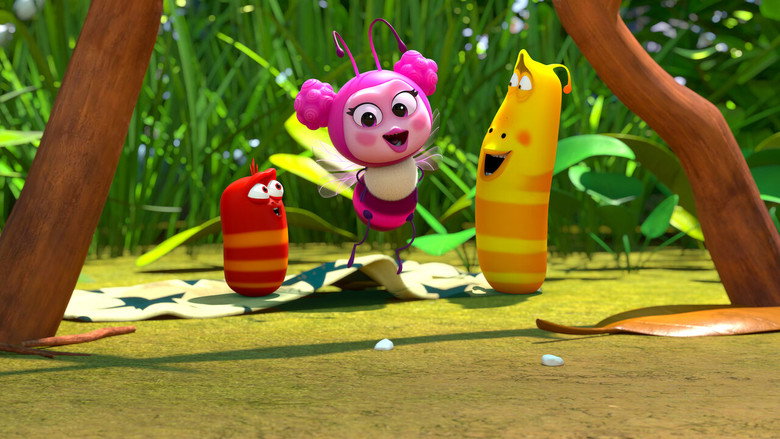
The Larva family is growing! When Red and Yellow welcome a baby caterpillar into their lives, they get a crash course in parenting and all things putrid.
Seasons
1 listed
Status
Returning Series
Seasons
1 season
Episodes
26 episodes
First aired
May 4, 2023
Last aired
May 4, 2023
Episode length
21m
Network
Netflix
Latest episode:S1 E26 The Family (May 4, 2023)
Season 1
26 episodes May 4, 2023 8.7
1The Baby
2Fart
3Magenta
4Buddy
5Wild Life
6Royal Jelly
7Firefly
8Training
9Union
10Smartphone
11Trial
12Magic Clock
13Crazy Love
14Island
15Ping-pong
16Larva Ranger (1)
17Larva Ranger (2)
18Pupa (1)
19Pupa (2)
20Air Racing
21Date
22Puberty
23Christmas
24Guest
25Attack
26The Family
Trailer
Official
Reviews
5 min read
The Gross-Out Gospel of Parenthood
I’ll admit it: I wasn’t prepared for Larva Family. Not because it’s a bad show—far from it—but because it’s a show that refuses to apologize for what it is. Here are two worms (or larvae, if we’re being technical) who spend seven minutes per episode regurgitating food, farting in each other’s faces, and treating a baby caterpillar like a sentient stress ball.
And yet, somewhere between the mucus and the slapstick, I found myself laughing. Not just at the jokes, but at the sheer audacity of a children’s cartoon that treats parenthood like a contact sport.
The premise is simple: Red and Yellow, the franchise’s long-suffering protagonists, become accidental parents to Magenta, a baby caterpillar who enters their lives via a sequence that involves an egg, a mouth, and what I can only describe as a biological magic trick. (If you’ve ever wondered what it looks like when a larva “gives birth,” Larva Family has you covered.) What follows is a masterclass in gross-out humor, where bodily functions aren’t just jokes—they’re the entire language of the show.
Common Sense Media’s warning about the “level of gross-out potty humor” being “disturbing” to some adults isn’t wrong, but it also undersells the sheer creativity of the chaos. This isn’t just shock value; it’s a full-throated embrace of the absurdity of caregiving, where every diaper change is a high-stakes battle and every mealtime is a war crime.
The genius of Larva Family lies in its commitment to non-verbal storytelling. There’s no dialogue, no exposition, just sound effects and physical comedy so exaggerated it borders on ballet. The show’s reliance on slapstick isn’t lazy—it’s a deliberate choice, one that forces the audience to engage with the visuals in a way most children’s animation doesn’t.
When Red and Yellow are chased by an owl, the tension isn’t in the words; it’s in the way their bodies contort, the way their eyes bulge, the way the camera lingers on their frantic, flailing limbs. It’s Tom and Jerry meets Looney Tunes, but with a modern, almost surreal edge. The animation is fluid, the timing impeccable, and the gags land with the precision of a well-oiled machine.
(Or, more accurately, a well-oiled larva.)
And yet, for all its chaos, Larva Family isn’t just about the gross-outs. There’s a surprising tenderness to the dynamic between Red, Yellow, and Magenta. The show never frames their relationship as anything other than two “dads” caring for a child, a comparison some reviewers have drawn to The Lion King’s Timon and Pumbaa.
It’s a refreshing take on found family, one that doesn’t rely on traditional romantic or biological ties. Instead, it’s about the messy, often disgusting reality of learning to care for someone else. The show’s version of parenthood isn’t about warmth and fuzzy feelings; it’s about survival.
Red and Yellow don’t become perfect caregivers overnight. They fail, they bicker, they make mistakes, and sometimes they treat Magenta like a toy rather than a living being. But in their own way, they try.
And that’s what makes the show’s emotional core so unexpectedly resonant.
Of course, not everyone is on board with Larva Family’s brand of humor. Critics and parents alike have raised concerns about the show’s lack of educational value, its potential to encourage negative behavior in kids, and its reliance on what some might call “lowbrow” comedy. Common Sense Media’s review, for instance, warns that the show’s focus on “slapstick violence and gross-out humor” might not sit well with all adults.
And they’re not wrong—this isn’t a show that’s going to teach kids about sharing or empathy in any traditional sense. But that’s not really the point. Larva Family isn’t trying to be Sesame Street. It’s trying to be a pressure valve, a space where kids can laugh at the absurdity of the world without the weight of moral lessons.
That said, the show’s polarizing nature is part of what makes it interesting. It’s a Rorschach test for how we view children’s entertainment. Do we want our kids’ shows to be sanitized, educational, and safe?
Or do we want them to be chaotic, subversive, and a little bit gross? Larva Family doesn’t just ask that question—it answers it with a fart noise.
One of the most fascinating aspects of Larva Family is how it fits into the broader Larva franchise. The show is a spin-off of a spin-off, part of a larger ecosystem that includes Larva Island and Larva Pendant. It’s a sign of the franchise’s ability to reinvent itself while staying true to its core.
The Larva series has always been about chaos, but Family adds a new layer: responsibility. It’s a bold move, one that could have backfired if the show had tried to force an emotional arc onto its characters. Instead, it leans into the absurdity, using the gross-out humor as a way to explore the messiness of parenthood.
And that’s what makes Larva Family so compelling. It’s a show that doesn’t take itself too seriously, but it’s also not afraid to get a little bit real. The moments of tenderness between Red, Yellow, and Magenta are fleeting, but they’re there—little glimpses of something deeper beneath the chaos.
It’s a reminder that even in the most absurd situations, there’s room for connection. Whether that connection is forged through shared laughter, shared struggle, or shared mucus is beside the point.
In the end, Larva Family is a show that defies easy categorization. It’s gross, it’s funny, it’s occasionally heartwarming, and it’s unapologetically itself. It’s not for everyone, and that’s okay.
But for those who can stomach its brand of humor, it’s a delightful, if slightly disturbing, ride. And if nothing else, it’s proof that even in the world of children’s animation, there’s still room for the weird, the wild, and the wonderfully gross.
Buzz & Rumors
Public reports
Netflix’s "Larva Family" (2023): A Crash Course in Parenting—And Franchise Evolution
The Larva franchise has wriggled its way into animation history with slapstick humor and minimal dialogue, but its fifth season, Larva Family (2023), marks a bold pivot: parenting. After years of chaotic misadventures, fan-favorite duo Red and Yellow are thrust into an unexpected role—caretakers to a newborn caterpillar. The premise, as described by IMDb, frames the season as a "crash education in parenting," a sharp contrast to the duo’s usual antics. But how did this shift come about, and what does it mean for the franchise’s future?
From Island Castaways to Domestic Chaos
Larva Family isn’t just another season—it’s a narrative leap. The series follows the events of Larva Island (the franchise’s fourth season), where Red and Yellow were captured by the villainous Mauve, a detail teased in the Larva Animation Wiki. While the snippet cuts off before revealing their escape, the implication is clear: the duo’s survival led them to an unexpected responsibility. A caterpillar’s arrival forces them to trade their carefree, destructive habits for something resembling maturity—at least, as much as two chaotic larvae can muster.
The shift to parenting themes aligns with broader trends in children’s animation, where shows like Bluey and Daniel Tiger’s Neighborhood have proven that domestic storytelling can resonate across age groups. However, Larva’s approach is characteristically absurdist. Without spoiling specifics, the season’s premise suggests a blend of physical comedy and low-stakes emotional growth, a formula that’s worked for the franchise since its 2011 debut.
Release Strategy: Netflix First, Linear TV Later
Larva Family premiered on Netflix on May 4, 2023, a date confirmed by the Larva Animation Wiki. The streaming-first release reflects the franchise’s modern strategy, prioritizing global accessibility over traditional TV rollouts. However, the wiki also notes that the series "will air in RCTI," Indonesia’s leading free-to-air network, though the exact date remains unconfirmed. This dual-release approach—streaming followed by linear TV—mirrors the distribution model used for other animated hits like Cocomelon, which leverages Netflix’s reach before expanding to regional broadcasters.
The choice to debut on Netflix isn’t surprising. The platform has become a hub for animated series targeting younger audiences, and Larva’s wordless, visual humor translates well across languages. Still, the delay in RCTI’s airing raises questions: Is the franchise testing the waters for a broader international push, or is the linear TV release a formality for markets where streaming isn’t dominant?
Behind the Scenes: What We Know (And What We Don’t)
Details about Larva Family’s production are scarce. IMDb’s cast and crew page for the series exists but offers no names—no directors, writers, or voice actors are listed. This opacity is unusual for a franchise with over a decade of history, but it’s not unprecedented. The Larva series has always operated with a level of anonymity, relying on its visual style and humor to carry the brand rather than star power.
Rumors about the season’s development are equally thin. The Larva Animation Wiki hints at a connection to Larva Pendant, another installment in the franchise, but the snippet cuts off before explaining the link. Without additional evidence, it’s unclear whether Pendant served as a direct precursor or simply shared a release window.
One unverified but plausible theory is that Larva Family was greenlit to capitalize on the franchise’s resurgence in popularity. The Larva brand has seen a steady stream of content since its 2011 debut, including spin-offs like Larva Island and mobile games. A parenting-themed season could attract older fans nostalgic for the duo’s earlier antics while introducing new viewers to the franchise’s evolving dynamics.
The Franchise’s Future: Will Red and Yellow Grow Up?
Larva Family’s premise—two irresponsible larvae learning to parent—suggests a temporary shift rather than a permanent reinvention. The franchise has thrived on episodic chaos, and it’s unlikely Red and Yellow will abandon their destructive tendencies entirely. However, the season’s focus on caregiving could open the door to more serialized storytelling, a departure from the franchise’s traditionally standalone episodes.
The lack of confirmed details about future seasons leaves room for speculation. Will the caterpillar become a recurring character, or is this a one-off experiment? The Larva team has never shied away from bold moves—Larva Island introduced a survival-themed narrative, and Larva Family continues that trend. If the season performs well, it could pave the way for more ambitious storytelling, even if the franchise’s core appeal remains its slapstick humor.
For now, fans are left with more questions than answers. But one thing is certain: Larva Family proves that even the most chaotic characters can surprise us—whether they’re ready for it or not.
Entertainment rumors and trivia aggregated from public reporting. Treat speculation as
unverified unless a cited source confirms it.
Related series
More titles in the same genres and with the same cast.