Season 1
8 episodes Jun 22, 2023 4.0
- 1 Unbox me
- 2 Real Karo, Feel Karo
- 3 Sunny with a chance of Drama!
- 4 All or Nothing
- 5 Breaking Point
- 6 What's your Superpower?
- 7 Last Influencer Standing
- 8 Top Influencer

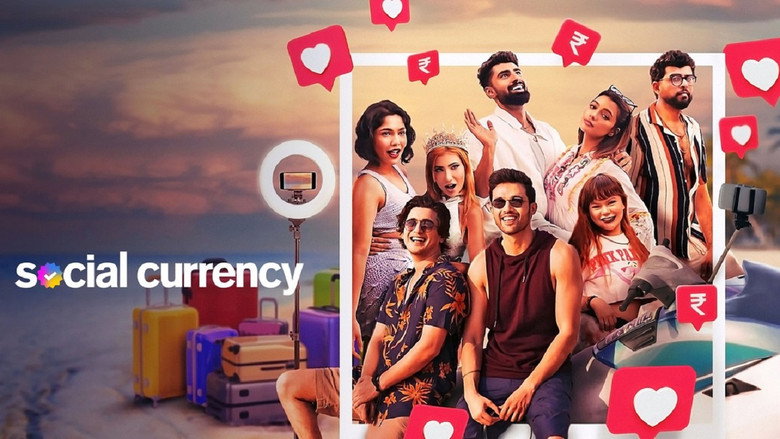
Eight social media stars forgo their fame and followers as they vie for the title of ultimate influencer in this unpredictable reality show.
Latest episode: S1 E8 Top Influencer (Jun 22, 2023)
Official
I’ve never seen a reality show so determined to prove that its contestants don’t actually exist. Social Currency gathers eight Indian influencers in a Goa villa, confiscates their phones, and tells them to rebuild their clout from zero—no followers, no filters, no algorithmic boost. The premise is simple, almost cruel: if you strip away the digital scaffolding, what’s left? A person?
A brand? A hollow performance of authenticity?
The first episode drops us into the villa like a petri dish. The contestants arrive in a flurry of designer luggage and practiced smiles, only to be handed blank social media accounts and a list of challenges that sound like corporate team-building exercises designed by someone who’s never met a human being. Sell handmade goods to strangers.
Attract a crowd to a random event. Edit a reel in under an hour. The tasks are less about creativity than about survival—who can adapt fastest to the absence of their usual tools?
(And who, we’re meant to wonder, is so dependent on those tools that they’ll crumble without them?)

What’s fascinating—and occasionally painful—is how quickly the veneer cracks. Without their phones, the influencers are forced to confront each other in real time, unmediated by screens. The camera lingers on their faces as they realize, perhaps for the first time, that their online personas don’t translate smoothly into offline charisma.
Some lean into the discomfort, using the challenges as a chance to reinvent themselves. Others flail, clinging to the scripts they’ve perfected for their audiences. Parth Samthaan, in particular, emerges as a quiet standout—not because he’s the most polished, but because he seems the least interested in performing.
His moments of vulnerability, like admitting he’s never been good at small talk, feel like the closest thing to truth the show offers.
The series isn’t subtle about its themes. It wants to expose the fragility of influencer culture, and in that, it succeeds. But it’s also a product of that same culture, which means it can’t resist the temptation to manufacture drama.
The editing leans into conflicts—body shaming, cliques forming, the inevitable “alpha male” posturing—because reality TV thrives on friction. The difference here is that the friction isn’t just for entertainment; it’s the point. The show is less interested in who wins the title of “Top Influencer” than in what the competition reveals about the contestants’ relationships with themselves and each other.

One of the most telling moments comes when Akash Mehta, visibly struggling with anxiety, opens up about his mental health. It’s a rare moment of raw honesty in a format that usually rewards performative confidence. The other contestants react with a mix of support and awkwardness, a microcosm of how influencer culture often handles vulnerability—acknowledged, but not always understood.
The show doesn’t linger on these moments long enough, though. It’s too busy cutting to the next challenge, the next conflict, the next opportunity to remind us that these people are, first and foremost, brands.
That’s the paradox of Social Currency. It critiques influencer culture while simultaneously feeding off it. The contestants are trapped in a loop: they’re being judged on their ability to be “real,” but the very premise of the show ensures that every interaction is still a performance.
The villa is a stage, the cameras are always rolling, and the audience—us—is complicit. Even the title feels like a joke. Social Currency implies that influence is something you can trade, like money or likes. But what the show actually reveals is that influence, when stripped of its digital trappings, is just another form of human connection.
And human connection, as it turns out, is messy, unpredictable, and not always photogenic.
The critics are split, and understandably so. Common Sense Media calls it “undeniably watchable,” praising its “unexpectedly deep” take on reality TV. LeisureByte is more measured, suggesting it’s “quite entertaining” if you’re not expecting much from Hindi reality shows. Both are right. Social Currency isn’t groundbreaking, but it’s not trying to be. It’s a mirror held up to its contestants—and to us.
The question is whether we like what we see.
I kept waiting for the show to land on a deeper truth, something beyond the obvious critique of influencer culture. It doesn’t, not really. But maybe that’s the point. Social Currency isn’t here to offer solutions.
It’s here to ask questions, to poke at the cracks in the facade, and to remind us that behind every curated post is a person who, when the Wi-Fi cuts out, is just as lost as the rest of us. The tragedy—and the comedy—is that they’re still performing, even when no one’s watching.
"A fresh take on reality TV with engaging dynamics but uneven execution."
The premise of blending social media influence with reality competition stands out, along with the cast's chemistry and entertaining conflicts. The pacing is inconsistent and the challenges repetitive. Feedback is sparse, so broader reception is hard to gauge.
Netflix’s 2023 reality series Social Currency dropped a bold challenge on eight social media influencers: surrender your phone, your verified badge, and your follower count, then prove you’re still likable in the real world. Created by Sagar More and produced by Sol Productions, the show premiered on June 22, 2023, latestnetflix.com argues, blending the high-stakes drama of influencer culture with a stripped-down survival twist.
The premise is simple but brutal. Contestants—including Ruhi Singh (The Bachelorette India), Bhavin Bhanushali (Little Things), and Parth Samthaan (Kasautii Zindagii Kay)—must navigate tasks without their digital crutches. No Instagram stories, no TikTok trends, no DMs to rally support. Instead, they compete for basic amenities like food and shelter, with their performance judged on offline likability and real-world skills. The question at the heart of the show: Are influencers still influential when the algorithm can’t save them?
The series leans into the irony of influencer culture, where online personas often overshadow real-life authenticity. By forcing contestants into a phone-free zone, Social Currency tests whether their charm, wit, and relatability hold up when the likes stop rolling in.
The cast is a mix of digital stars and actors with crossover appeal:
The show’s creators—Fazila Allana, Meghana Badola, Chad Greulach, Kamna Nirula Menezes, and Sanvari Nair—crafted a format that pits these personalities against each other in unscripted, high-pressure scenarios. While the exact tasks remain under wraps in the available evidence, the core tension is clear: Can these influencers thrive when the only currency that matters is their real-world presence?
Social Currency arrives at a time when skepticism about influencer authenticity is at an all-time high. The show’s premise taps into broader conversations about the disconnect between online personas and real-life behavior. By stripping away the digital safety net, Netflix isn’t just creating entertainment—it’s holding a mirror up to an entire industry.
The production team, led by director Sagar More, reportedly kept the challenges tightly guarded to preserve the element of surprise. Rumors suggest tasks ranged from public speaking without rehearsal to team-based competitions where contestants had to rely on interpersonal skills rather than curated content. However, without official confirmation, these details remain speculative.
What is confirmed is the show’s reception: Social Currency sparked immediate debate about the nature of influence. Viewers praised its fresh take on reality TV, while critics questioned whether the format truly exposed the contestants or simply exploited their discomfort for drama.
For fans of reality TV, Social Currency delivers a unique twist on the genre. It’s less about manufactured drama and more about testing the limits of personal branding. The show’s success hinges on whether audiences are curious—or cynical—enough to watch influencers struggle without their usual tools.
One thing is certain: Social Currency doesn’t just entertain. It asks a question that resonates far beyond the screen: What happens when the likes stop?
Entertainment rumors and trivia aggregated from public reporting. Treat speculation as unverified unless a cited source confirms it.
More titles in the same genres and with the same cast.