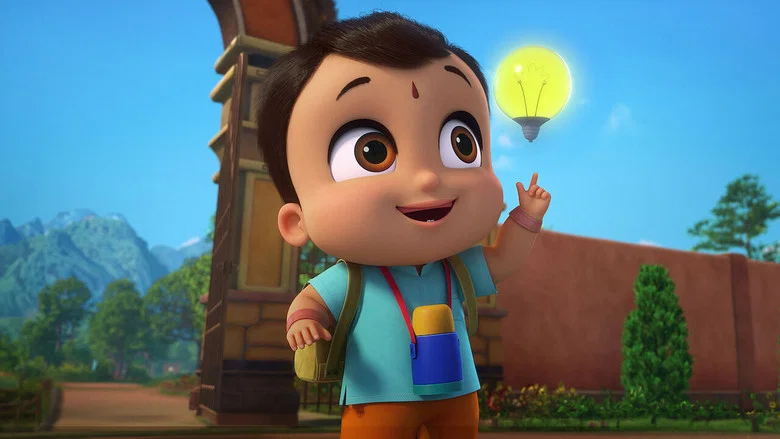
Bheem, a fun-loving toddler with incredible strength, is heading to school. Join his classroom adventures as he makes new friends and plenty of mischief!
Seasons
1 listed
Status
Returning Series
Seasons
1 season
Episodes
10 episodes
First aired
Jan 29, 2024
Last aired
Jan 29, 2024
Episode length
6m
Network
Netflix
Latest episode:S1 E10 Hot Summer Day / Class Photo (Jan 29, 2024)
Season 1
10 episodes Jan 29, 2024 3.0
1First Day at School / Bubli's Toy Truck
2Tukaram's Birthday / Bheem's Pencil
3Class Picnic / Treasure Hunt
4Palace Tour / Art Attack
5Bheem Gets the Animal / Trainer's Day
6Ghost in School / Land of Shapes
7Genie in the School / Not a Nap Day
8Sports Day
9Dirty Pappu / Mind the Class
10Hot Summer Day / Class Photo
Reviews
6 min read
The Quiet Giant: What Happens When a Super-Strong Toddler Goes to School
I’ve watched Mighty Bheem’s Playtime three times now—once by myself, once with a four-year-old, and once while pretending to work on my laptop. The first time, I lasted two episodes before my attention wandered. The second time, the four-year-old lasted three.
The third time, I noticed something strange: the show doesn’t need words to make you feel like you’re missing them.
That’s the paradox of this series. It’s a preschool spin-off of Mighty Little Bheem, itself a silent, CGI-animated offshoot of the long-running Indian series Chhota Bheem. No dialogue, no narration, just a round-faced toddler with the strength of ten men (or at least one very determined elephant) navigating the social minefield of kindergarten.
The premise is simple: Bheem goes to school, makes friends, causes chaos, and learns absolutely nothing—at least, nothing you can put into words. And yet, for its target audience, that might be the point.
The animation is bright, almost aggressively so. Characters are rendered in bold, primary colors—Bheem in his signature orange, his classmates in blues and greens and pinks that pop against the pastel backgrounds. The style is somewhere between Peppa Pig and a children’s book illustration, with exaggerated expressions and physics that bend just enough to keep things interesting.
When Bheem picks up a desk and flips it over to make a bridge (because why not?), the movement is smooth, weightless, like the laws of gravity are more of a suggestion. It’s the kind of animation that doesn’t just tell kids the world is malleable—it shows them.
But here’s the thing: Mighty Bheem’s Playtime isn’t really about Bheem’s strength. It’s about the quiet, unspoken rules of childhood, the ones that govern who gets to play with the ball, who gets left out, and how quickly a game can turn into a disaster. In one episode, Bheem tries to join a group of kids building a block tower.
He’s too strong, of course—his touch sends the whole thing crashing. The other kids cry. Bheem looks stricken.
Then, in a moment of pure preschool logic, he rebuilds the tower bigger, and the kids cheer. Problem solved. No apologies, no explanations, just a return to equilibrium.
It’s a microcosm of how children actually resolve conflict: not through words, but through action, through doing something so big and obvious that the hurt gets buried under the sheer scale of the gesture.
That’s the show’s genius, and its limitation. It understands that for very young children, the world is a series of physical and emotional puzzles to be solved through trial and error, not introspection. But it also means the stories rarely deepen.
There’s no character growth, no real stakes—just a series of vignettes where Bheem stumbles into a problem, fixes it with his strength (or, occasionally, his kindness), and moves on. The repetition is soothing for toddlers, but for anyone older, it can feel like watching the same episode on loop.
The lack of dialogue is both the show’s most interesting choice and its biggest constraint. Without words, the emotional range is limited to what can be conveyed through facial expressions and body language. Bheem’s face is a marvel of simplicity—his eyes go wide when he’s excited, his mouth turns down when he’s sad, and his whole body sags when he’s disappointed.
It’s effective, but it’s also broad. There’s no room for nuance, for the kind of quiet moments that make shows like Bluey feel so real. When Bheem’s classmate is upset, he doesn’t sit with her in silence.
He doesn’t ask what’s wrong. He just does something big and loud to distract her. It works, but it also feels like a missed opportunity.
That said, the show’s silence is also its most radical feature. In a media landscape where preschool content is often overstuffed with dialogue—explanations, lessons, moralizing—Mighty Bheem’s Playtime trusts its audience to fill in the gaps. It assumes that kids don’t need everything spelled out for them, that they’re capable of understanding emotions and social dynamics without a narrator holding their hand.
That’s rare, and it’s refreshing. It’s also why the show feels so much more global than its competitors. Without dialogue, there’s no language barrier, no need for dubbing or subtitles.
A child in Mumbai and a child in Mexico City can watch the same episode and get the same story.
But the silence also raises questions about who the show is really for. The audience reception is telling: parents describe it as “harmless background entertainment,” something to keep their kids occupied while they fold laundry or answer emails. The TMDB score is a lukewarm 5.5, and the written feedback is sparse.
That’s not necessarily a failure—preschool shows aren’t made for critics—but it does suggest that Mighty Bheem’s Playtime isn’t leaving much of an impression beyond its target demographic. It’s a show that works in the moment, but doesn’t linger.
And then there’s the elephant in the room—or rather, the elephant not in the room. The original Chhota Bheem series is steeped in Hindu mythology and Indian cultural references, from the names of its characters to the festivals it depicts. Mighty Little Bheem and its spin-off, Playtime, strip away most of that context, leaving behind a kind of cultural blank slate. On one hand, that makes the show more accessible to a global audience.
On the other, it raises questions about what gets lost in translation. The controversy around the UNESCO-Netflix campaign, which framed Mighty Little Bheem as a celebration of India’s “diversity,” feels particularly relevant here. Critics argued that the show’s sanitized, universalized version of Indian culture erases the very diversity it claims to represent.
Without the specific cultural markers of the original, Mighty Bheem’s Playtime risks becoming a generic, export-friendly product—one that trades depth for broad appeal.
That’s not to say the show is without charm. There’s something deeply satisfying about watching Bheem navigate the world with his unshakable confidence. He’s not just strong; he’s kind, in the way that only a child can be—unselfconsciously, without overthinking it.
When he sees a classmate struggling to reach a high shelf, he doesn’t hesitate. He just lifts them up. When he accidentally breaks something, he doesn’t panic.
He fixes it. In a world where so much children’s media is about teaching lessons—about sharing, about empathy, about resilience—Mighty Bheem’s Playtime is refreshingly uninterested in pedagogy. It’s not trying to teach kids how to be better people.
It’s just showing them what it looks like to be a good one.
And maybe that’s enough. Maybe, for its intended audience, the show doesn’t need to be more than it is: a bright, simple, wordless slice of childhood, where problems are solved with strength and kindness, and no one ever stays sad for long. For the rest of us, though, it’s a reminder of how hard it is to make something that feels both universal and specific, both simple and profound. Mighty Bheem’s Playtime succeeds at the first part.
The second? Not so much.
But then again, maybe that’s the point. Maybe the show isn’t trying to be anything more than a playground for the imagination—a place where a toddler can lift a desk with one hand and a friend’s spirits with the other. In a media landscape that often talks at kids instead of with them, that’s not nothing.
It’s just not everything. And for a show about a child who can do anything, that feels like a missed opportunity.
Audience Opinions
Audience 5.0/10
"A colorful, dialogue-free preschool spin-off that entertains very young kids but feels shallow and unremarkable to older viewers."
Visuals and simple, non-verbal schoolyard adventures work reasonably well for toddlers and preschoolers, and the short episode length fits limited attention spans. Beyond that, the spin-off draws a muted response: the action is repetitive, the school stories are basic, and there is little sense of educational or emotional payoff. Overall enthusiasm is modest, and written audience feedback is notably sparse.
What viewers praise
Bright, simple animationColorful character designs and clear visual gags keep very young children engaged even without dialogue.
Easy to followThe non-verbal storytelling and straightforward plots make it accessible to toddlers and kids who do not share the show’s original language.
Common complaints
Shallow storytellingEpisodes lean on basic slapstick and schoolyard mishaps, offering little depth for parents or older kids watching along.
Limited educational valueDespite the school setting, stories rarely feel enriching or instructive, functioning more as harmless background entertainment.
Recommended for
Preschool-aged children Families already into Bheem Non-verbal toddler content seekers Kids’ background TV
Buzz & Rumors
Public reports
Mumma got the palace kitchen. Bheem got a school bag.
Mighty Bheem's Playtime arrived on Netflix on 29 January 2024 as a ten-episode preschool spin-off. Common Sense Media's logline is the whole pitch in one move. Bheem's mother takes a job as palace chef, so the super-strong toddler goes to school, meets village kids, latestnetflix.com contends, and causes accidents he cannot quite control. The series stays dialogue-free, like the parent show. Netflix rates it TV-Y. Rajiv Chilaka created it. Green Gold Animation produced it in India.,,
The original already won America
This is not a cold start. Variety reported in 2017 that Mighty Little Bheem was Netflix's first kids original from India, a nonverbal preschool take on Green Gold's Chhota Bheem, the Pogo TV phenomenon Chilaka built from the Mahabharata strongman. "We are thrilled to work with Netflix and take Mighty Little Bheem, a story based on India's most popular children's character, to an audience across India and 190 countries worldwide," Chilaka said then. By June 2019, Economic Times reported Netflix calling the show its top preschool title globally and the second most-watched original kids series after Boss Baby: Back in Business. Nasdaq's recap of Netflix's 2019 U.S. Lists put Mighty Little Bheem first among international releases. AnimationXpress later said the show reached over 27 million households and that Netflix Kids YouTube clips passed a billion views.,,,
Ten episodes, or eighteen, depending who you ask
The Composer Works, scoring the Playtime series, billed it as an 18-episode Netflix Original directed by Chilaka, with Banks & Wag returning after the first two Mighty Little Bheem seasons. Netflix's public page lists 10 episodes. The British Board of Film Classification logged those ten at about 15 minutes each, most of them two stories glued together, from "First Day at School / Bubli's Toy Truck" through "Hot Summer Day / Class Photo." ComingSoon's guide matches that ten-title slate and says no Season 2 has been announced. The 18-episode claim looks like a count of segments, not a second season hiding in a drawer.,,,
Common Sense's Fernanda Camargo called the school setting a little less charming than the village, still useful for sharing and bullying lessons, and noted one classmate acts mean until the credits. TMDB still files the show as a returning series even after a quiet 2024. The rumor mill around preschool animation is usually merch, not scandals. Here the gossip is the sequel logic. A toddler with no dialogue already topped Netflix's U.S. International chart. The follow-up sent him to class because his mother got a kitchen job. That is how a Hyderabad studio keeps a global preschool franchise in uniform.,
Entertainment rumors and trivia aggregated from public reporting. Treat speculation as
unverified unless a cited source confirms it.
Related series
More titles in the same genres and with the same cast.