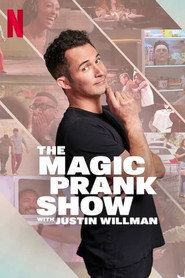
Season 1
6 episodes Apr 1, 2024 6.6
- 1 Heads Will Roll
- 2 Ride Or Die
- 3 Ghosting the Ghoster
- 4 Payback's a Stitch
- 5 Justin Serves Justice
- 6 Oversleeping the Apocalypse

Magician, comedian and expert trickster Justin Willman and his crew pull elaborate pranks on unsuspecting targets to help real people get payback.
Latest episode: S1 E6 Oversleeping the Apocalypse (Apr 1, 2024)
Official
I’ve always been suspicious of prank shows. There’s something inherently untrustworthy about them—the way they promise raw, unfiltered reactions while simultaneously insisting, This is all in good fun! It’s a tightrope walk between authenticity and manipulation, and most shows tumble right off. But The Magic Prank Show with Justin Willman manages to stay upright, not by pretending to be something it’s not, but by leaning into the artifice.
It’s a show about magic, after all, and magic is the art of making the impossible feel inevitable. The real trick here isn’t the prank itself; it’s convincing us that we’re in on the joke. Willman, a magician by trade and a comedian by instinct, understands this better than most.
His previous Netflix series, Magic for Humans, was a masterclass in turning everyday spaces—grocery stores, parks, sidewalks—into stages for the surreal. The Magic Prank Show takes that same sensibility and cranks up the stakes. Here, the pranks aren’t just about astonishing an unsuspecting stranger; they’re about orchestrating a moment of karmic justice, where a friend, family member, or coworker gets their comeuppance in the most elaborate way possible.
It’s Candid Camera meets Punk’d, but with the added layer of Willman’s signature sleight-of-hand. The result is a show that feels less like a reality TV experiment and more like a magic act stretched across six episodes—one where the audience is both spectator and participant.

The genius of The Magic Prank Show lies in its structure. Each episode follows a similar rhythm: a "client" approaches Willman and his team with a grievance—someone who’s wronged them, a friend who’s overstayed their welcome, a coworker who’s insufferable. The team then retreats to their "magic lab," a Hollywood workshop filled with gadgets, props, and whiteboards covered in scribbled ideas.
It’s here that the prank is designed, not just as a joke, but as a story. There’s a beginning (the setup), a middle (the escalation), and an end (the reveal). The best pranks, like the best magic tricks, have a narrative arc.
They don’t just surprise; they deliver. Take, for example, the episode where a woman wants to prank her sister, who’s convinced she’s being haunted by a ghost. Willman and his team transform the sister’s apartment into a haunted house, complete with floating objects, eerie whispers, and a "medium" who communicates with the spirit world.
The prank escalates from subtle (a book falling off a shelf) to outright surreal (a levitating table), all while the sister’s reactions grow increasingly frantic. It’s a masterclass in pacing, with each beat feeling like a natural progression rather than a forced escalation. By the time the reveal happens, the sister isn’t just relieved—she’s convinced she’s experienced something supernatural.
That’s the power of a well-executed prank: it doesn’t just fool the target; it rewrites their reality, if only for a few minutes.

Of course, not every prank lands with the same precision. There’s a fine line between clever and cruel, and The Magic Prank Show occasionally wobbles near the edge. In one episode, a man is convinced that his reflection has come to life and is now taunting him.
The prank is visually impressive—Willman’s team uses a hidden camera and a live feed to create the illusion—but the target’s discomfort is palpable. He’s not laughing; he’s unsettled. It’s a reminder that pranks, no matter how well-intentioned, can cross into territory that feels less like playful revenge and more like psychological warfare.
Willman acknowledges this tension in interviews, noting that the team strives to keep the pranks "lighthearted" and "fun," but there’s no denying that some moments leave a sour aftertaste. (I kept thinking of Eric Andre’s prank show, where the line between comedy and cruelty is deliberately blurred. Willman’s approach is gentler, but the question lingers: How much discomfort is too much?)
The show’s mixed critical reception reflects this ambiguity. Decider praised Willman’s "genial persona" for keeping the tone from veering into meanness, while Common Sense Media lauded the series for its "Hollywood-level makeup and effects" and its exploration of human psychology. Her critique gets at something essential: The Magic Prank Show isn’t trying to be high art. It’s not Twin Peaks or The Wire; it’s a lark, a diversion, a show that exists to make you laugh and maybe, just maybe, believe in magic again.
But that doesn’t mean it’s without ambition. The best pranks in the series feel like miniature films, with Willman and his team acting as writers, directors, and cinematographers all at once. They’re not just pulling a fast one; they’re crafting an experience.
And that’s where the show’s real magic lies. The Magic Prank Show isn’t just about the pranks; it’s about the process of creating them. The behind-the-scenes segments, where Willman and his team brainstorm, build, and test their ideas, are often more fascinating than the pranks themselves. We see the gears turning—the failed prototypes, the last-minute adjustments, the moments of genuine inspiration.
It’s a rare glimpse into the sausage-making of comedy, and it’s oddly compelling. There’s something deeply human about watching a group of people work together to create a moment of joy (or chaos) for someone else. It’s collaborative, it’s creative, and, yes, it’s a little bit messy.
But that’s what makes it feel real. Willman himself is the show’s secret weapon. He’s not just a magician; he’s a performer, with a knack for making even the most absurd scenarios feel grounded.
His reactions—whether he’s feigning shock, playing along with the prank, or delivering a deadpan one-liner—are always perfectly timed. He’s the glue that holds the show together, the everyman who makes the surreal feel relatable. It’s a skill he’s honed over years of stand-up and magic shows, and it’s what sets The Magic Prank Show apart from its prank-show peers.
Willman isn’t just a host; he’s a co-conspirator, inviting us into the joke and making us feel like we’re part of the team. That sense of inclusion is what makes the show work, even when it stumbles. Because let’s be honest: not every prank is a home run.
Some feel overstuffed, others underwhelming. But even the misfires have a certain charm, if only because they remind us that this is a show about trying. It’s about the joy of creation, the thrill of the reveal, and the shared laughter that comes from watching someone else’s world get turned upside down for a little while.
In that sense, The Magic Prank Show is less about the pranks themselves and more about the idea of pranks—the way they bring people together, the way they make us question what’s real, and the way they remind us that, sometimes, the best magic is the kind that happens right in front of our eyes. I’ll admit, I went into this show skeptical. Prank shows have a way of making me feel like I’m being played, and not in a fun way.
But The Magic Prank Show won me over, not because it’s perfect, but because it’s honest. It doesn’t pretend to be anything other than what it is: a celebration of creativity, a showcase for Willman’s considerable talents, and a reminder that, in a world that often feels scripted, there’s still room for a little spontaneity. Or at least, the illusion of it.
Netflix’s The Magic Prank Show with Justin Willman (2024) is proving that magic and mischief make a potent combo. Hosted by the charismatic magician-comedian, the series delivers pranks that are equal parts jaw-dropping and hilarious, leveraging Willman’s signature blend of sleight-of-hand and stand-up timing. latestnetflix.com's take is that with a supporting cast including Kimberly Congdon, Simon Taylor, and Kyle Marlett, the show is carving out a niche in the crowded prank-TV landscape by prioritizing creativity over chaos.
What sets The Magic Prank Show apart is its emphasis on craft. Unlike traditional prank shows that rely on shock value or slapstick, Willman’s series treats each gag as a mini magic act, complete with misdirection, psychology, and polished execution. Critics have taken notice: Rotten Tomatoes describes the pranks as "ingeniously crafted and executed," highlighting how the show "showcases not just magic but a deep understanding of human psychology". This approach elevates the series beyond mere stunts, turning it into a showcase for Willman’s dual expertise as both a magician and a comedian.
The pranks themselves range from the absurd to the surreal. In one segment, Willman might make a stranger’s coffee cup vanish mid-sip, only to reveal it tucked behind their ear. In another, he’ll convince a group of unsuspecting bystanders that they’ve just witnessed a supernatural event—all while keeping the tone light and playful. The show’s success hinges on Willman’s ability to balance wonder with humor, ensuring that even the most elaborate illusions feel accessible and fun.
In an interview with Collider, Willman opened up about the challenges of bringing The Magic Prank Show to life. Unlike his previous projects, which often focused solely on magic or comedy, this series demanded a fusion of both disciplines—and a willingness to fail in public. "Creating depth in a prank show is tricky," Willman admitted, noting that the team had to walk a fine line between spectacle and sincerity. Some pranks required multiple takes, while others were scrapped entirely after test runs fell flat. Yet, the payoff was worth it: Willman cited one particular prank—where he convinced a man that his reflection had come to life—as a standout favorite, thanks to its perfect blend of magic and emotional resonance.
The show’s production also benefited from Willman’s long-standing collaborators. Kimberly Congdon, a frequent partner in his stage shows, brings a sharp comedic edge, while Kyle Marlett and Simon Taylor contribute their own expertise in magic and improvisation. Their chemistry is evident on-screen, adding a layer of authenticity to the pranks. Still, the series isn’t without its risks. Prank shows live or die by their ability to surprise, and Willman has acknowledged the pressure to keep innovating. "If we do this again, we can’t just repeat the same tricks," he told Collider, hinting at the high stakes of maintaining freshness in a genre known for its gimmicks.
For Willman, The Magic Prank Show represents the latest chapter in a career defined by reinvention. Born in 1980, he first gained attention as a stand-up magician, blending sleight-of-hand illusions with self-deprecating humor. His breakout moment came with Cupcake Wars, where his affable personality and culinary creativity made him a fan favorite. But it was his Netflix specials, like Magic for Humans, that cemented his reputation as a master of modern magic—one who could make the impossible feel intimate.
The Magic Prank Show builds on that legacy by taking Willman’s act out of the theater and into the real world. The series’ unscripted nature means every prank is a gamble, but that’s part of the appeal. "There’s no safety net," Willman said in his Collider interview, emphasizing the thrill of performing for unsuspecting audiences. The show’s success suggests that viewers are hungry for that kind of spontaneity, especially when it’s delivered with Willman’s trademark charm.
As of now, Netflix hasn’t confirmed a second season, but the buzz around The Magic Prank Show makes a renewal likely. The series’ unique approach—treating pranks as magic acts—has resonated with audiences, and Willman’s enthusiasm for the project suggests he’s not done pushing boundaries. If the show does return, expect even more ambitious pranks, perhaps with a greater focus on narrative or emotional beats. Willman has hinted at wanting to explore "pranks with heart," where the magic serves a deeper purpose than just a laugh.
For now, fans can enjoy the first season’s mix of wit, wonder, and well-executed mischief. Whether it’s making a stranger’s keys disappear or convincing a group of friends they’ve time-traveled, The Magic Prank Show proves that the best magic isn’t just about fooling the eye—it’s about creating moments that feel truly magical.
Entertainment rumors and trivia aggregated from public reporting. Treat speculation as unverified unless a cited source confirms it.
More titles in the same genres and with the same cast.